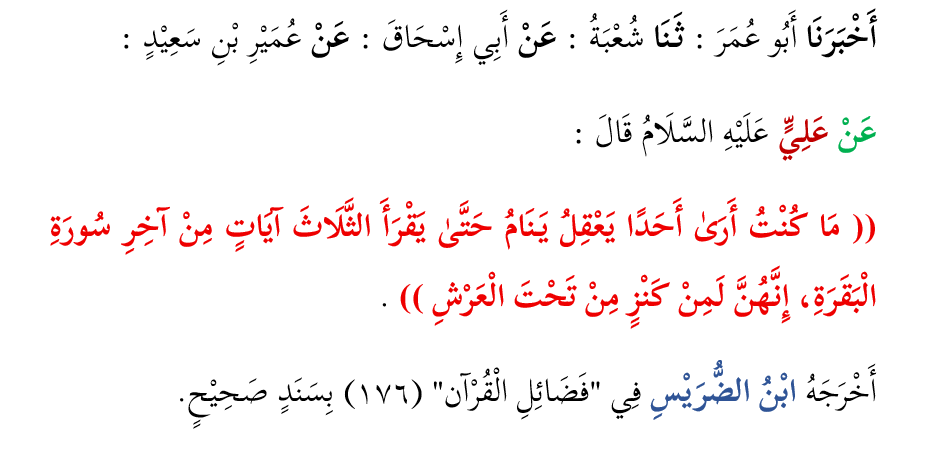
Reciting the Last Three Verses of Surah al-Baqarah at Bedtime

ʿAlī, peace be upon him, said,

I cannot imagine anyone of sound mind going to sleep before reciting the last three verses of Sūrah al-Baqarah; they are truly a treasure from beneath the Throne.”

Reported by Ibn al-Ḍurays in Faḍāʾil al-Qurʾān (176) with a sound chain.

It is also recorded by al-Dārimī (3427) and Ibn Abī Dāwūd in Sharīʿat al-Maghāzī as in Ibn Ḥajar’s Natāʾij al-Afkār (3: 90) with slight differences.

Ibn al-Ḍurays’s particular chain to ʿAlī, may Allāh be pleased with him, is sound. Here is the analysis of the chain along with a key to their biographical sources:

Key: AD = Sunan Abī Dāwūd, B = Ṣaḥīḥ al-Bukhārī, IḤT = al-Thiqāt of Ibn Ḥibbān, IḤṬM = Ibn Ḥajar’s Ṭabaqāt al-Mudallisīn, IM = Sunan Ibn Mājah, JTIAḤ = al-Jarḥ wa al-Taʿdīl of Ibn Abī Ḥātim, M = Ṣaḥīḥ Muslim, N = Sunan al-Nasāʾī, Siyar = Siyar Aʿlām al-Nubalāʾ of al-Dhahabī, TKB = al-Tārīkh al-Kabīr of al-Bukhārī, The Six = Ṣaḥīḥ al-Bukhārī, Ṣaḥīḥ Muslim, Sunan Abī Dāwūd, Sunan al-Tirmidhī, Sunan al-Nasāʾī, and Sunan Ibn Mājah, TK = Tahdhīb al-Kamāl of al-Mizzī, TQT = Taqrīb al-Tahdhīb of Ibn Ḥajar, TT = Tahdhīb al-Tahdhīb of Ibn Ḥajar, TTT = Taḥrīr Taqrīb al-Tahdhīb,

Ibn al-Ḍurays (d. 294): Abū ʿAbd Allāh Muḥammad b. Ayyūb b. Yaḥyá b. Ḍurays al-Bajalī, al-Rāzī, memoriser, traditionist, lived a long life (born around 200H), author of Faḍāʾil al-Qurʾān wa mā Unzila min al-Qurʾān bi Makkah wa mā Unzila bi al-Madīnah, audited by the ḥadīth master and rijāl critic Ibn Abī Ḥātim who declared him trustworthy and truthful, declared trustworthy by al-Dhahabī as well, and is included in al-Thiqāt by Ibn Ḥibbān, and he narrated from Abū ʿUmar Ḥafṣ b. ʿUmar. See: JTIAḤ (7: 198, no. 1114), IḤT (9: 152), and Siyar (13: 449, no. 222).

Abū ʿUmar (d. 225): Ḥafṣ b. ʿUmar b. al-Ḥārith b. Sakhbarah al-Azdī al-Namarī, Abū ʿUmar al-Ḥawḍī al-Baṣrī, from al-Namir b. Ghaymān or it is said the client of Banū ʿAdī, trustworthy, B-AD-N, audited by Muḥammad b. Ayyūb b. Yaḥyá b. al-Ḍurays al-Rāzī, as well as al-Bukhārī, Abū Dāwūd, Abū Zurʿah al-Rāzī, and Abū Ḥātim al-Rāzī, and he narrated from Shuʿbah b. al-Ḥajjāj (B-AD). Aḥmad said about him, “[He is] firm, firm, precise, precise, not a single word is held against him.” Ibn Abī Ḥātim said, “Truthful, precise, and ʿAlī b. al-Madīnī used to put him amongst the companions of Shuʿbah.” See: JTIAH (3: 182, no. 786) and TK (7: 27, no. 1397).

Shuʿbah (d. 160): b. al-Ḥajjāj b. al-Ward al-ʿAtakī al-Azdī, Abū Bisṭām al-Wāsiṭī, client of ʿAbdah b. al-Agharr, the client of Yazīd b. al-Muhallab b. Abī Ṣufrah,  leader of the believers in ḥadīth according to Sufyān al-Thawrī, leading rijāl critic, student of the famous tābiʿī al-Ḥasan al-Baṣrī (d. 110), vessel of knowledge, trustworthy, The Six, audited by Abū ʿUmar Ḥafṣ b. ʿUmar (B-AD), and narrated from Abū Isḥāq al-Sabīʿī. His narrations from al-Sabīʿī – who is a mudallis – are considered connected as he would only narrate from him that which al-Sabīʿī narrated with explicit direct audition. al-Bayhaqī reports in Maʿrifat al-Sunan wa al-Āthār (1: 152, no. 204) that Shuʿbah said, “I have sufficed you from the tadlīs of three: al-Aʿmash, Abū Ishāq, and Qatādah.”  See: JTIAḤ (5: 369, no. 1609), TK (12: 479, no. 2739), Siyar (7: 202, no. 80), TTT (2790).

Abū Isḥāq (d. 127): ʿAmr b. ʿAbd Allāh b. ʿUbayd/ʿAlī/Abū Shaʿīrah, al-Kūfī, tābiʿī, trustworthy, The Six, mudallis, Ibn Ḥajar places him in the third level of tadlīs practitioners whose reports are only accepted if he declares explicit direct audition, an exception is made if Shuʿbah narrates from him, as in this case. He narrated from ʿUmayr b. Saʿīd al-Nakhaʿī. See: TKB (4: 244, no. 2678), JTIAḤ (6: 242, no. 1347), TK (22: 102, 4400), and IḤṬM (p. 42, no. 91).

ʿUmayr b. Saʿīd (d. 107/115): al-Nakhaʿī al-Ṣuhbānī, Abū Yaḥyá al-Kūfī, tābiʿī, trustworthy, B-M-AD-IM, audited by Abū Isḥāq al-Sabīʿī, and narrated from ʿAlī b. Abī Ṭālib (B-M-AD-IM). See: JTIAḤ (6: 376, no. 2080), TK (22: 376, no. 4514), and TTT (5182).

ʿAlī (d. 40): b. Abī Ṭālib, Companion, fourth Rightly-Guided Caliph, audited by ʿUmayr b. Saʿīd al-Nakhaʿī (B-M-AD-IM). See: TK (20: 472, no. 4089).

As you can see, all of the transmitters are reliable and the chain is connected. The issue of Abū Isḥāq’s tadlīs is resolved by the fact Shuʿbah would only transmit from him when Abū Isḥāq declared explicit audition of his material.

Lastly: the report is marfūʿ ḥukman (raised to the Prophet ﷺ in ruling) because ʿAlī, may Allāh be pleased with him, mentions that which can only be established via revelation and not personal opinion. Consequently, he must have acquired this knowledge from the Prophet ﷺ himself as none of the Companions would say something like this via their own opinion.

Explicit evidence for it being raised to the Prophet ﷺ in ruling is indicated in a sound report recorded by Ibn Ḥibbān (6400) in which the Prophet ﷺ said, “I have been given superiority over people through three: the whole earth has been made a masjid for us and its dust has been made pure and purifying for us if we do not find water; our rows (in prayer) have been made like the rows of the angels; and I have been given these verses from the end of Sūrah al-Baqarah from a treasure underneath the Throne, the like of which has not been given to anyone before me nor after me.” It is included in Ṣaḥīḥ al-Jāmiʿ (4223) by al-Albānī.

And all praise is due to Allāh, and may the praise and protection of Allāh be upon His Messenger, his family, his Companions, and those who follow him until the Last Day.

Written by Salal Ahmed Haque (Abū Ḥayyān al-Atharī) on Yawm al-Arbiʿāʾ, 2nd Muḥarram 1448 or Wednesday, 17th June 2026.

Bibliography

al-Bukhārī, Muḥammad b. Ismāʿīl. Kitāb al-Tārīkh al-Kabīr, Supervised by Muḥammad ʿAbd al-Muʿīd Khān, eds. ʿAbd al-Raḥmān b. Yaḥyá al-Muʿallimī al-Yamānī, Hāshim al-Nadwī, Muḥammad Ṭāhā al-Nadwī, Muḥammad ʿĀdil al-Quddūsī, Ḥasan Jamāl al-Layl al-Madanī, and Abū al-Wafāʾ al-Afghānī. Hyderabad: Dāʾirat al-Maʿārif al-ʿUthmāniyyah (1360-1378/1941-1959). 10 vols.

al-Dārimī, Abū Muḥammad ʿAbd Allāh b. ʿAbd al-Raḥmān b. al-Faḍl b. Harām. Musnad al-Dārimī al-Maʿrūf bi Sunan al-Dārimī, ed. Ḥusayn Ṣalīm Asad al-Dārānī. al-Riyāḍ: Dār al-Mughnī (1420). 4 vols.

al-Dhahabī, Shams al-Dīn Muḥammad b. Aḥmad b. ʿUthmān al-Dhahabī. Siyar Aʿlām al-Nubalāʾ. Eds. Shuʿayb al-Arnāʾūṭ and Ḥusayn al-Asad. Beirut: Muʾassasat al-Risālah (1417/1996). 28 vols.

Ibn Abī Ḥātim, Abū Muḥammad ʿAbd al-Raḥmān. Kitāb al-Jarḥ wa al-Taʿdīl, ed. ʿAbd al-Raḥmān b. Yaḥyá al-Muʿallimī al-Yamānī. Hyderabad: Dāʾirat al-Maʿārif al-ʿUthmāniyyah (1371/1952). 9 vols.

Ibn Balbān, al-Amīr ʿAlāʾ al-Dīn ʿAlī al-Fārisī. Ṣaḥīḥ Ibn Ḥibbān bi Tartīb Ibn Balbān, ed. Shuʿayb al-Arnāʾūṭ, 1st edition. Damascus: al-Risālah al-ʿĀlamiyyah (1432/2011). 18 vols.

Ibn al-Ḍurays, Abū ʿAbd Allāh Muḥammad b. Ayyūb. Faḍāʾil al-Qurʾān wa mā Unzila min al-Qurʾān bi Makkah wa mā Unzila bi al-Madīnah, ed. ʿUrwah Budayr. Damascus: Dār al-Fikar (1408/1987).

Ibn Ḥajar, Aḥmad b. Muḥammad.

  • Natāʾij al-Afkār fī Takhrīj Aḥādīth al-Adhkār, ed. Ḥamdī ʿAbd al-Majīd al-Salafī, 2nd edition. 5 vols.
  • Taʿrīf Ahl al-Taqdīs bi Marātib al-Mawṣūfīn bi al-Tadlīs, ed. ʿĀṣim b. ʿAbd Allāh al-Qaryūtī. ʿAmmān: Maktabat al-Manār (1404). Damascus and Beirut: Dār Ibn Kathīr (1429/2008).

Ibn Ḥibbān, Muḥammad. Kitāb al-Thiqāt, Supervised by Muḥammad ʿAbd al-Muʿīd Khān. Hyderabad: Dāʾirat al-Maʿārif al-ʿUthmāniyyah (1393/1973). 9 vols.

Maʿrūf, Bashshār ʿAwwād and al-Arnāʾūṭ, Shuʿayb. Taḥrīr Taqrīb al-Tahdhīb li al-Ḥāfiẓ Aḥmad b. ʿAlī b. Ḥajar al-ʿAsqalānī. Beirut: Muʾassasat al-Risālah (1417/1997). 4 vols.

al-Mizzī, Jamāl al-Dīn Abū al-Ḥajjāj Yūsuf. Tahdhīb al-Kamāl fī Asmāʾ al-Rijāl, ed. Bashshār ʿAwwād Maʿrūf. Beirut: Muʾassasat al-Risālah (1403/1983). 35 vols.

Shkūkānī, Aḥmad Ismāʿīl and al-Laḥḥām, Ṣāliḥ ʿUthmān. Muʿjam Asāmī al-Ruwāh alladhīna Tarjama lahum al-ʿAllāmah Muḥammad Nāṣir al-Dīn al-Albānī Jarḥan wa Taʿdīlan. Beirut: Dār Ibn Ḥazm (1421/2000). 4 vols.

How the Salaf Were with Their Families

Be Easy-Going and Joyful with Your Family

Thābit b. ʿUbayd said, “Zayd b. Thābit used to be the most cheerful person amongst his family.”

Thābit b. ʿUbayd said, “I never saw anyone more dignified when he sat with people, nor more cheerful in his house than Zayd b. Thābit.”

Encourage Your Child to Fast if He’s Capable

Hishām b. ʿUrwah b. al-Zubayr reported from his father that he would command his children to fast if they were capable of it.

Force Your Child to Learn the Obligatory Aspects of the Dīn

Sufyān al-Thawrī said, “It is necessary for a man to force his child to acquire knowledge, for indeed he will be questioned about it.”

Teach Your Child the Qurʾān

ʿAbd Allāh b. ʿĪsá said, “This Ummah will continue to be upon goodness as long as its children learn the Qurʾān.”

Teach Your Child Manners

ʿUthmān al-Ḥāṭibī said, “I heard Ibn ʿUmar say to a man, ‘Teach your son manners, for indeed you will be asked about your son and what manners you taught him, and what (knowledge) you taught him.’”

Muḥammad b. Sīrīn (d. 110) said, “They used to say, “Honour your child, and teach him excellent manners.”

Sufyān said, “It used to be said that from the rights of a child upon his parent is that he teaches him excellent manners.”

It used to be said, “Manners are from fathers, and righteousness is from Allāh.” And it used to be said, “Whoever teaches his son manners when he is young, he will be delighted with him when grows up.”

Exhort Your Family

Zayd b. Aslam reported from his father that ʿUmar b. al-Khaṭṭāb used to pray whatever Allāh willed during the night. When the end of the night came, he would wake up his family and say, “The prayer, the prayer” and recite {And command your family with prayer} [Ṭā-Hā (20): 132].

al-Ḥasan al-Baṣrī (d. 110) said, “May Allāh have mercy upon one who exhorts himself and his family, and says, ‘O my family, (take care of) your prayer (take care of) your prayer, (take care of) your zakāh (take care of) your zakāh, (take care of) your neighbours (take care of) your neighbours, (take care of) your poor (take care of) your poor; perhaps Allāh will have mercy upon you on the Day of Resurrection, for indeed Allāh praised the servant who does these deeds. He the Majestic and Most High said, {And he used to command his family with prayer and zakāh, and his Lord was pleased with him} [Maryam (19: 55)].”

Muʿāwiyah b. Murrah said that his father used to say to his children after they had prayed ʿIshāʾ, “O my dear children, go to sleep, for perhaps Allāh will provide you with goodness from the night.”

Ṣāliḥ, the son of Imām Aḥmad said that if an ascetic man came to his father, his father would send him to observe that man in the hope that he would be like him.

Be Beneficial to Your Family

Ḍirār b. Murrah used to milk his sheep for his family and draw water for them. He said, “It used to be said, ‘The best of you is the one who is most beneficial to his family.’”

Mubārak b. Saʿīd said, “Sufyān wrote to me, ‘To proceed: look after your family in the best way, and let death be on your mind – peace (be upon you).’”

Providing for Your Family is Better than Optional Acts of Worship

Muslim said that he met Muʿāwiyah b. Qurrah and asked him where he had just come from. He replied he went out and bought food for his family. Muslim asked him whether he acquired it with ḥalāl wealth. He replied, “Yes.” He then said, “It is more beloved to me that I set out every day for what you set out, than praying the night and fasting the day.”

Source: Min Akhbār al-Salaf by Abū Zakariyā al-Bākistānī, pp. 401-406.

The Salaf and Their Parents

Abū Hurayrah (d. 59) saw two men and said to one of them, “Who is this to you?” He replied, “My father.” He said, “Do not call him by his name, do not walk in front of him, and do not sit before him.”

Abū Ḥāzim al-Ashjaʿī (c. 100) was a close companion of Abū Hurayrah and is said to have spent half a century with him. He said, “Abū Hurayrah did not perform Ḥajj until his mother passed away.”

ʿAbd Allāh b. ʿUmar (d. 74) saw a Yemenī man going around the Kaʿbah while carrying his mother on his back, saying, “I am her humble camel, if her mount is frightened, I am not frightened.” He then said, “O Ibn ʿUmar! Do you think that I have repaid her?” He replied, “No! Not even one groan!”

Ḥafṣah bt. Sīrīn (c. 100), the sister of Muḥammad b. Sīrīn (d. 110) said, “When Muḥammad would enter upon his mother, he would not speak to her with his whole tongue out of shyness towards her.”

Ibn ʿAwn (d. 151) said, “When Muḥammad b. Sīrīn (d. 110) would be in the presence of his mother, he would lower his voice and speak gently.”

Hishām b. Ḥassān said that someone from the family of Sīrīn said, “I never saw Muḥammad b. Sīrīn talking to his mother except while (he seemed) abased.” [Ḥilyah (2: 273)].

A man entered upon Muḥammad b. Sīrīn while he was in the presence of his mother, so he said, “What’s the matter with Muḥammad, is he suffering from something?” They said, “No, this is just how he is when he is in the presence of his mother.” [Ḥilyah (2: 273)].

Bundār (d. 252) said, “I wanted to go travelling (to seek ḥadīth) but my mother prevented me so I obeyed her, and I was blessed due to that.” Allāh blessed him by making him the teacher of the authors of The Six Books: al-Bukhārī, Muslim, Abū Dāwūd, al-Tirmidhī, al-Nasāʾī, and Ibn Mājah.

al-Ḥasan al-Baṣrī (d. 110) was asked about being righteous towards one’s parents and he said, “That you spend on them from what you possess, and you obey them as long as it does not involve sin.”

ʿAṭāʾ was asked about a man whose mother made him swear he would not pray except the obligatory and not fast except the month of Ramaḍān. He replied, “He should obey her.”

Iyās b. Muʿāwiyah (d. 122) cried when his mother passed away. He was asked, “What makes you cry?” He replied, “I used to have two doors to Paradise open for me, but one of them has been shut.”

al-Ashjaʿī (d. 182) said, “We were with Sufyān al-Thawrī (d. 161) when his son Saʿīd came and said, ‘Do you see him (meaning his father)? I have never been harsh with him; indeed, he would call me whilst I would be praying an optional prayer, and I would cut it for him.’”

A man said to al-Ḥasan al-Baṣrī (d. 110), “Indeed I performed Ḥajj (again) and my mother gave me permission for the pilgrimage.” He said, “Sitting with her at her dinner table is more beloved to me than your Ḥajj.”

A man said to ʿAlī b. al-Ḥusayn (d. 94), “You are the most righteous of people and yet we do not see you eat with your mother?” He said, “I fear my hand will go first to what her eyes had already reached, and thus I would be disobeying her.”

ʿUrwah b. al-Zubayr (d. 94) said, “He has not been dutiful to his parents the one who looks at them sharply.”

Manṣūr b. al-Muʿtamir (d. 132) said, “It used to be said that the mother is due three-fourths of kind treatment.” [Ḥilyah (5: 42)]

Saʿīd b. Jubayr (d. 95) said, “I was bitten by a scorpion, and my mother made me promise to seek ruqyah, so I gave the rāqī the hand which had not been bitten as I hated to break my promise to her.” He did this so he could be among the 70,000 who will enter Paradise without any account; one of their characteristics is that they do not seek ruqyah.

Ṭalq b. Ḥabīb (c. 100) used to help his mum with her chores.

Kahmas (d. 149) used to work in plastering every day for two small coins. When evening would come, he would buy fruits and take them to his mother.

ʿAwn b. ʿAbd Allāh reported that ʿAbd Allāh said, “Keep ties with those your father used to keep ties with, for indeed keeping ties with the deceased in his grave is that you keep ties with the one your father used to keep ties with.”

ʿAmr b. Maymūn b. Mihrān said, “I went out with my father guiding him through one of the streets of al-Baṣrah. We came across a streamlet and he was not able to cross it so I lay down and he walked over my back.” [ḤA (4: 82)].

ʿAbd Allāh b. ʿAwn said that his mother called him once, and he responded but raised his voice; he then freed two slaves. [Ḥilyah (3: 39)].

ʿAbd Allāh b. Yūsuf said that Abū ʿAbd Rabb used to buy slaves and free them. One day he bought an old female Roman slave and freed her. She said, “I don’t know where I’m going to stay.” So, he sent her to his house. When he departed from the masjid, he brought some dinner on the way, invited her to eat, and she ate. He then spoke to her and it turned out she was his mother! He immediately invited her to Islām but she refused. Despite that, from that point onwards, he was kind and dutiful to her to the highest degree. One day, when he returned from the ʿAṣr prayer on the Day of al-Jumuʿah, he was informed that his mother had accepted Islam, he fell down in prostration and stayed there until the sun set. [Ḥilyah (5: 160)].

Sources:

Min Akhbār al-Salaf al-Ṣāliḥ by Abū Yaḥyá Zakariyyā b. Ghulām Qādir, pp. 396-400.

al-Tahdhīb al-Mawḍūʿī li Ḥilyat al-Awliyāʾ li Abū Nuʿaym Aḥmad b. ʿAbd Allāh al-Aṣbahānī, prepared by Muḥammad b. ʿAbd Allāh b. Ṣāliḥ al-Habdān, pp. 151-153.

816 – Salam Before Kalam

(( السَّلَامُ قَبْلَ السُّؤَالِ؛ فَمَنْ بَدَأَكُمْ بِالسُّؤَالِ قَبْلَ السَّلَامِ فَلَا تُجِيْبُوهُ ))

“Greeting with salām comes before asking a question; so, whoever begins with the question before greeting with salām, do not answer him.”

Source of the Ḥadīth

This ḥadīth is recorded by Ibn ʿAdī in al-Kāmil (2: 303) via al-Sarī b. ʿĀṣim who narrated to us: Ḥafṣ b. ʿUmar al-Aylī who narrated to us: ʿAbd al-ʿAzīz b. Abī Rawwād narrated to us: from Nāfiʿ: from Ibn ʿUmar who said: “The Messenger of Allāh ﷺ said…” then he mentioned it.

Ibn Abī Rawwād

Ibn ʿAdī mentions this ḥadīth in the biography of Ibn Abī Rawwād, and says regarding him, “And in some of his transmissions [there is] that which is not followed up.”

al-Albānī says that this is soft impugnment of him, and that a group have declared him reliable, and Muslim utilised him as proof. So, if the chain did not contain other than him, it would have been good.

Ḥafṣ b. ʿUmar

However, al-Albānī notes, the defect lies in those lower than him, for indeed, Ibn ʿAdī said regarding Ḥafṣ b. ʿUmar: “His traditions – all of them – are rejected either in the text or the chain, and he is closer to weakness.”

Abū Ḥātim said, “He was a lying shaykh.”

al-Sarī b. ʿĀṣim

And al-Sarī b. ʿĀṣim was declared feeble by Ibn ʿAdī, and he said, “He steals traditions.”

Ibn Khirāsh declared him a liar.

al-Dhahabī cited some of his rejected traditions and said, “Indeed they are from his trials and afflictions.”

After citing these criticisms of al-Sarī, al-Albānī states that it would have been closer to correctness for Ibn ʿAdī to have cited the ḥadīth in the biography of one of them instead of including it in the biography of Ibn Abī Rawwād.

He then opines that perhaps Ibn ʿAdī only mentioned it in the biography of Ibn Abī Rawwād because the ḥadīth is recognised due to him.

Other Routes

Others, besides these two (Ḥafṣ b. ʿUmar and al-Sarī b. ʿĀṣim) have reported it from him:

Ibn Abī Ḥātim states in al-ʿIlal (2: 331): “Abū Zurʿah was asked about the ḥadīth reported by Abū Taqī who said: Baqiyyah narrated to me and said: ʿAbd al-ʿAzīz b. Abī Rawwād narrated to me with it…then he mentioned it with the wording, “Do not initiate speech before extending salām, thus, whoever begins with speech before extending salām – do not answer him.” Abū Zurʿah said, ‘This ḥadīth does not have any basis; Baqiyyah did not hear this ḥadīth from ʿAbd al-ʿAzīz – it is only from the people of Ḥimṣ, and the people of Ḥimṣ do not differentiate this [i.e., the mode of audition being ambiguous or explicit].”

al-Albānī notes that Abū Taqī’s name is Hishām b. ʿAbd al-Malik, and that Abū Nuʿaym reports it via him in his Ḥilyat al-Awliyāʾ (8: 199) and says at the end: “[It is] strange (gharīb); from the ḥadīth of ʿAbd al-ʿAzīz, we did not write it except from the ḥadīth of Baqiyyah.”

al-Albānī then states that Abū Nuʿaym’s report does not contain explicit audition, but that it does in another transmission recorded by Ibn al-Sunnī in his ʿAmal al-Yawm wa al-Laylah (210). The chain is: al-ʿAbbās b. Aḥmad al-Ḥimṣī informed us: Kathīr b. ʿUbayd narrated to us: Baqiyyah b. al-Walīd narrated to us: Ibn Abī Rawwād narrated to us in an abridged form with the wording:

“Whoever begins with speech before extending salām, then do not answer him.”

Kathīr b. ʿUbayd, al-Albānī says, is Ḥimṣī and reliable, and that he finds it difficult to agree with Abū Zurʿah that the mere fact he is Ḥimṣī – while being reliable – would necessitate him not making a distinction between Baqiyyah saying “from” (ambiguous audition) and “he narrated to us” (explicit audition)! This is the reason why al-Albānī remarks that he holds the view that the ḥadīth with this chain is, at a minimum, the level of ḥasan.

With regards to al-ʿAbbās b. Aḥmad al-Ḥimṣī, al-Albānī states that Ibn ʿAsākir included a biographical entry for him in his Tārīkh (8: 444: 21), but did not mention any validation or impugnment of him, although a group has narrated from him.

I (Salal) say: the point of al-Albānī mentioning that a group has narrated from him is to indicate that al-ʿAbbās is not an unknown narrator. One can also add to this, the fact that, Ibn Ḥibbān includes al-ʿAbbās in his Ṣaḥīḥ which is an indication of his validation of him. However, due to Ibn Ḥibbān’s leniency in validating transmitters, we would need to find another leading transmitter-critic, who grades this al-ʿAbbās reliable as well, in order for any validation of him to be accepted.

al-Albānī then goes on to mention other routes via which this report is transmitted via Nāfiʿ, however, he states that they are all weak.

Firstly: al-Ṭabarānī records in his al-Awsaṭ via Hārūn b. Muḥammad Abū al-Ṭayyib: from ʿAbd Allāh al-ʿUmarī. al-Haythamī (8: 32) states, “Hārūn b. Muḥammad is an inveterate liar.” According to al-Albānī, when Abū Zurʿah said that this ḥadīth has no basis, he was referring to this particular iteration of the report.

Secondly: al-Silafī records it in al-Ṭuyuriyyāt (manuscript, 1: 252) via al-Wāqidī. This al-Wāqidī, the Shaykh says, is accused of lying, and his name is Muḥammad b. ʿUmar b. Wāqid al-Aslamī.

In Summary

I (Salal) say: what is apparent from the above is that al-Albānī grades the ḥadīth ḥasan due to the following:

[1] Ibn Abī Ḥātim’s report in his al-ʿIlal: the only issue Abū Zurʿah had with the chain was Abū Ṭaqī stating that Baqiyyah reported the ḥadīth with explicit audition, which indicates he did not have an issue with the rest of the chain. al-Albānī disagrees with Abū Zurʿah’s view regarding the people of Ḥimṣ not differentiating between ambiguous and explicit forms of audition. Baqiyyah is mudallis and would do tadlīs via unknown and weak transmitters which is why Ibn Ḥajar includes him amongst the tadlīs practitioners whose reports are only accepted if they state explicit audition. See his Taʿrīf Ahl al-Taqdīs bi Marātib al-Mawṣūfīn bi al-Tadlīs, pages 14 and 49, ed. Dr. ʿĀṣim al-Qaryūtī.

[2] Abū Nuʿaym’s report in al-Ḥilyah: this chain does not contain explicit audition from Baqiyyah. But this is remedied by:

[3] Ibn al-Sunnī’s report which does contain explicit audition from Baqiyyah. The only issue is al-ʿAbbās b. Aḥmad al-Ḥimṣī who is ungraded. This is remedied by the above two chains which all indicate a fair basis for this report.

    The Shaykh did not base the authenticity of the ḥadīth on the extremely weak chains from:

    1. Ibn ʿAdī in al-Kāmil: two of its narrators are extremely weak (al-Sarī b. ʿĀṣim and Ḥafṣ b. ʿUmar al-Aylī).
    2. al-Ṭabarānī’s report in al-Awsa as it contains a liar (Hārūn b. Muḥammad).
    3. al-Silafī’s report: it also contains a liar (al-Wāqidī).

    Further Notes

    • This ḥadīth indicates giving salām is obligatory.
    • Imām al-Albānī held the opinion it is obligatory to extend the greeting of salām: https://www.youtube.com/watch?v=wriEWtZoSDA
    • The opinion that it is obligatory is also indicated by the ḥadīth, “The right of a Muslim over another Muslim are 6…when you meet him extend the greeting of salām to him…” Reported by Muslim (2162).