In the Name of Allāh, all praise is due to Allāh, may praise and protection be upon the Messenger of Allāh.
To proceed: this particular post highlights mistakes I have come across in Darussalam translations of ḥadīth works. I will keep adding to this whenever I come across more if Allāh wills.
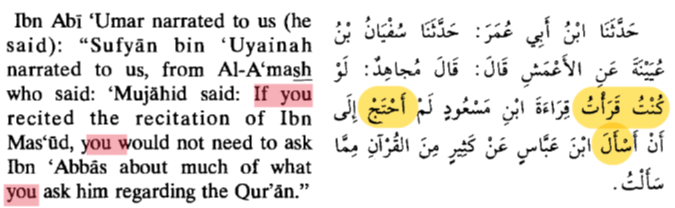
[1] al-Tirmidhī (5: 276, no. 2952):
Mujāhid’s words should be in the first person and not second person.
The correct translation is:
Mujāhid said, “If I had recited the recitation of Ibn Masʿūd, I would not have needed to ask Ibn ʿAbbās about much of what I asked him regarding the Qurʾān.”
In the Name of Allāh, the Most Merciful, the Especially Merciful
All praise is due to Allāh for His apparent and hidden blessings, both past and present, praise and protection be upon His Prophet and His Messenger Muḥammad, his family and Companions who strove earnestly in support of His religion, and upon their followers who inherited their knowledge; for the scholars are the heirs of the Prophets, and how noble they are – both the inheritor and the one from whom he inherits.
To proceed: this is a concise work comprising the fundamental ḥadīth proofs for legal rulings. I have compiled it meticulously so that whoever memorises it becomes distinguished amongst his peers, and so the novice student may use it as an aid, whilst the advanced scholar cannot dispense with it.
I have indicated, following each ḥadīth, which of the imāms narrated it, with the intent of sincere counsel to the Ummah. Thus, the intent of ‘the Seven’ is: Aḥmad, al-Bukhārī, Muslim, Abū Dāwūd, al-Tirmidhī, al-Nasāʾī, and Ibn Mājah; ‘the Six’ means: all except Aḥmad; ‘the Five’ means: all except al-Bukhārī and Muslim, and I may say ‘the Four and Aḥmad; ‘the Four’ excludes the first three; ‘the Three’ excludes them and the last one; and ‘agreed-upon’ means: al-Bukhārī and Muslim – and I may not mention others along with them both. Everything besides that is stated clearly (by name).
I have titled it Bulūgh al-Marām min Adillat al-Aḥkām (Attainment of the Objective from the Proofs of Legal Rulings).
I ask Allāh not to make what we have learnt a punishment for us, and to grant us deeds which please Him, Glorified and Exalted be He.
[Salal]: for further clarity:
The Seven: Aḥmad, al-Bukhārī, Muslim, Abū Dāwūd, al-Tirmidhī, al-Nasāʾī, and Ibn Mājah.
The Six: al-Bukhārī, Muslim, Abū Dāwūd, al-Tirmidhī, al-Nasāʾī, and Ibn Mājah.
The Five: Aḥmad, Abū Dāwūd, al-Tirmidhī, al-Nasāʾī, and Ibn Mājah.
The Four: Abū Dāwūd, al-Tirmidhī, al-Nasāʾī, and Ibn Mājah.
In the Name of Allāh, all praise is due to Allāh, may praise and protection be upon the Messenger of Allāh.
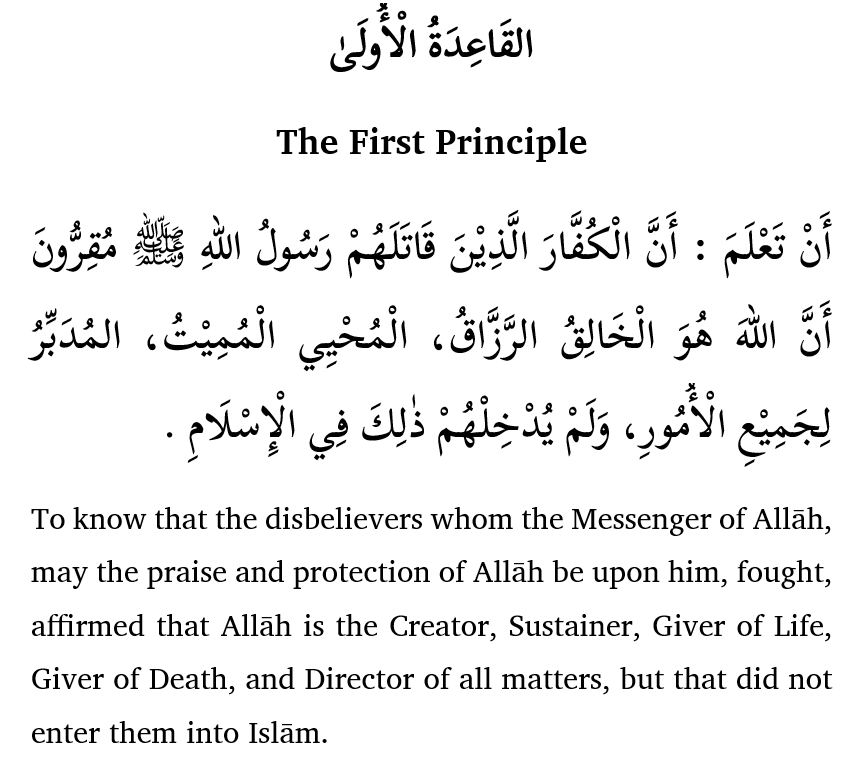
This, by the mercy of Allāh, is my third translation of a creedal study-text composed by Imām Muḥammad b. ʿAbd al-Wahhāb b. Sulaymān al-Tamīmī, may Allāh have mercy upon him. I previously translated and published the Imām’s Thalāthat-ul-Uṣūl (The Three Fundamental Principles) and Nawāqiḍ-ul-Islām (The Nullifiers of Islām). The title of this present creedal text is al-Qawāʿid al-Arbaʿ (The Four Principles).
Continuing the theme on tawḥīd (Islamic monotheism), in this work, the author presents four principles relating to shirk (associating partners with Allāh). To substantiate them, he cites proof-texts from the foundational sources of our Dīn: the Book of Allāh, the Almighty and Majestic, and the authentic Sunnah of His Messenger, may the praise and protection of Allāh be upon him.
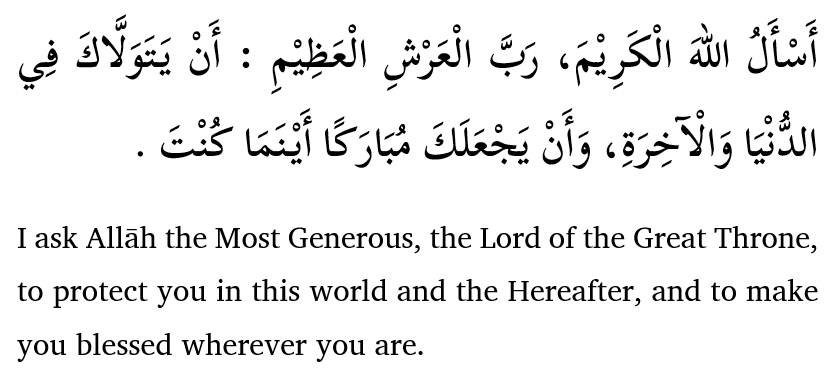
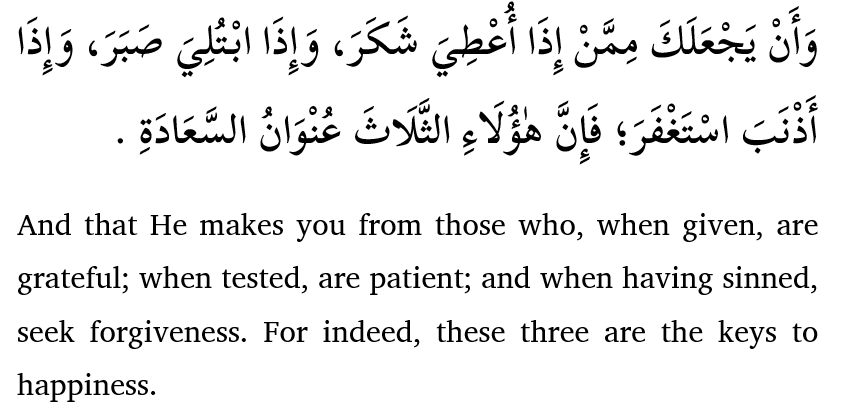
Prior to presenting the four principles, the author includes an introduction supplicating for the reader to be blessed with the three keys to happiness. He then highlights the following points:
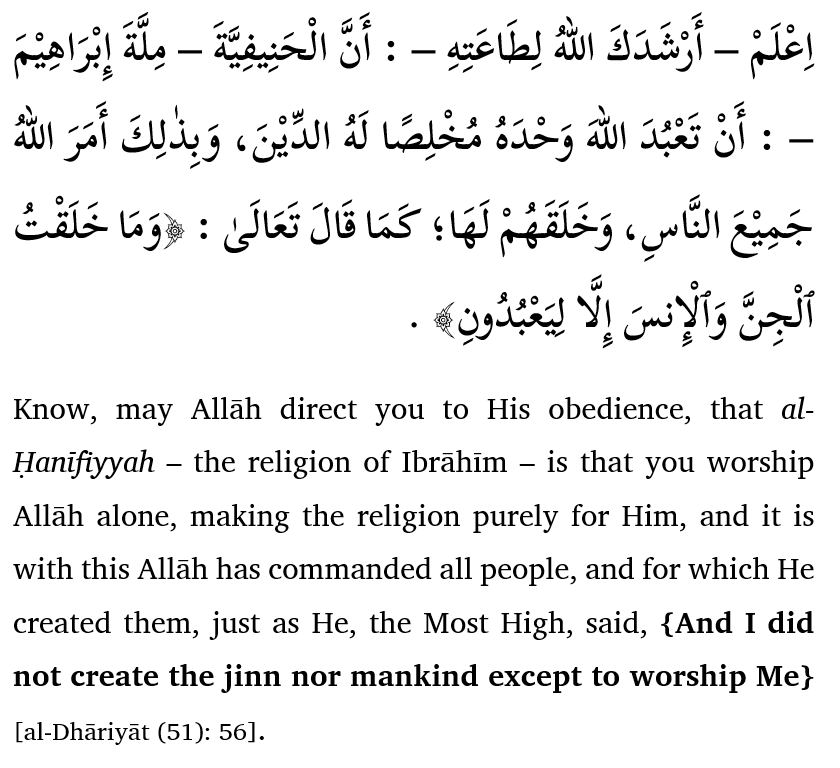
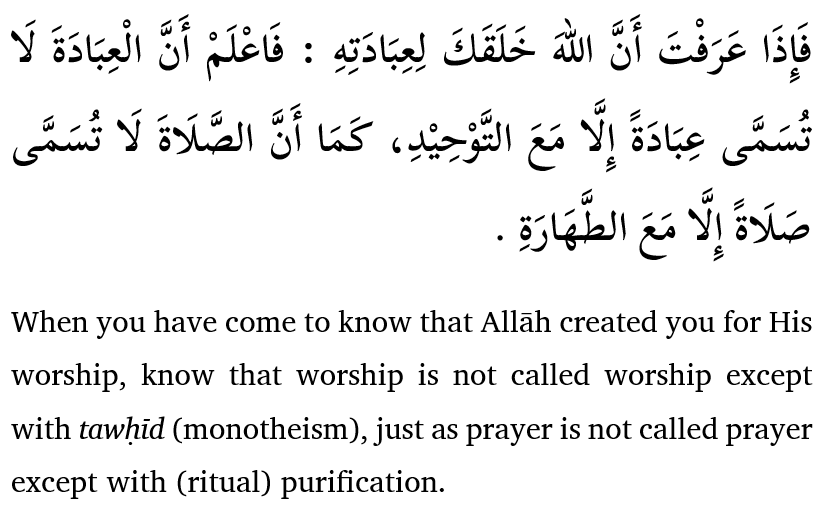
The centrality of tawḥīd: this whole religion of ours is nothing but the singling out of Allāh with everything that is exclusive to Him.
The validity of worship (ʿibādah) is contingent upon tawḥīd.
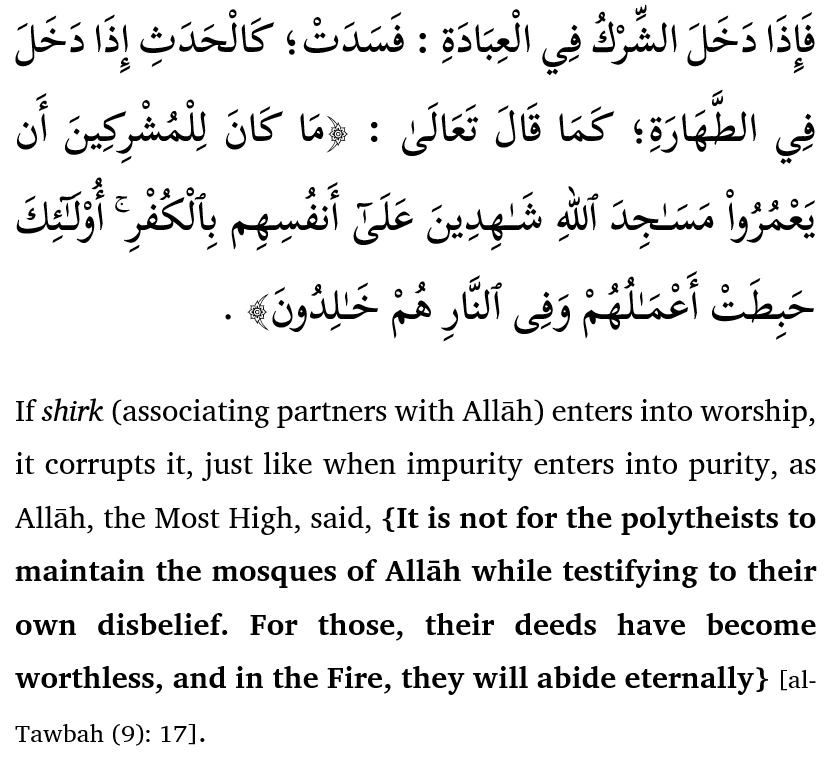
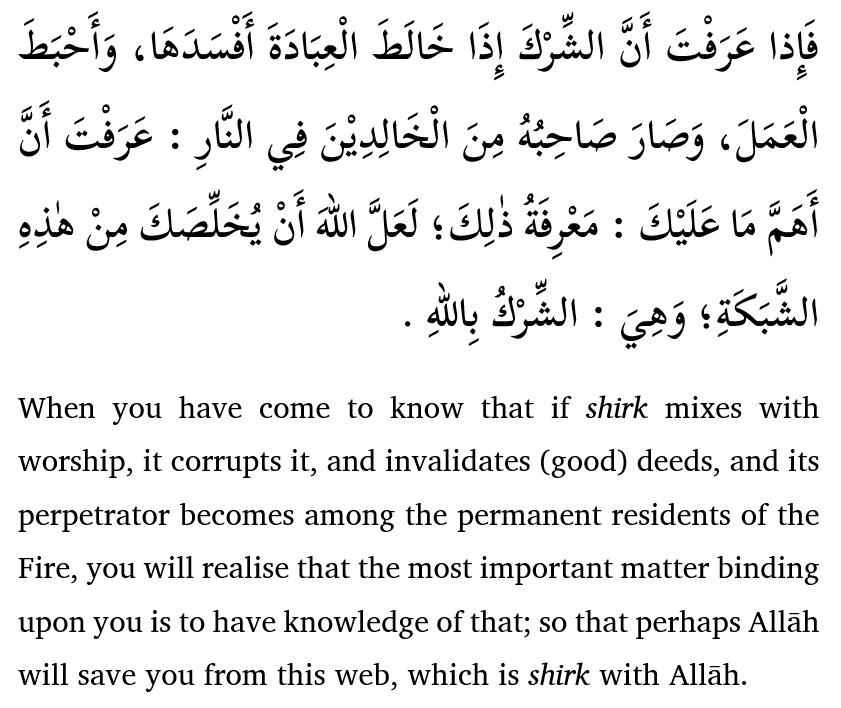
Shirk nullifies worship and results in the most dangerous of outcomes for its perpetrator – eternal damnation in the Fire.
Thus, knowledge of this is critical for salvation.
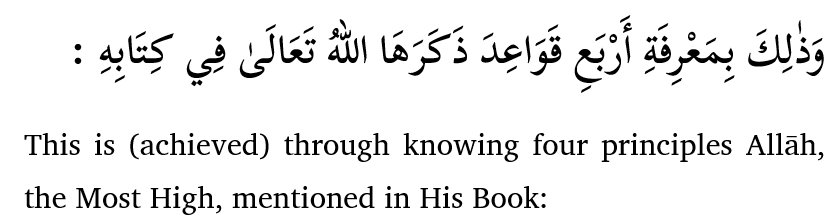
The four principles which follow his short introduction can be summarised as follows:
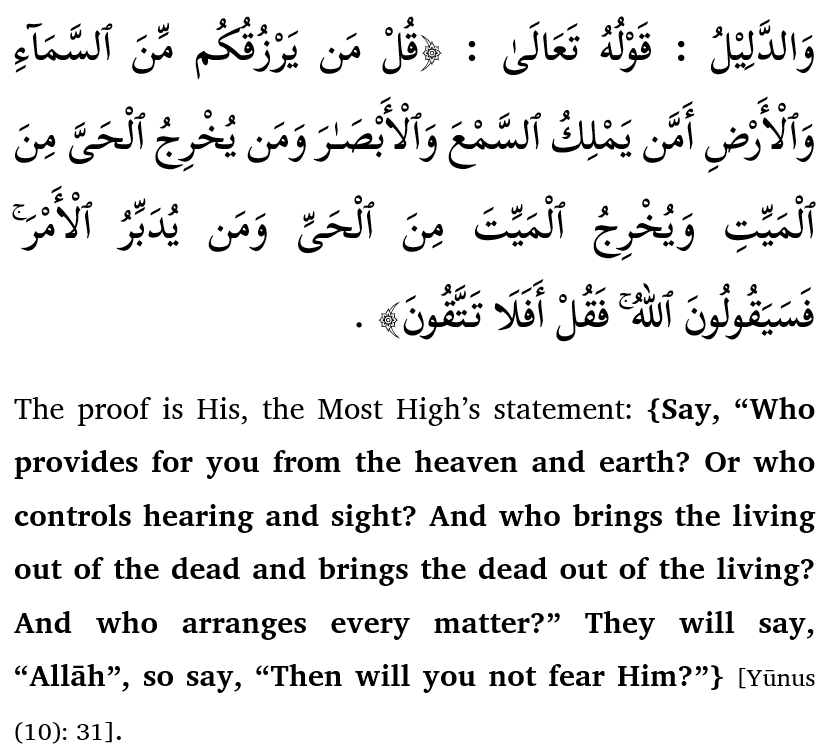
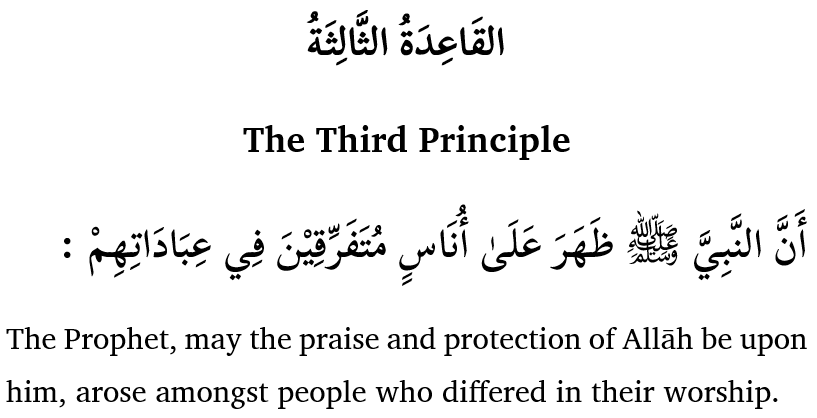
Believing that Allāh alone is the Creator, Sustainer, and Sovereign over all creation (Tawḥīd al-Rubūbiyyah: Monotheism of Lordship) is not enough to make a person a Muslim. The mushrikūn (associators of partners with Allāh) at the time of the Prophet, may the praise and protection of Allāh be upon him, believed in these qualities of Allāh and yet Allāh still declared them disbelievers.
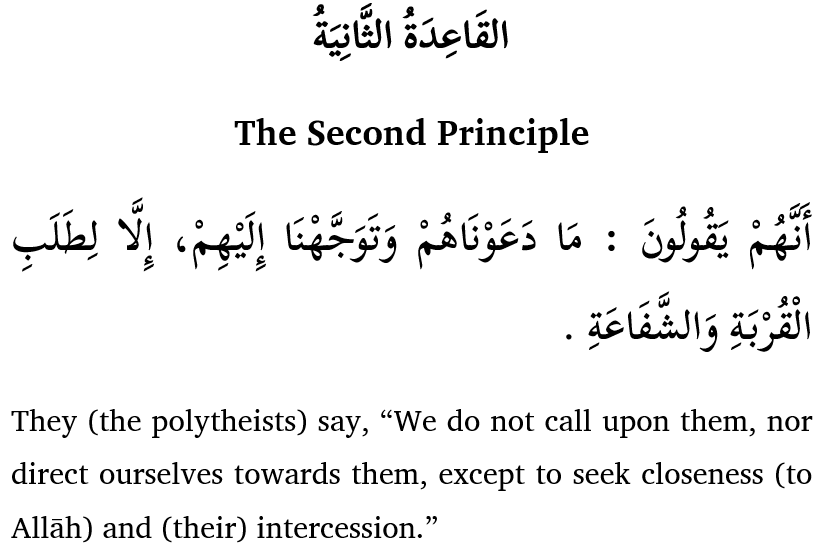
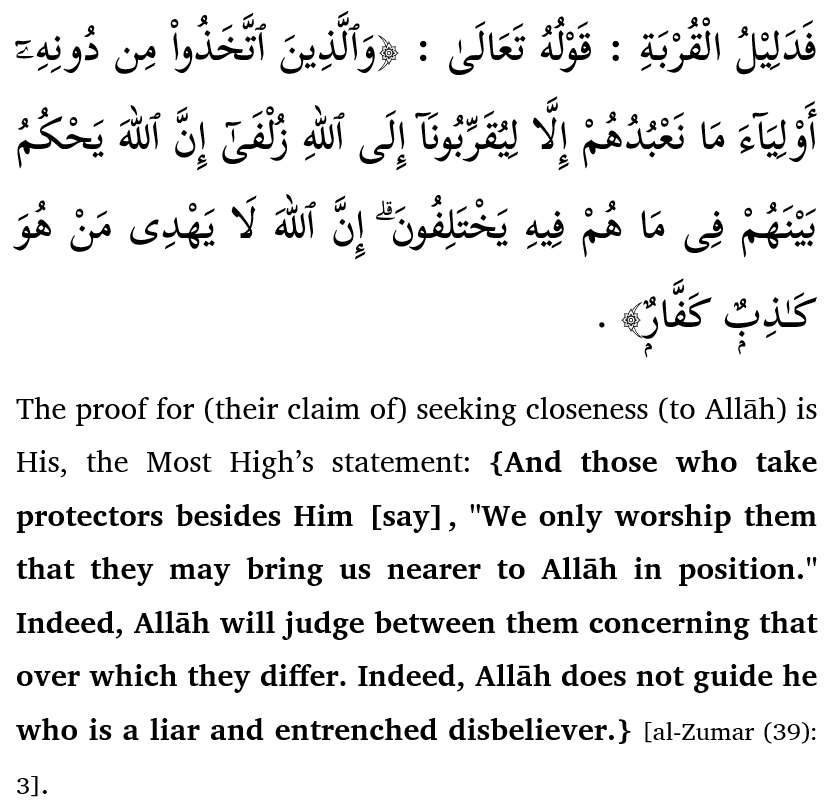
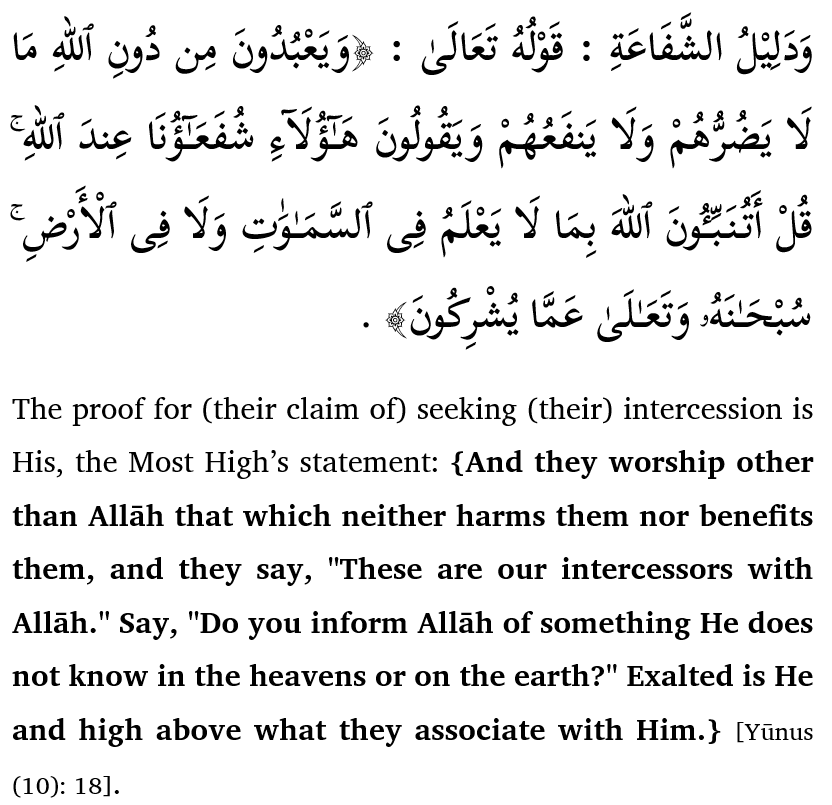
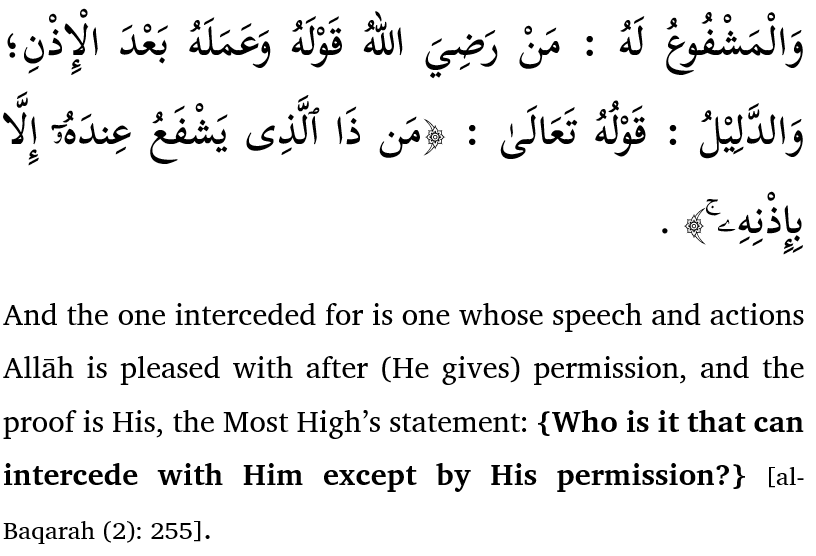
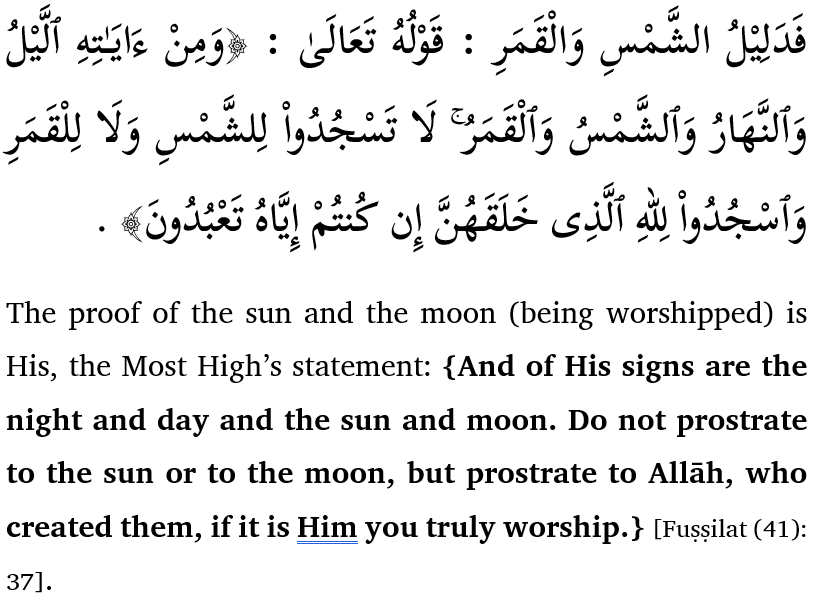
Although they believed in Allāh’s al-Rubūbiyyah, they claimed they only worship and call upon other than Allāh in order to gain nearness to Him and to obtain the intercession of these objects and entities. They believed they needed an intermediary between them and Allāh.
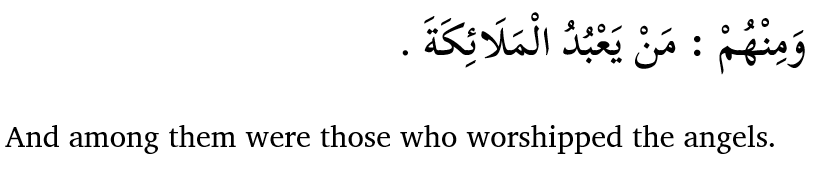
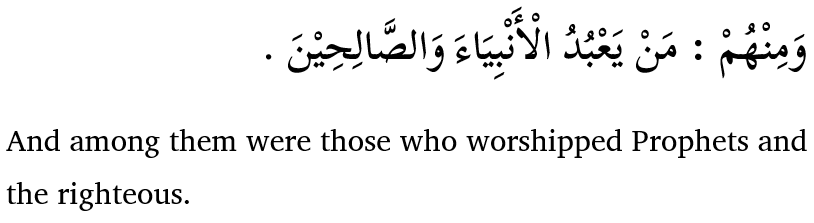
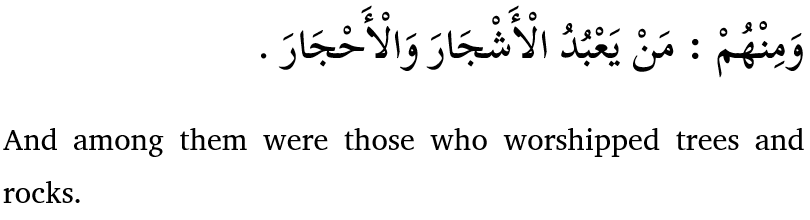
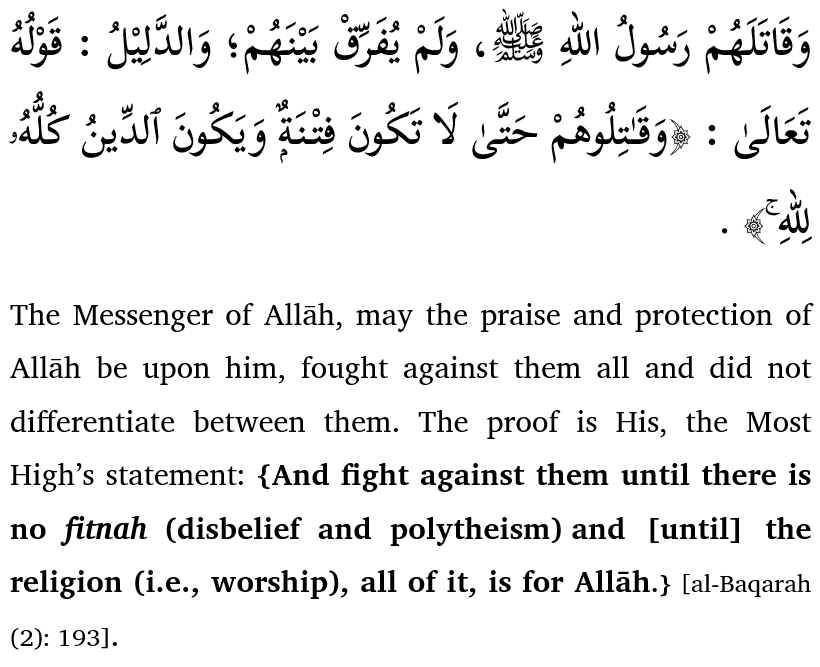
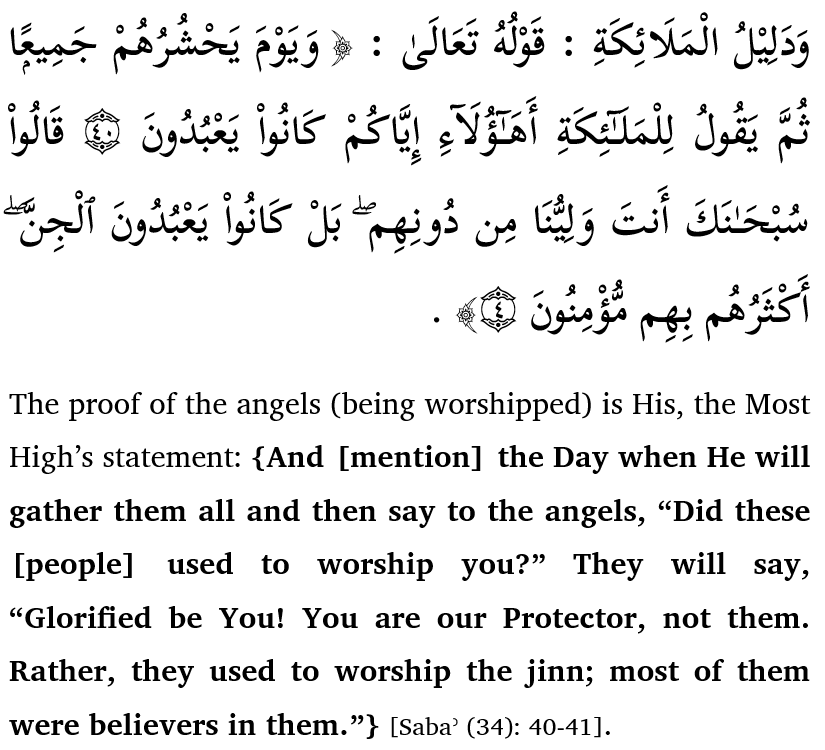
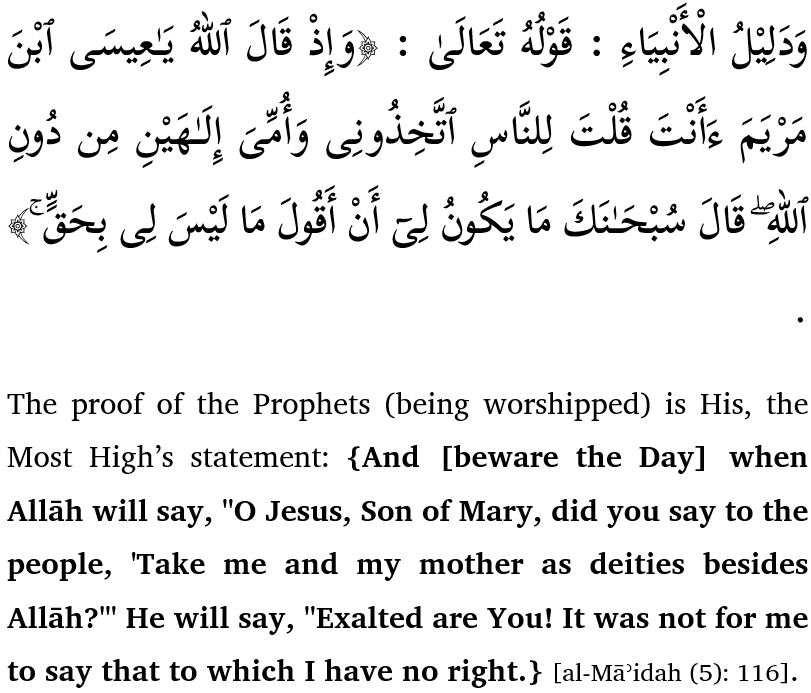
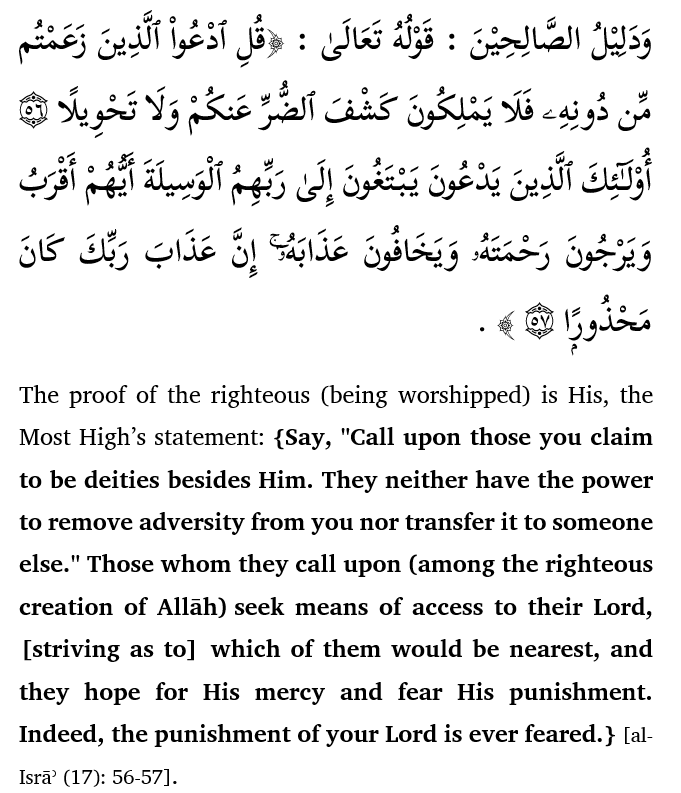
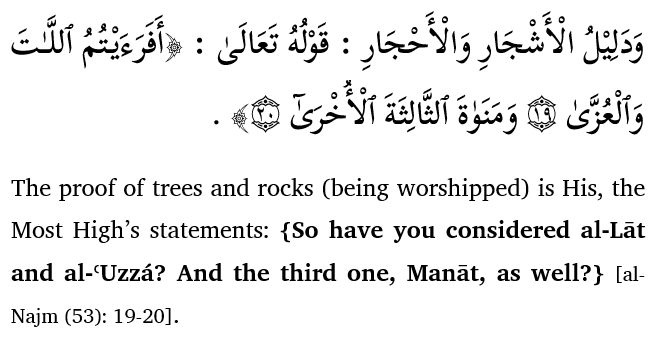
These objects and entities they worshipped and called upon were not limited to idols – they also called upon angels, Prophets, and righteous servants of Allāh. Despite this, the Prophet ﷺ fought them all equally, i.e., he did not limit his opposition to those who called upon idols, he also opposed those who called upon angels, Prophets, and the righteous servants of Allāh.
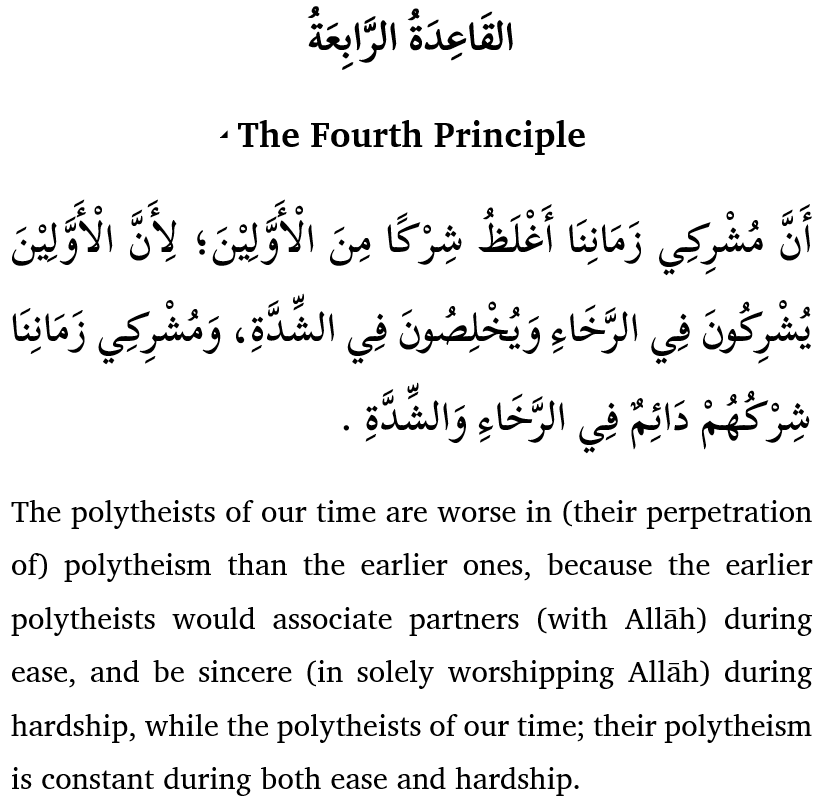
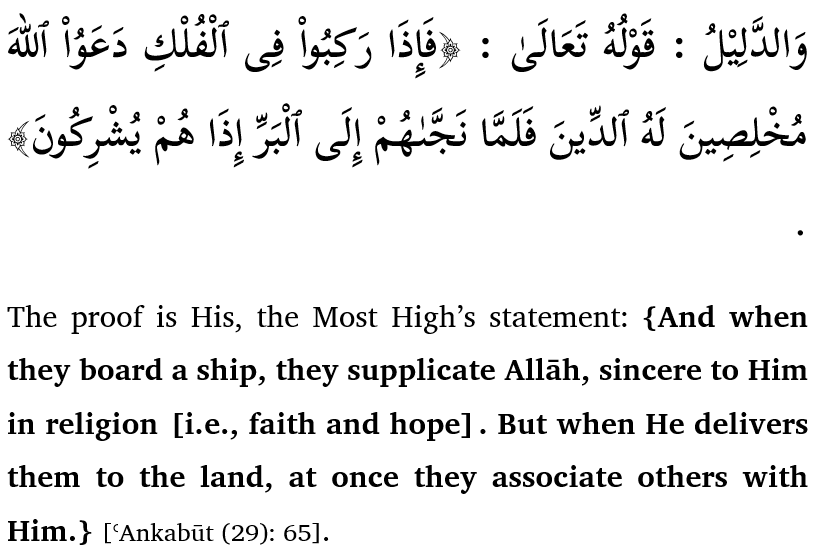
These earlier mushrikūn would call upon these objects and entities during times of ease but when they faced hardship, they would call upon Allāh alone. This is in stark contrast to the mushrikūn of today who call upon other than Allāh in both times of ease and hardship; thus, making the latter worser than the former.
Learning these principles will help one refute the doubts brought by deviants surrounding the issue of invocation, intercession, the scope and nature of shirk, and the correct understanding of tawḥīd.
I advise the reader to study the explanations of scholars such as Sh. ʿAbd al-ʿAzīz b. ʿAbd Allāh b. Bāz, Sh. Ṣāliḥ al-Fawzān, Sh. ʿAbd al-ʿAzīz al-Rājiḥī, Sh. Muḥammad Amān al-Jāmī, Sh. Rabīʿ b. Hādī al-Madkhalī, Sh. ʿUbayd al-Jābirī, Sh. Ṣāliḥ b. ʿAbd al-ʿAzīz Āl al-Shaykh, and Sh. ʿAbd al-Razzāq al-Badr – may Allāh reward them heavily for their efforts. Some of these are available in the English language – and all praise is due to Allāh.
This Translation
This particular translation of al-Qawāʿid al-Arbaʿ is based on Sh. ʿAbd al-Muḥsin b. Muḥammad b. al-Qāsim’s edition from his Mutūn Ṭālib al-ʿIlm: al-Mustawá al-Thānī (1446/2025), pp. 59-69.
The main part of this book is the point-by-point Arabic-English translation with notetaking space. For those who wish to memorise the Arabic text, I have included it in whole after this introduction. I also did the same for the English text for those who want to peruse the treatise uninterrupted. In both cases, I retained the Shaykh’s paragraphing of the text.
I ask Allāh, the Almighty and Majestic, to make this work a means for us to gain closeness to Him, and that it helps us to actualise tawḥīd with our every breath until our inevitable death.
Salal Ahmed Haque (Abū Ḥayyān al-Atharī).
Yawm al-Aḥad, 26th Ṣafar 1448 or Sunday, 9th August 2026.
Abū Saʿīd al-Khudrī reported that the Messenger of Allāh ﷺ said:
“Whoever reads Sūrah al-Kahf as it was revealed, he will have a light on the Day of Resurrection from his standing place to Makkah, and whoever reads ten verses from its end, and then the Dajjāl (False Messiah) emerges, he will not be overpowered, and whoever performs ablution and then says:
‘Far removed are You, O Allāh, from every imperfection, and praise be to You, there is no deity worthy of worship except You, I seek Your forgiveness and repent to You’
[It] will be written on a parchment and then sealed with a seal, and it will not be broken until the Day of Resurrection.”
Reported by al-Ḥākim.
Ṣaḥīḥ li Ghayrih: al-Ḥākim (2097) ed. al-Risālah, and in authentic mawqūf form in Ibn Abī Shaybah (19) ed. al-Shithrī. See: al-Albānī’s Ṣaḥīḥ al-Targhīb wa al-Tarhīb (1473).
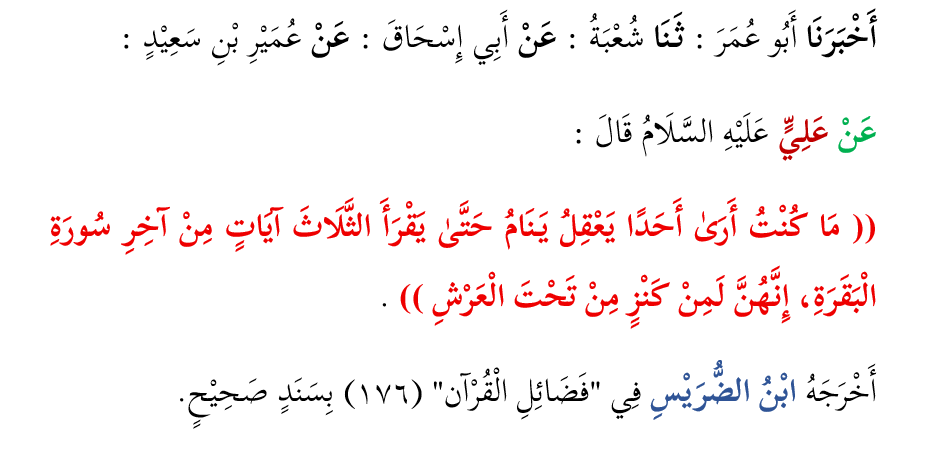
“I cannot imagine anyone of sound mind going to sleep before reciting the last three verses of Sūrah al-Baqarah; they are truly a treasure from beneath the Throne.”
Reported by Ibn al-Ḍurays in Faḍāʾil al-Qurʾān (176) with a sound chain.
It is also recorded by al-Dārimī (3427) and Ibn Abī Dāwūd in Sharīʿat al-Maghāzī as in Ibn Ḥajar’s Natāʾij al-Afkār (3: 90) with slight differences.
Ibn al-Ḍurays’s particular chain to ʿAlī, may Allāh be pleased with him, is sound. Here is the analysis of the chain along with a key to their biographical sources:
Key: AD = Sunan Abī Dāwūd, B = Ṣaḥīḥ al-Bukhārī, IḤT = al-Thiqāt of Ibn Ḥibbān, IḤṬM = Ibn Ḥajar’s Ṭabaqāt al-Mudallisīn, IM = Sunan Ibn Mājah, JTIAḤ = al-Jarḥ wa al-Taʿdīl of Ibn Abī Ḥātim, M = Ṣaḥīḥ Muslim, N = Sunan al-Nasāʾī, Siyar = Siyar Aʿlām al-Nubalāʾ of al-Dhahabī, TKB = al-Tārīkh al-Kabīr of al-Bukhārī, The Six = Ṣaḥīḥ al-Bukhārī, Ṣaḥīḥ Muslim, Sunan Abī Dāwūd, Sunan al-Tirmidhī, Sunan al-Nasāʾī, and Sunan Ibn Mājah, TK = Tahdhīb al-Kamāl of al-Mizzī, TQT = Taqrīb al-Tahdhīb of Ibn Ḥajar, TT = Tahdhīb al-Tahdhīb of Ibn Ḥajar, TTT = Taḥrīr Taqrīb al-Tahdhīb,
Ibn al-Ḍurays (d. 294): Abū ʿAbd Allāh Muḥammad b. Ayyūb b. Yaḥyá b. Ḍurays al-Bajalī, al-Rāzī, memoriser, traditionist, lived a long life (born around 200H), author of Faḍāʾil al-Qurʾān wa mā Unzila min al-Qurʾān bi Makkah wa mā Unzila bi al-Madīnah, audited by the ḥadīth master and rijāl critic Ibn Abī Ḥātim who declared him trustworthy and truthful, declared trustworthy by al-Dhahabī as well, and is included in al-Thiqāt by Ibn Ḥibbān, and he narrated from Abū ʿUmar Ḥafṣ b. ʿUmar. See: JTIAḤ (7: 198, no. 1114), IḤT (9: 152), and Siyar (13: 449, no. 222).
Abū ʿUmar (d. 225): Ḥafṣ b. ʿUmar b. al-Ḥārith b. Sakhbarah al-Azdī al-Namarī, Abū ʿUmar al-Ḥawḍī al-Baṣrī, from al-Namir b. Ghaymān or it is said the client of Banū ʿAdī, trustworthy, B-AD-N, audited by Muḥammad b. Ayyūb b. Yaḥyá b. al-Ḍurays al-Rāzī, as well as al-Bukhārī, Abū Dāwūd, Abū Zurʿah al-Rāzī, and Abū Ḥātim al-Rāzī, and he narrated from Shuʿbah b. al-Ḥajjāj (B-AD). Aḥmad said about him, “[He is] firm, firm, precise, precise, not a single word is held against him.” Ibn Abī Ḥātim said, “Truthful, precise, and ʿAlī b. al-Madīnī used to put him amongst the companions of Shuʿbah.” See: JTIAH (3: 182, no. 786) and TK (7: 27, no. 1397).
Shuʿbah (d. 160): b. al-Ḥajjāj b. al-Ward al-ʿAtakī al-Azdī, Abū Bisṭām al-Wāsiṭī, client of ʿAbdah b. al-Agharr, the client of Yazīd b. al-Muhallab b. Abī Ṣufrah, leader of the believers in ḥadīth according to Sufyān al-Thawrī, leading rijāl critic, student of the famous tābiʿī al-Ḥasan al-Baṣrī (d. 110), vessel of knowledge, trustworthy, The Six, audited by Abū ʿUmar Ḥafṣ b. ʿUmar (B-AD), and narrated from Abū Isḥāq al-Sabīʿī. His narrations from al-Sabīʿī – who is a mudallis – are considered connected as he would only narrate from him that which al-Sabīʿī narrated with explicit direct audition. al-Bayhaqī reports in Maʿrifat al-Sunan wa al-Āthār (1: 152, no. 204) that Shuʿbah said, “I have sufficed you from the tadlīs of three: al-Aʿmash, Abū Ishāq, and Qatādah.” See: JTIAḤ (5: 369, no. 1609), TK (12: 479, no. 2739), Siyar (7: 202, no. 80), TTT (2790).
Abū Isḥāq (d. 127): ʿAmr b. ʿAbd Allāh b. ʿUbayd/ʿAlī/Abū Shaʿīrah, al-Kūfī, tābiʿī, trustworthy, The Six, mudallis, Ibn Ḥajar places him in the third level of tadlīs practitioners whose reports are only accepted if he declares explicit direct audition, an exception is made if Shuʿbah narrates from him, as in this case. He narrated from ʿUmayr b. Saʿīd al-Nakhaʿī. See: TKB (4: 244, no. 2678), JTIAḤ (6: 242, no. 1347), TK (22: 102, 4400), and IḤṬM (p. 42, no. 91).
ʿUmayr b. Saʿīd (d. 107/115): al-Nakhaʿī al-Ṣuhbānī, Abū Yaḥyá al-Kūfī, tābiʿī, trustworthy, B-M-AD-IM, audited by Abū Isḥāq al-Sabīʿī, and narrated from ʿAlī b. Abī Ṭālib (B-M-AD-IM). See: JTIAḤ (6: 376, no. 2080), TK (22: 376, no. 4514), and TTT (5182).
ʿAlī (d. 40): b. Abī Ṭālib, Companion, fourth Rightly-Guided Caliph, audited by ʿUmayr b. Saʿīd al-Nakhaʿī (B-M-AD-IM). See: TK (20: 472, no. 4089).
As you can see, all of the transmitters are reliable and the chain is connected. The issue of Abū Isḥāq’s tadlīs is resolved by the fact Shuʿbah would only transmit from him when Abū Isḥāq declared explicit audition of his material.
Lastly: the report is marfūʿ ḥukman (raised to the Prophet ﷺ in ruling) because ʿAlī, may Allāh be pleased with him, mentions that which can only be established via revelation and not personal opinion. Consequently, he must have acquired this knowledge from the Prophet ﷺ himself as none of the Companions would say something like this via their own opinion.
Explicit evidence for it being raised to the Prophet ﷺ in ruling is indicated in a sound report recorded by Ibn Ḥibbān (6400) in which the Prophet ﷺ said, “I have been given superiority over people through three: the whole earth has been made a masjid for us and its dust has been made pure and purifying for us if we do not find water; our rows (in prayer) have been made like the rows of the angels; and I have been given these verses from the end of Sūrah al-Baqarah from a treasure underneath the Throne, the like of which has not been given to anyone before me nor after me.” It is included in Ṣaḥīḥ al-Jāmiʿ (4223) by al-Albānī.
And all praise is due to Allāh, and may the praise and protection of Allāh be upon His Messenger, his family, his Companions, and those who follow him until the Last Day.
Written by Salal Ahmed Haque (Abū Ḥayyān al-Atharī) on Yawm al-Arbiʿāʾ, 2nd Muḥarram 1448 or Wednesday, 17th June 2026.
al-Dārimī, Abū Muḥammad ʿAbd Allāh b. ʿAbd al-Raḥmān b. al-Faḍl b. Harām. Musnad al-Dārimī al-Maʿrūf bi Sunan al-Dārimī, ed. Ḥusayn Ṣalīm Asad al-Dārānī. al-Riyāḍ: Dār al-Mughnī (1420). 4 vols.
al-Dhahabī, Shams al-Dīn Muḥammad b. Aḥmad b. ʿUthmān al-Dhahabī. Siyar Aʿlām al-Nubalāʾ. Eds. Shuʿayb al-Arnāʾūṭ and Ḥusayn al-Asad. Beirut: Muʾassasat al-Risālah (1417/1996). 28 vols.
Ibn Abī Ḥātim, Abū Muḥammad ʿAbd al-Raḥmān. Kitāb al-Jarḥ wa al-Taʿdīl, ed. ʿAbd al-Raḥmān b. Yaḥyá al-Muʿallimī al-Yamānī. Hyderabad: Dāʾirat al-Maʿārif al-ʿUthmāniyyah (1371/1952). 9 vols.
Ibn Balbān, al-Amīr ʿAlāʾ al-Dīn ʿAlī al-Fārisī. Ṣaḥīḥ Ibn Ḥibbān bi Tartīb Ibn Balbān, ed. Shuʿayb al-Arnāʾūṭ, 1st edition. Damascus: al-Risālah al-ʿĀlamiyyah (1432/2011). 18 vols.
Ibn al-Ḍurays, Abū ʿAbd Allāh Muḥammad b. Ayyūb. Faḍāʾil al-Qurʾān wa mā Unzila min al-Qurʾān bi Makkah wa mā Unzila bi al-Madīnah, ed. ʿUrwah Budayr. Damascus: Dār al-Fikar (1408/1987).
Taʿrīf Ahl al-Taqdīs bi Marātib al-Mawṣūfīn bi al-Tadlīs, ed. ʿĀṣim b. ʿAbd Allāh al-Qaryūtī. ʿAmmān: Maktabat al-Manār (1404). Damascus and Beirut: Dār Ibn Kathīr (1429/2008).
Ibn Ḥibbān, Muḥammad. Kitāb al-Thiqāt, Supervised by Muḥammad ʿAbd al-Muʿīd Khān. Hyderabad: Dāʾirat al-Maʿārif al-ʿUthmāniyyah (1393/1973). 9 vols.
Maʿrūf, Bashshār ʿAwwād and al-Arnāʾūṭ, Shuʿayb. Taḥrīr Taqrīb al-Tahdhīb li al-Ḥāfiẓ Aḥmad b. ʿAlī b. Ḥajar al-ʿAsqalānī. Beirut: Muʾassasat al-Risālah (1417/1997). 4 vols.
Sh. Muḥammad b. Ṣāliḥ al-ʿUthaymīn رَحِمَهُ اللهُ was asked about a person who normally fasts the ten days of Dhū al-Ḥijjah, and he wants to do Ḥajj – can he fast those ten days?
The Shaykh رَحِمَهُ اللهُ replied:
“Fasting the ten days of Dhū al-Ḥijjah is not obligatory, so if a person wishes he can fast them, and if he wishes he does not fast them, whether he travels for Ḥajj or remains in his country. This is because every fast that is optional, then the person has a choice about it: thus, if he is in his country and he wishes to fast then let him fast, and if he travels and sees fasting to be difficult then let him not fast, because it is not appropriate for one for whom fasting is difficult during travelling to fast – whether that be an obligatory or optional fast. However, in ʿArafah he is not to fast because the Messenger of Allāh ﷺ did not fast during the day of ʿArafah, and it has been narrated from him ﷺ that he forbade fasting (the day of) ʿArafah at ʿArafah.”
Majmūʿ Fatāwá wa Rasāʾil al-Shaykh Muḥammad b. Ṣāliḥ al-ʿUthaymīn, 20: 45, no. 402.
Note: The ḥadīth regarding the Prophet ﷺ forbidding the fasting of ʿArafah at ʿArafah (Abū Dāwūd (2440)) is graded weak by al-Albānī. See: Ḍaʿīf Abī Dāwūd (421) and al-Ḍaʿīfah (404).
Thābit b. ʿUbayd said, “Zayd b. Thābit used to be the most cheerful person amongst his family.”
Thābit b. ʿUbayd said, “I never saw anyone more dignified when he sat with people, nor more cheerful in his house than Zayd b. Thābit.”
Encourage Your Child to Fast if He’s Capable
Hishām b. ʿUrwah b. al-Zubayr reported from his father that he would command his children to fast if they were capable of it.
Force Your Child to Learn the Obligatory Aspects of the Dīn
Sufyān al-Thawrī said, “It is necessary for a man to force his child to acquire knowledge, for indeed he will be questioned about it.”
Teach Your Child the Qurʾān
ʿAbd Allāh b. ʿĪsá said, “This Ummah will continue to be upon goodness as long as its children learn the Qurʾān.”
Teach Your Child Manners
ʿUthmān al-Ḥāṭibī said, “I heard Ibn ʿUmar say to a man, ‘Teach your son manners, for indeed you will be asked about your son and what manners you taught him, and what (knowledge) you taught him.’”
Muḥammad b. Sīrīn (d. 110) said, “They used to say, “Honour your child, and teach him excellent manners.”
Sufyān said, “It used to be said that from the rights of a child upon his parent is that he teaches him excellent manners.”
It used to be said, “Manners are from fathers, and righteousness is from Allāh.” And it used to be said, “Whoever teaches his son manners when he is young, he will be delighted with him when grows up.”
Exhort Your Family
Zayd b. Aslam reported from his father that ʿUmar b. al-Khaṭṭāb used to pray whatever Allāh willed during the night. When the end of the night came, he would wake up his family and say, “The prayer, the prayer” and recite {And command your family with prayer} [Ṭā-Hā (20): 132].
al-Ḥasan al-Baṣrī (d. 110) said, “May Allāh have mercy upon one who exhorts himself and his family, and says, ‘O my family, (take care of) your prayer (take care of) your prayer, (take care of) your zakāh (take care of) your zakāh, (take care of) your neighbours (take care of) your neighbours, (take care of) your poor (take care of) your poor; perhaps Allāh will have mercy upon you on the Day of Resurrection, for indeed Allāh praised the servant who does these deeds. He the Majestic and Most High said, {And he used to command his family with prayer and zakāh, and his Lord was pleased with him} [Maryam (19: 55)].”
Muʿāwiyah b. Murrah said that his father used to say to his children after they had prayed ʿIshāʾ, “O my dear children, go to sleep, for perhaps Allāh will provide you with goodness from the night.”
Ṣāliḥ, the son of Imām Aḥmad said that if an ascetic man came to his father, his father would send him to observe that man in the hope that he would be like him.
Be Beneficial to Your Family
Ḍirār b. Murrah used to milk his sheep for his family and draw water for them. He said, “It used to be said, ‘The best of you is the one who is most beneficial to his family.’”
Mubārak b. Saʿīd said, “Sufyān wrote to me, ‘To proceed: look after your family in the best way, and let death be on your mind – peace (be upon you).’”
Providing for Your Family is Better than Optional Acts of Worship
Muslim said that he met Muʿāwiyah b. Qurrah and asked him where he had just come from. He replied he went out and bought food for his family. Muslim asked him whether he acquired it with ḥalāl wealth. He replied, “Yes.” He then said, “It is more beloved to me that I set out every day for what you set out, than praying the night and fasting the day.”
Source: Min Akhbār al-Salaf by Abū Zakariyā al-Bākistānī, pp. 401-406.
Hilāl b. Khabbāb said, “I set out with Saʿīd b. Jubayr (d. 95) when some days had passed in Rajab, so he entered into a state of iḥrām from al-Kūfah for ʿUmrah. He then returned from ʿUmrah. He then entered into a state of iḥrām for Ḥajj during the middle of Dhū al-Qaʿdah; he used to set out twice every year: once for Ḥajj and once for ʿUmrah.”
Mūsá b. Hārūn (d. 294) used to perform Ḥajj frequently; he would reside in Baghdād for a year and perform Ḥajj for a year.
al-Ḥasan b. Aḥmad said that Ibn Abī ʿUmar al-ʿAdanī (d. 243) performed Ḥajj 77 times.
Aḥmad b. Janāb (d. 230) said, “ʿĪsá b. Yūnus (d. 187) performed Ḥajj 45 times.”
Saḥnūn (d. 240) said, “Ibn Wahb (d. 197) used to divide the year into three: a third guarding the border, a third teaching knowledge, and a third in Ḥajj.” He mentioned that he performed Ḥajj 36 times.
Saʿīd b. al-Musayyib (d. 94) said, “I performed 40 pilgrimages.”
ʿAmr b. Maymūn (d. 75) performed a combination of Ḥajj and ʿUmrah 60 times.
Abū Isḥāq al-Sabīʿī (33-127H) said, “al-Aswad al-Nakhaʿī (d. 75) performed a combination of 80 Ḥajj and ʿUmrah.”
Hishām b. Ḥassān (d. 146) stated that Ayyūb al-Sakhtiyānī (d. 131) performed Ḥajj 40 times.
Ibn Abī Laylá (d. 148) stated that ʿAṭāʾ b. Abī Rabāḥ (d. 114) performed Ḥajj more than 70 times.
Sufyān b. ʿUyaynah (d. 198) said, “I witnessed 80 standings in ʿArafah.” He used to say in every standing, “O Allāh, do not make this the last time with You.” When it came to the year in which he died, he did not say anything and stated, “I felt shy in front of Allāh the Most High.”
Source: Min Akhbār al-Salaf al-Ṣāliḥ by Abū Yaḥyá Zakariyyā b. Ghulām Qādir, pp. 118-119.
Sh. ʿAbd al-ʿAzīz b. Bāz رَحِمَهُ اللهُ was asked whether it is possible to use the fact that Jibrīl عَلَيْهِ السَّلام studied the Qurʾān with the Prophet ﷺ during Ramaḍān, as evidence of the virtue of completing a recitation of the Qurʾān.
He replied:
“Studying [the Qurʾān] is derived from this and that it is recommended for the believer to study the Qurʾān with one who can benefit him, because the Messenger ﷺ studied it with Jibrāʾīl عَلَيْهِ السَّلام in order to benefit, for Jibrāʾīl is the one who comes from Allāh, the Majestic and Most High, and is the intermediary between Allāh and the Messengers. Jibrāʾīl must have benefitted the Prophet ﷺ with things from Allāh, the Majestic and Most High, in terms of proper recitation of the letters of the Qurʾān, and with respect to its meanings which Allāh intended.
If a person studies with someone who helps him to understand the Qurʾān, and one who helps him to recite its letters properly; this is something desired, just as the Prophet ﷺ studied with Jibrāʾīl. This does not mean Jibrāʾīl is better than the Prophet ﷺ, but rather that Jibrāʾīl is the messenger who came from Allāh and then conveys to the Messenger ﷺ what Allāh has commanded him with in terms of the Qurʾān, its words, and meanings. The Messenger ﷺ benefitted from Jibrāʾīl in this way – not that Jibrāʾīl is better than him, rather he is the best of mankind and better than the angels. However, studying contains much good for the Prophet ﷺ and the Ummah, because it is a study of what he brings from Allāh, and in order to benefit from what he brings from Allāh the Almighty and Majestic.
It contains another benefit: studying at night is better than the day because this studying (of the Qurʾān) occurred during the night, and it is known that the night is more conducive to the focusing of the heart and its presence, and there is more benefit than studying at daytime.
It also contains other benefits: the legality of studying and that it is a righteous deed even in other than Ramaḍān, because it contains benefit for both of them. If they are more than two, there is no harm in all of them benefitting from his brother, and encouraging him to recite, and motivating him, for he may not be motivated when sitting alone. However, if he is with a companion of his with whom he studies, or companions, that would be more encouraging and motivating for him, along with the tremendous benefits that occur between them, in terms of revision and perusal of what is difficult for them – all of that contains abundant goodness.
It is also possible to understand from this that recitation of the complete Qurʾān by the Imām in congregation during Ramaḍān is a type of this study, because in this way he benefits them with the entire Qurʾān. This is why Imām Aḥmad, may Allāh have mercy upon him, liked for the one who leads them in prayer to complete the Qurʾān with them. This is one of the practices of the Salaf in their love of hearing the entire Qurʾān. However, this does not necessitate rushing and not taking time in one’s recitation, nor striving for humility and tranquillity, rather striving for these matters is more deserving than observing the completion of the Qurʾān.”
Source: Majmūʿ Fatāwá wa Maqālāt Mutanawwiʿah (15: 324-326).