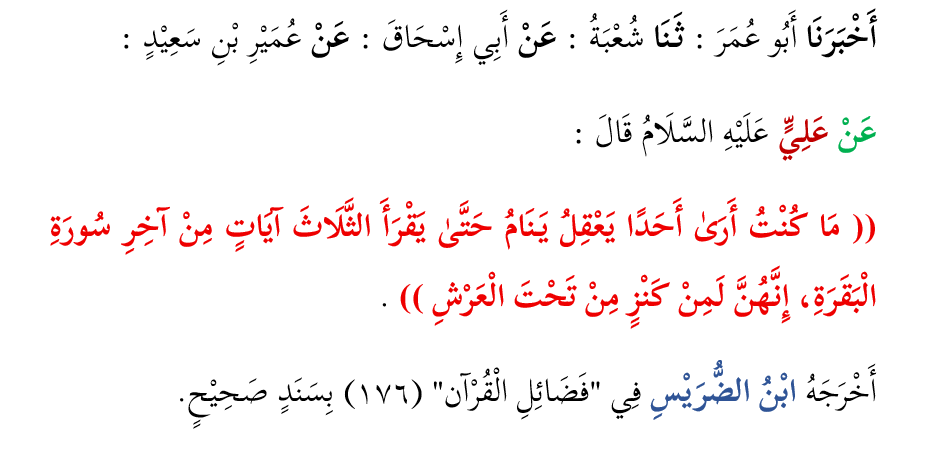
ʿAlī, peace be upon him, said,
“I cannot imagine anyone of sound mind going to sleep before reciting the last three verses of Sūrah al-Baqarah; they are truly a treasure from beneath the Throne.”
Reported by Ibn al-Ḍurays in Faḍāʾil al-Qurʾān (176) with a sound chain.
It is also recorded by al-Dārimī (3427) and Ibn Abī Dāwūd in Sharīʿat al-Maghāzī as in Ibn Ḥajar’s Natāʾij al-Afkār (3: 90) with slight differences.
Ibn al-Ḍurays’s particular chain to ʿAlī, may Allāh be pleased with him, is sound. Here is the analysis of the chain along with a key to their biographical sources:
Key: AD = Sunan Abī Dāwūd, B = Ṣaḥīḥ al-Bukhārī, IḤT = al-Thiqāt of Ibn Ḥibbān, IḤṬM = Ibn Ḥajar’s Ṭabaqāt al-Mudallisīn, IM = Sunan Ibn Mājah, JTIAḤ = al-Jarḥ wa al-Taʿdīl of Ibn Abī Ḥātim, M = Ṣaḥīḥ Muslim, N = Sunan al-Nasāʾī, Siyar = Siyar Aʿlām al-Nubalāʾ of al-Dhahabī, TKB = al-Tārīkh al-Kabīr of al-Bukhārī, The Six = Ṣaḥīḥ al-Bukhārī, Ṣaḥīḥ Muslim, Sunan Abī Dāwūd, Sunan al-Tirmidhī, Sunan al-Nasāʾī, and Sunan Ibn Mājah, TK = Tahdhīb al-Kamāl of al-Mizzī, TQT = Taqrīb al-Tahdhīb of Ibn Ḥajar, TT = Tahdhīb al-Tahdhīb of Ibn Ḥajar, TTT = Taḥrīr Taqrīb al-Tahdhīb,
Ibn al-Ḍurays (d. 294): Abū ʿAbd Allāh Muḥammad b. Ayyūb b. Yaḥyá b. Ḍurays al-Bajalī, al-Rāzī, memoriser, traditionist, lived a long life (born around 200H), author of Faḍāʾil al-Qurʾān wa mā Unzila min al-Qurʾān bi Makkah wa mā Unzila bi al-Madīnah, audited by the ḥadīth master and rijāl critic Ibn Abī Ḥātim who declared him trustworthy and truthful, declared trustworthy by al-Dhahabī as well, and is included in al-Thiqāt by Ibn Ḥibbān, and he narrated from Abū ʿUmar Ḥafṣ b. ʿUmar. See: JTIAḤ (7: 198, no. 1114), IḤT (9: 152), and Siyar (13: 449, no. 222).
Abū ʿUmar (d. 225): Ḥafṣ b. ʿUmar b. al-Ḥārith b. Sakhbarah al-Azdī al-Namarī, Abū ʿUmar al-Ḥawḍī al-Baṣrī, from al-Namir b. Ghaymān or it is said the client of Banū ʿAdī, trustworthy, B-AD-N, audited by Muḥammad b. Ayyūb b. Yaḥyá b. al-Ḍurays al-Rāzī, as well as al-Bukhārī, Abū Dāwūd, Abū Zurʿah al-Rāzī, and Abū Ḥātim al-Rāzī, and he narrated from Shuʿbah b. al-Ḥajjāj (B-AD). Aḥmad said about him, “[He is] firm, firm, precise, precise, not a single word is held against him.” Ibn Abī Ḥātim said, “Truthful, precise, and ʿAlī b. al-Madīnī used to put him amongst the companions of Shuʿbah.” See: JTIAH (3: 182, no. 786) and TK (7: 27, no. 1397).
Shuʿbah (d. 160): b. al-Ḥajjāj b. al-Ward al-ʿAtakī al-Azdī, Abū Bisṭām al-Wāsiṭī, client of ʿAbdah b. al-Agharr, the client of Yazīd b. al-Muhallab b. Abī Ṣufrah, leader of the believers in ḥadīth according to Sufyān al-Thawrī, leading rijāl critic, student of the famous tābiʿī al-Ḥasan al-Baṣrī (d. 110), vessel of knowledge, trustworthy, The Six, audited by Abū ʿUmar Ḥafṣ b. ʿUmar (B-AD), and narrated from Abū Isḥāq al-Sabīʿī. His narrations from al-Sabīʿī – who is a mudallis – are considered connected as he would only narrate from him that which al-Sabīʿī narrated with explicit direct audition. al-Bayhaqī reports in Maʿrifat al-Sunan wa al-Āthār (1: 152, no. 204) that Shuʿbah said, “I have sufficed you from the tadlīs of three: al-Aʿmash, Abū Ishāq, and Qatādah.” See: JTIAḤ (5: 369, no. 1609), TK (12: 479, no. 2739), Siyar (7: 202, no. 80), TTT (2790).
Abū Isḥāq (d. 127): ʿAmr b. ʿAbd Allāh b. ʿUbayd/ʿAlī/Abū Shaʿīrah, al-Kūfī, tābiʿī, trustworthy, The Six, mudallis, Ibn Ḥajar places him in the third level of tadlīs practitioners whose reports are only accepted if he declares explicit direct audition, an exception is made if Shuʿbah narrates from him, as in this case. He narrated from ʿUmayr b. Saʿīd al-Nakhaʿī. See: TKB (4: 244, no. 2678), JTIAḤ (6: 242, no. 1347), TK (22: 102, 4400), and IḤṬM (p. 42, no. 91).
ʿUmayr b. Saʿīd (d. 107/115): al-Nakhaʿī al-Ṣuhbānī, Abū Yaḥyá al-Kūfī, tābiʿī, trustworthy, B-M-AD-IM, audited by Abū Isḥāq al-Sabīʿī, and narrated from ʿAlī b. Abī Ṭālib (B-M-AD-IM). See: JTIAḤ (6: 376, no. 2080), TK (22: 376, no. 4514), and TTT (5182).
ʿAlī (d. 40): b. Abī Ṭālib, Companion, fourth Rightly-Guided Caliph, audited by ʿUmayr b. Saʿīd al-Nakhaʿī (B-M-AD-IM). See: TK (20: 472, no. 4089).
As you can see, all of the transmitters are reliable and the chain is connected. The issue of Abū Isḥāq’s tadlīs is resolved by the fact Shuʿbah would only transmit from him when Abū Isḥāq declared explicit audition of his material.
Lastly: the report is marfūʿ ḥukman (raised to the Prophet ﷺ in ruling) because ʿAlī, may Allāh be pleased with him, mentions that which can only be established via revelation and not personal opinion. Consequently, he must have acquired this knowledge from the Prophet ﷺ himself as none of the Companions would say something like this via their own opinion.
Explicit evidence for it being raised to the Prophet ﷺ in ruling is indicated in a sound report recorded by Ibn Ḥibbān (6400) in which the Prophet ﷺ said, “I have been given superiority over people through three: the whole earth has been made a masjid for us and its dust has been made pure and purifying for us if we do not find water; our rows (in prayer) have been made like the rows of the angels; and I have been given these verses from the end of Sūrah al-Baqarah from a treasure underneath the Throne, the like of which has not been given to anyone before me nor after me.” It is included in Ṣaḥīḥ al-Jāmiʿ (4223) by al-Albānī.
And all praise is due to Allāh, and may the praise and protection of Allāh be upon His Messenger, his family, his Companions, and those who follow him until the Last Day.
Written by Salal Ahmed Haque (Abū Ḥayyān al-Atharī) on Yawm al-Arbiʿāʾ, 2nd Muḥarram 1448 or Wednesday, 17th June 2026.
Bibliography
al-Bukhārī, Muḥammad b. Ismāʿīl. Kitāb al-Tārīkh al-Kabīr, Supervised by Muḥammad ʿAbd al-Muʿīd Khān, eds. ʿAbd al-Raḥmān b. Yaḥyá al-Muʿallimī al-Yamānī, Hāshim al-Nadwī, Muḥammad Ṭāhā al-Nadwī, Muḥammad ʿĀdil al-Quddūsī, Ḥasan Jamāl al-Layl al-Madanī, and Abū al-Wafāʾ al-Afghānī. Hyderabad: Dāʾirat al-Maʿārif al-ʿUthmāniyyah (1360-1378/1941-1959). 10 vols.
al-Dārimī, Abū Muḥammad ʿAbd Allāh b. ʿAbd al-Raḥmān b. al-Faḍl b. Harām. Musnad al-Dārimī al-Maʿrūf bi Sunan al-Dārimī, ed. Ḥusayn Ṣalīm Asad al-Dārānī. al-Riyāḍ: Dār al-Mughnī (1420). 4 vols.
al-Dhahabī, Shams al-Dīn Muḥammad b. Aḥmad b. ʿUthmān al-Dhahabī. Siyar Aʿlām al-Nubalāʾ. Eds. Shuʿayb al-Arnāʾūṭ and Ḥusayn al-Asad. Beirut: Muʾassasat al-Risālah (1417/1996). 28 vols.
Ibn Abī Ḥātim, Abū Muḥammad ʿAbd al-Raḥmān. Kitāb al-Jarḥ wa al-Taʿdīl, ed. ʿAbd al-Raḥmān b. Yaḥyá al-Muʿallimī al-Yamānī. Hyderabad: Dāʾirat al-Maʿārif al-ʿUthmāniyyah (1371/1952). 9 vols.
Ibn Balbān, al-Amīr ʿAlāʾ al-Dīn ʿAlī al-Fārisī. Ṣaḥīḥ Ibn Ḥibbān bi Tartīb Ibn Balbān, ed. Shuʿayb al-Arnāʾūṭ, 1st edition. Damascus: al-Risālah al-ʿĀlamiyyah (1432/2011). 18 vols.
Ibn al-Ḍurays, Abū ʿAbd Allāh Muḥammad b. Ayyūb. Faḍāʾil al-Qurʾān wa mā Unzila min al-Qurʾān bi Makkah wa mā Unzila bi al-Madīnah, ed. ʿUrwah Budayr. Damascus: Dār al-Fikar (1408/1987).
Ibn Ḥajar, Aḥmad b. Muḥammad.
- Natāʾij al-Afkār fī Takhrīj Aḥādīth al-Adhkār, ed. Ḥamdī ʿAbd al-Majīd al-Salafī, 2nd edition. 5 vols.
- Taʿrīf Ahl al-Taqdīs bi Marātib al-Mawṣūfīn bi al-Tadlīs, ed. ʿĀṣim b. ʿAbd Allāh al-Qaryūtī. ʿAmmān: Maktabat al-Manār (1404). Damascus and Beirut: Dār Ibn Kathīr (1429/2008).
Ibn Ḥibbān, Muḥammad. Kitāb al-Thiqāt, Supervised by Muḥammad ʿAbd al-Muʿīd Khān. Hyderabad: Dāʾirat al-Maʿārif al-ʿUthmāniyyah (1393/1973). 9 vols.
Maʿrūf, Bashshār ʿAwwād and al-Arnāʾūṭ, Shuʿayb. Taḥrīr Taqrīb al-Tahdhīb li al-Ḥāfiẓ Aḥmad b. ʿAlī b. Ḥajar al-ʿAsqalānī. Beirut: Muʾassasat al-Risālah (1417/1997). 4 vols.
al-Mizzī, Jamāl al-Dīn Abū al-Ḥajjāj Yūsuf. Tahdhīb al-Kamāl fī Asmāʾ al-Rijāl, ed. Bashshār ʿAwwād Maʿrūf. Beirut: Muʾassasat al-Risālah (1403/1983). 35 vols.
Shkūkānī, Aḥmad Ismāʿīl and al-Laḥḥām, Ṣāliḥ ʿUthmān. Muʿjam Asāmī al-Ruwāh alladhīna Tarjama lahum al-ʿAllāmah Muḥammad Nāṣir al-Dīn al-Albānī Jarḥan wa Taʿdīlan. Beirut: Dār Ibn Ḥazm (1421/2000). 4 vols.


