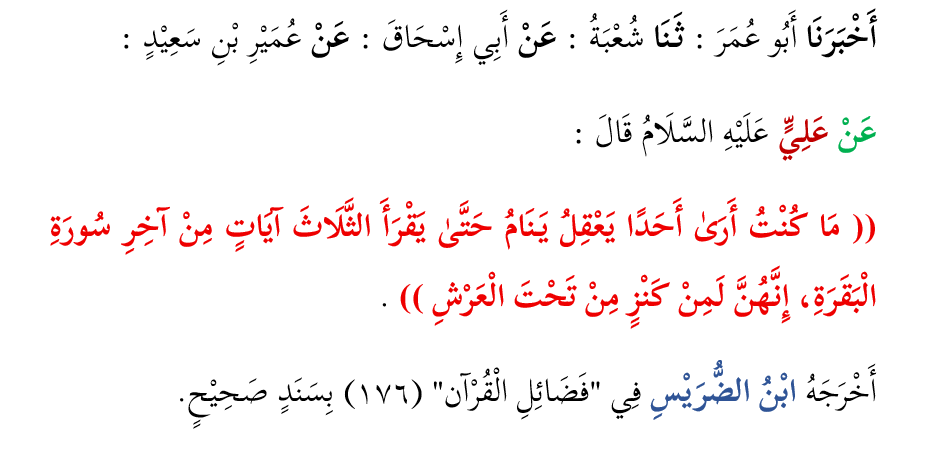
Reciting the Last Three Verses of Surah al-Baqarah at Bedtime

ʿAlī, peace be upon him, said,

I cannot imagine anyone of sound mind going to sleep before reciting the last three verses of Sūrah al-Baqarah; they are truly a treasure from beneath the Throne.”

Reported by Ibn al-Ḍurays in Faḍāʾil al-Qurʾān (176) with a sound chain.

It is also recorded by al-Dārimī (3427) and Ibn Abī Dāwūd in Sharīʿat al-Maghāzī as in Ibn Ḥajar’s Natāʾij al-Afkār (3: 90) with slight differences.

Ibn al-Ḍurays’s particular chain to ʿAlī, may Allāh be pleased with him, is sound. Here is the analysis of the chain along with a key to their biographical sources:

Key: AD = Sunan Abī Dāwūd, B = Ṣaḥīḥ al-Bukhārī, IḤT = al-Thiqāt of Ibn Ḥibbān, IḤṬM = Ibn Ḥajar’s Ṭabaqāt al-Mudallisīn, IM = Sunan Ibn Mājah, JTIAḤ = al-Jarḥ wa al-Taʿdīl of Ibn Abī Ḥātim, M = Ṣaḥīḥ Muslim, N = Sunan al-Nasāʾī, Siyar = Siyar Aʿlām al-Nubalāʾ of al-Dhahabī, TKB = al-Tārīkh al-Kabīr of al-Bukhārī, The Six = Ṣaḥīḥ al-Bukhārī, Ṣaḥīḥ Muslim, Sunan Abī Dāwūd, Sunan al-Tirmidhī, Sunan al-Nasāʾī, and Sunan Ibn Mājah, TK = Tahdhīb al-Kamāl of al-Mizzī, TQT = Taqrīb al-Tahdhīb of Ibn Ḥajar, TT = Tahdhīb al-Tahdhīb of Ibn Ḥajar, TTT = Taḥrīr Taqrīb al-Tahdhīb,

Ibn al-Ḍurays (d. 294): Abū ʿAbd Allāh Muḥammad b. Ayyūb b. Yaḥyá b. Ḍurays al-Bajalī, al-Rāzī, memoriser, traditionist, lived a long life (born around 200H), author of Faḍāʾil al-Qurʾān wa mā Unzila min al-Qurʾān bi Makkah wa mā Unzila bi al-Madīnah, audited by the ḥadīth master and rijāl critic Ibn Abī Ḥātim who declared him trustworthy and truthful, declared trustworthy by al-Dhahabī as well, and is included in al-Thiqāt by Ibn Ḥibbān, and he narrated from Abū ʿUmar Ḥafṣ b. ʿUmar. See: JTIAḤ (7: 198, no. 1114), IḤT (9: 152), and Siyar (13: 449, no. 222).

Abū ʿUmar (d. 225): Ḥafṣ b. ʿUmar b. al-Ḥārith b. Sakhbarah al-Azdī al-Namarī, Abū ʿUmar al-Ḥawḍī al-Baṣrī, from al-Namir b. Ghaymān or it is said the client of Banū ʿAdī, trustworthy, B-AD-N, audited by Muḥammad b. Ayyūb b. Yaḥyá b. al-Ḍurays al-Rāzī, as well as al-Bukhārī, Abū Dāwūd, Abū Zurʿah al-Rāzī, and Abū Ḥātim al-Rāzī, and he narrated from Shuʿbah b. al-Ḥajjāj (B-AD). Aḥmad said about him, “[He is] firm, firm, precise, precise, not a single word is held against him.” Ibn Abī Ḥātim said, “Truthful, precise, and ʿAlī b. al-Madīnī used to put him amongst the companions of Shuʿbah.” See: JTIAH (3: 182, no. 786) and TK (7: 27, no. 1397).

Shuʿbah (d. 160): b. al-Ḥajjāj b. al-Ward al-ʿAtakī al-Azdī, Abū Bisṭām al-Wāsiṭī, client of ʿAbdah b. al-Agharr, the client of Yazīd b. al-Muhallab b. Abī Ṣufrah,  leader of the believers in ḥadīth according to Sufyān al-Thawrī, leading rijāl critic, student of the famous tābiʿī al-Ḥasan al-Baṣrī (d. 110), vessel of knowledge, trustworthy, The Six, audited by Abū ʿUmar Ḥafṣ b. ʿUmar (B-AD), and narrated from Abū Isḥāq al-Sabīʿī. His narrations from al-Sabīʿī – who is a mudallis – are considered connected as he would only narrate from him that which al-Sabīʿī narrated with explicit direct audition. al-Bayhaqī reports in Maʿrifat al-Sunan wa al-Āthār (1: 152, no. 204) that Shuʿbah said, “I have sufficed you from the tadlīs of three: al-Aʿmash, Abū Ishāq, and Qatādah.”  See: JTIAḤ (5: 369, no. 1609), TK (12: 479, no. 2739), Siyar (7: 202, no. 80), TTT (2790).

Abū Isḥāq (d. 127): ʿAmr b. ʿAbd Allāh b. ʿUbayd/ʿAlī/Abū Shaʿīrah, al-Kūfī, tābiʿī, trustworthy, The Six, mudallis, Ibn Ḥajar places him in the third level of tadlīs practitioners whose reports are only accepted if he declares explicit direct audition, an exception is made if Shuʿbah narrates from him, as in this case. He narrated from ʿUmayr b. Saʿīd al-Nakhaʿī. See: TKB (4: 244, no. 2678), JTIAḤ (6: 242, no. 1347), TK (22: 102, 4400), and IḤṬM (p. 42, no. 91).

ʿUmayr b. Saʿīd (d. 107/115): al-Nakhaʿī al-Ṣuhbānī, Abū Yaḥyá al-Kūfī, tābiʿī, trustworthy, B-M-AD-IM, audited by Abū Isḥāq al-Sabīʿī, and narrated from ʿAlī b. Abī Ṭālib (B-M-AD-IM). See: JTIAḤ (6: 376, no. 2080), TK (22: 376, no. 4514), and TTT (5182).

ʿAlī (d. 40): b. Abī Ṭālib, Companion, fourth Rightly-Guided Caliph, audited by ʿUmayr b. Saʿīd al-Nakhaʿī (B-M-AD-IM). See: TK (20: 472, no. 4089).

As you can see, all of the transmitters are reliable and the chain is connected. The issue of Abū Isḥāq’s tadlīs is resolved by the fact Shuʿbah would only transmit from him when Abū Isḥāq declared explicit audition of his material.

Lastly: the report is marfūʿ ḥukman (raised to the Prophet ﷺ in ruling) because ʿAlī, may Allāh be pleased with him, mentions that which can only be established via revelation and not personal opinion. Consequently, he must have acquired this knowledge from the Prophet ﷺ himself as none of the Companions would say something like this via their own opinion.

Explicit evidence for it being raised to the Prophet ﷺ in ruling is indicated in a sound report recorded by Ibn Ḥibbān (6400) in which the Prophet ﷺ said, “I have been given superiority over people through three: the whole earth has been made a masjid for us and its dust has been made pure and purifying for us if we do not find water; our rows (in prayer) have been made like the rows of the angels; and I have been given these verses from the end of Sūrah al-Baqarah from a treasure underneath the Throne, the like of which has not been given to anyone before me nor after me.” It is included in Ṣaḥīḥ al-Jāmiʿ (4223) by al-Albānī.

And all praise is due to Allāh, and may the praise and protection of Allāh be upon His Messenger, his family, his Companions, and those who follow him until the Last Day.

Written by Salal Ahmed Haque (Abū Ḥayyān al-Atharī) on Yawm al-Arbiʿāʾ, 2nd Muḥarram 1448 or Wednesday, 17th June 2026.

Bibliography

al-Bukhārī, Muḥammad b. Ismāʿīl. Kitāb al-Tārīkh al-Kabīr, Supervised by Muḥammad ʿAbd al-Muʿīd Khān, eds. ʿAbd al-Raḥmān b. Yaḥyá al-Muʿallimī al-Yamānī, Hāshim al-Nadwī, Muḥammad Ṭāhā al-Nadwī, Muḥammad ʿĀdil al-Quddūsī, Ḥasan Jamāl al-Layl al-Madanī, and Abū al-Wafāʾ al-Afghānī. Hyderabad: Dāʾirat al-Maʿārif al-ʿUthmāniyyah (1360-1378/1941-1959). 10 vols.

al-Dārimī, Abū Muḥammad ʿAbd Allāh b. ʿAbd al-Raḥmān b. al-Faḍl b. Harām. Musnad al-Dārimī al-Maʿrūf bi Sunan al-Dārimī, ed. Ḥusayn Ṣalīm Asad al-Dārānī. al-Riyāḍ: Dār al-Mughnī (1420). 4 vols.

al-Dhahabī, Shams al-Dīn Muḥammad b. Aḥmad b. ʿUthmān al-Dhahabī. Siyar Aʿlām al-Nubalāʾ. Eds. Shuʿayb al-Arnāʾūṭ and Ḥusayn al-Asad. Beirut: Muʾassasat al-Risālah (1417/1996). 28 vols.

Ibn Abī Ḥātim, Abū Muḥammad ʿAbd al-Raḥmān. Kitāb al-Jarḥ wa al-Taʿdīl, ed. ʿAbd al-Raḥmān b. Yaḥyá al-Muʿallimī al-Yamānī. Hyderabad: Dāʾirat al-Maʿārif al-ʿUthmāniyyah (1371/1952). 9 vols.

Ibn Balbān, al-Amīr ʿAlāʾ al-Dīn ʿAlī al-Fārisī. Ṣaḥīḥ Ibn Ḥibbān bi Tartīb Ibn Balbān, ed. Shuʿayb al-Arnāʾūṭ, 1st edition. Damascus: al-Risālah al-ʿĀlamiyyah (1432/2011). 18 vols.

Ibn al-Ḍurays, Abū ʿAbd Allāh Muḥammad b. Ayyūb. Faḍāʾil al-Qurʾān wa mā Unzila min al-Qurʾān bi Makkah wa mā Unzila bi al-Madīnah, ed. ʿUrwah Budayr. Damascus: Dār al-Fikar (1408/1987).

Ibn Ḥajar, Aḥmad b. Muḥammad.

  • Natāʾij al-Afkār fī Takhrīj Aḥādīth al-Adhkār, ed. Ḥamdī ʿAbd al-Majīd al-Salafī, 2nd edition. 5 vols.
  • Taʿrīf Ahl al-Taqdīs bi Marātib al-Mawṣūfīn bi al-Tadlīs, ed. ʿĀṣim b. ʿAbd Allāh al-Qaryūtī. ʿAmmān: Maktabat al-Manār (1404). Damascus and Beirut: Dār Ibn Kathīr (1429/2008).

Ibn Ḥibbān, Muḥammad. Kitāb al-Thiqāt, Supervised by Muḥammad ʿAbd al-Muʿīd Khān. Hyderabad: Dāʾirat al-Maʿārif al-ʿUthmāniyyah (1393/1973). 9 vols.

Maʿrūf, Bashshār ʿAwwād and al-Arnāʾūṭ, Shuʿayb. Taḥrīr Taqrīb al-Tahdhīb li al-Ḥāfiẓ Aḥmad b. ʿAlī b. Ḥajar al-ʿAsqalānī. Beirut: Muʾassasat al-Risālah (1417/1997). 4 vols.

al-Mizzī, Jamāl al-Dīn Abū al-Ḥajjāj Yūsuf. Tahdhīb al-Kamāl fī Asmāʾ al-Rijāl, ed. Bashshār ʿAwwād Maʿrūf. Beirut: Muʾassasat al-Risālah (1403/1983). 35 vols.

Shkūkānī, Aḥmad Ismāʿīl and al-Laḥḥām, Ṣāliḥ ʿUthmān. Muʿjam Asāmī al-Ruwāh alladhīna Tarjama lahum al-ʿAllāmah Muḥammad Nāṣir al-Dīn al-Albānī Jarḥan wa Taʿdīlan. Beirut: Dār Ibn Ḥazm (1421/2000). 4 vols.

The Salaf and Their Parents

Abū Hurayrah (d. 59) saw two men and said to one of them, “Who is this to you?” He replied, “My father.” He said, “Do not call him by his name, do not walk in front of him, and do not sit before him.”

Abū Ḥāzim al-Ashjaʿī (c. 100) was a close companion of Abū Hurayrah and is said to have spent half a century with him. He said, “Abū Hurayrah did not perform Ḥajj until his mother passed away.”

ʿAbd Allāh b. ʿUmar (d. 74) saw a Yemenī man going around the Kaʿbah while carrying his mother on his back, saying, “I am her humble camel, if her mount is frightened, I am not frightened.” He then said, “O Ibn ʿUmar! Do you think that I have repaid her?” He replied, “No! Not even one groan!”

Ḥafṣah bt. Sīrīn (c. 100), the sister of Muḥammad b. Sīrīn (d. 110) said, “When Muḥammad would enter upon his mother, he would not speak to her with his whole tongue out of shyness towards her.”

Ibn ʿAwn (d. 151) said, “When Muḥammad b. Sīrīn (d. 110) would be in the presence of his mother, he would lower his voice and speak gently.”

Hishām b. Ḥassān said that someone from the family of Sīrīn said, “I never saw Muḥammad b. Sīrīn talking to his mother except while (he seemed) abased.” [Ḥilyah (2: 273)].

A man entered upon Muḥammad b. Sīrīn while he was in the presence of his mother, so he said, “What’s the matter with Muḥammad, is he suffering from something?” They said, “No, this is just how he is when he is in the presence of his mother.” [Ḥilyah (2: 273)].

Bundār (d. 252) said, “I wanted to go travelling (to seek ḥadīth) but my mother prevented me so I obeyed her, and I was blessed due to that.” Allāh blessed him by making him the teacher of the authors of The Six Books: al-Bukhārī, Muslim, Abū Dāwūd, al-Tirmidhī, al-Nasāʾī, and Ibn Mājah.

al-Ḥasan al-Baṣrī (d. 110) was asked about being righteous towards one’s parents and he said, “That you spend on them from what you possess, and you obey them as long as it does not involve sin.”

ʿAṭāʾ was asked about a man whose mother made him swear he would not pray except the obligatory and not fast except the month of Ramaḍān. He replied, “He should obey her.”

Iyās b. Muʿāwiyah (d. 122) cried when his mother passed away. He was asked, “What makes you cry?” He replied, “I used to have two doors to Paradise open for me, but one of them has been shut.”

al-Ashjaʿī (d. 182) said, “We were with Sufyān al-Thawrī (d. 161) when his son Saʿīd came and said, ‘Do you see him (meaning his father)? I have never been harsh with him; indeed, he would call me whilst I would be praying an optional prayer, and I would cut it for him.’”

A man said to al-Ḥasan al-Baṣrī (d. 110), “Indeed I performed Ḥajj (again) and my mother gave me permission for the pilgrimage.” He said, “Sitting with her at her dinner table is more beloved to me than your Ḥajj.”

A man said to ʿAlī b. al-Ḥusayn (d. 94), “You are the most righteous of people and yet we do not see you eat with your mother?” He said, “I fear my hand will go first to what her eyes had already reached, and thus I would be disobeying her.”

ʿUrwah b. al-Zubayr (d. 94) said, “He has not been dutiful to his parents the one who looks at them sharply.”

Manṣūr b. al-Muʿtamir (d. 132) said, “It used to be said that the mother is due three-fourths of kind treatment.” [Ḥilyah (5: 42)]

Saʿīd b. Jubayr (d. 95) said, “I was bitten by a scorpion, and my mother made me promise to seek ruqyah, so I gave the rāqī the hand which had not been bitten as I hated to break my promise to her.” He did this so he could be among the 70,000 who will enter Paradise without any account; one of their characteristics is that they do not seek ruqyah.

Ṭalq b. Ḥabīb (c. 100) used to help his mum with her chores.

Kahmas (d. 149) used to work in plastering every day for two small coins. When evening would come, he would buy fruits and take them to his mother.

ʿAwn b. ʿAbd Allāh reported that ʿAbd Allāh said, “Keep ties with those your father used to keep ties with, for indeed keeping ties with the deceased in his grave is that you keep ties with the one your father used to keep ties with.”

ʿAmr b. Maymūn b. Mihrān said, “I went out with my father guiding him through one of the streets of al-Baṣrah. We came across a streamlet and he was not able to cross it so I lay down and he walked over my back.” [ḤA (4: 82)].

ʿAbd Allāh b. ʿAwn said that his mother called him once, and he responded but raised his voice; he then freed two slaves. [Ḥilyah (3: 39)].

ʿAbd Allāh b. Yūsuf said that Abū ʿAbd Rabb used to buy slaves and free them. One day he bought an old female Roman slave and freed her. She said, “I don’t know where I’m going to stay.” So, he sent her to his house. When he departed from the masjid, he brought some dinner on the way, invited her to eat, and she ate. He then spoke to her and it turned out she was his mother! He immediately invited her to Islām but she refused. Despite that, from that point onwards, he was kind and dutiful to her to the highest degree. One day, when he returned from the ʿAṣr prayer on the Day of al-Jumuʿah, he was informed that his mother had accepted Islam, he fell down in prostration and stayed there until the sun set. [Ḥilyah (5: 160)].

Sources:

Min Akhbār al-Salaf al-Ṣāliḥ by Abū Yaḥyá Zakariyyā b. Ghulām Qādir, pp. 396-400.

al-Tahdhīb al-Mawḍūʿī li Ḥilyat al-Awliyāʾ li Abū Nuʿaym Aḥmad b. ʿAbd Allāh al-Aṣbahānī, prepared by Muḥammad b. ʿAbd Allāh b. Ṣāliḥ al-Habdān, pp. 151-153.

The Salaf and Night Prayer (Qiyam al-Layl)

al-Fuḍayl b. ʿIyāḍ (d. 187) said, “It was said: from the characteristics of the Prophets, the pure ones, and the chosen ones whose hearts are pure were three qualities: forbearance, deliberateness, and a share of the night prayer.” [ilyah (8: 95)].

Whenever ʿAbd Allāh b. ʿUmar (d. 74) would wake up at night, he would pray [ilyah (1: 304)].

ʿĀṣim b. Bahdalah (d. 127) said, “I reached a people who used to take this night as a provision, from them was Zirr b. Ḥubaysh (d. 83).”

Abū al-Zinād (d. 130) said, “I used to go out from the pre-dawn meal to the masjid of Allāh’s Messenger ﷺ, and I would not pass by a single house except there was someone reciting in it.”

ʿAmr b. Qays said, “I never raised my head up at night except that I saw Mūsá b. Abī ʿĀʾishah standing in prayer.”

Thābit al-Bunānī (d. 127) said, “There is nothing I find in my heart, more delightful to me, than praying at night.”

Sufyān al-Thawrī (d. 161) said, “Indeed I rejoice at the night when it comes”, and this was because of his great love for the night prayer.

ʿAmr b. Khālid al-Khuzāʿī (d. 229) said, “Hārūn b. Riʾāb al-Usayyidī used to stand the night in tahajjud, and when he would get up for tahajjud he would do so happily.”

al-Ḥasan al-Baṣrī (d. 110) was asked why those who prayed tahajjud had the most beautiful of faces. He replied, “Because they secluded themselves with the light of the Most Merciful in the darkness, so He covered them with a light from His light.”

Ibrāhīm, the son of Wakīʿ, said, “My father used to pray (the night prayer), so there would not remain anyone in our house except that he would pray, even a black slave-girl of ours.”

Ṣafwān b. Sulaym (d. 132) used to pray in his house during the summer, and when it would be winter, he would pray on the roof so as not to fall asleep.

ʿAbd al-ʿAzīz b. Abī Rawwād (d. 159) said, “When al-Mughīrah b. Ḥakīm al-Ṣanʿānī (d. 111/120) wanted to pray tahajjud, he would wear his best clothes and apply some perfume of his family – and he was from those who prayed tahajjud.”

The wife of Masrūq used to say, “By Allāh, Masrūq (d. 63) never woke up on a night except that his legs were swollen from standing (in prayer), and I used to sit behind him crying out of mercy for him, and when the night would become long for him and he would tire, he would pray sitting.”

Abū Isḥāq al-Sabīʿī (33-127) said, “Masrūq (d. 63) performed Ḥajj and did not sleep except whilst prostrating.”

ʿAbd Allāh b. Abī Mulaykah (d. 117) said, “I travelled with Ibn ʿAbbās (d. 68) from al-Madīnah to Makkah; he used to pray half of the night.”

Abū Isḥāq al-Sabīʿī (33-127) said, “My health has deteriorated, I have become frail, and my bones have become brittle, and today I stand in prayer and only recite al-Baqarah and Āl ʿImrān.”

ʿAbd Allāh b. ʿAlī b. Ḥamshādh said, “I do not know my father to have ever left out the night prayer.”

Qatādah (d. 118) said, “It used to be said, ‘Seldom does the hypocrite spend the night awake (in prayer).’”

al-Ḍaḥḥāk (c. 102) said, “I reached a people who felt ashamed before Allāh, with respect to the night, from sleeping a long time.”

One of the scholars used to pray before dawn but he slept through some nights. He saw a dream in which two men stood over him and one said to the other, “This man used to be amongst those who sought forgiveness before dawn.”

Abū Isḥāq al-Sabīʿī (33-127) used to say, “O gathering of young men, take advantage of your youth, rarely does a night pass me by except that I recite a thousand verses in it.”

Ibrāhīm b. Shammās (d. 220/221) said, “I knew Aḥmad b. Ḥanbal (d. 241) when he was a young boy and he would spend the night awake (in prayer).”

Muʿāwiyah b. Qurrah (d. 113) said, “We were with al-Ḥasan (d. 110) and we were discussing which deed was the best. They all agreed upon night prayer. I said, “Abandoning the prohibited.” al-Ḥasan noticed this and said, “The matter is settled, the matter is settled.” [Ḥilyah (2: 299)].

Ayyūb al-Sakhtiyānī (d. 131) would pray the whole night and conceal that, and then at dawn he would raise his voice as if he had just woken up at that hour. [Ḥilyah (3: 8)].

Wahb b. Munabbih (d. 110) said, “Through night prayer the lowly are honoured and the contemptible are exalted; and through the fasting of the day, the desires of a person are cut off; and there is no rest for the believer without entry into Paradise.”

Sources:

Min Akhbār al-Salaf al-Ṣāliḥ by Abū Yaḥyá Zakariyyā b. Ghulām Qādir, pp. 92-97.

al-Tahdhīb al-Mawḍūʿī li Ḥilyat al-Awliyāʾ li Abū Nuʿaym Aḥmad b. ʿAbd Allāh al-Aṣbahānī, prepared by Muḥammad b. ʿAbd Allāh b. Ṣāliḥ al-Habdān, pp. 664-669.

A related article: The Salaf and the Qur’an

The Breath of the People of the Fire

Anas b. Mālik, may Allāh be pleased with him, reported that the Prophet ﷺ said, “If there were 100,000 or more in this masjid, and among them was a man from the people of the Fire, and he were to breathe and his breath were to touch them: the masjid and those in it would be burnt.” Reported by Abū Yaʿlá.

Graded ṣaḥīḥ by al-Albānī in Ṣaḥīḥ al-Targhīb (3668).

And al-Bazzār narrated it with the wording:

“If there were 100,000 or more in the masjid, then a man from the people of the Fire were to breathe, he would have burnt them all.”

Graded ṣaḥīḥ li ghayrih by al-Albānī.

Why the Angel Mīkāʾīl Stopped Laughing

Anas b. Mālik, may Allāh be pleased with him, reported that the Messenger of Allāh ﷺ said to Jibrīl, “Why have I never seen Mīkāʾīl laughing?” He said, “Mīkāʾīl has not laughed since the Fire was created.” Reported by Aḥmad (13343).

Graded ḥasan li ghayrih by al-Albānī in Ṣaḥīḥ al-Targhīb (3664).

Give Charity to a Close Relative Who Has Enmity Towards You

Umm Kulthūm bt. ʿUqbah, may Allāh be pleased with her, reported that the Prophet ﷺ said, “The best charity is charity to a close relative who secretly harbours enmity.” Reported by al-Ṭabarānī in al-Kabīr.

Graded ṣaḥīḥ by al-Albānī in Ṣaḥīḥ al-Targhīb (894).

Ḥakīm b. Ḥizām, may Allāh be pleased with him, reported that a man asked the Messenger of Allāh ﷺ about charity and which form is the best. He said, “To the close relative who secretly harbours enmity.” Reported by Aḥmad and al-Ṭabarānī.

Graded ṣaḥīḥ li ghayrih by al-Albānī in Ṣaḥīḥ al-Targhīb (893).

Kicked in the Path of Knowledge

Aḥmad b. Manṣūr al-Ramādī (d. 265) said, “I went out with Aḥmad b. Ḥanbal (d. 241) and Yaḥyá b. Maʿīn (d. 233) to ʿAbd al-Razzāq (d. 211), as their servant.

When we returned to al-Kūfah, Yaḥyá b. Maʿīn said to Aḥmad b. Ḥanbal, “I want to test Abū Nuʿaym (d. 218/19).” Aḥmad said to him, “You don’t want to, the man is trustworthy.” Yaḥyá b. Maʿīn said, “No, I must.”  So he took a piece of paper and wrote 30 ḥadīths on it from the ḥadīths of Abū Nuʿaym, and he placed at the head of every ten traditions, a ḥadīth that was not from his ḥadīths.

They then came to Abū Nuʿaym and knocked on the door, so he came out and sat on a clay bench opposite his door. He took Aḥmad b. Ḥanbal and sat him on his right, and he took Yaḥyá b. Maʿīn and sat him on his left, then I sat below the bench.

Then Yaḥyá b. Maʿīn took out the sheet of paper and read ten ḥadīths to him while Abū Nuʿaym stayed silent. He then read the eleventh, and Abū Nuʿaym said, “This is not from my ḥadīth – cross it out.” He then read the second ten while Abū Nuʿaym stayed silent. Then he read the second ḥadīth and Abū Nuʿaym said, “This is not from my ḥadīth – cross it out.” Then he read the third ten and read the third ḥadīth, and Abū Nuʿaym changed and his eyes rolled backed. He turned to Yaḥyá b. Maʿīn and said, “As for this one – and Aḥmad b. Ḥanbal’s forearm was in his hand – he is too pious to do something like this, and as for this one – meaning me – he is too insignificant to do something like this, but this is your doing o doer!” He then took out his leg and kicked Yaḥyá b. Maʿīn, knocking him off the bench. He then got up and entered his house.

Aḥmad said to Yaḥyá, “Did I not forbid you from the man and tell you he was reliable?” he said, “By Allāh, his kicking me is dearer to me than my journey.”

Reported by al-Khaṭīb al-Baghdādī in Tārīkh Baghdād (14: 315-316) ed. Bashshār ʿAwwād Maʿrūf.

Mentioning a Deceased Person by Name and the Evil Deeds He Used to Do

Sh. ʿUthaymīn, may Allāh have mercy upon him, was asked about mentioning individuals by name, the evil deeds they used to do, and how Allāh dealt with them, and whether that falls under backbiting.

He, may Allāh have mercy upon him, replied:

“Yes, mentioning the dead with respect to their evil deeds was prohibited by the Messenger, upon him be praise and protection, for he said, ‘Do not speak badly of the dead, for they have reached the result of what they have sent forth.’ [al-Bukhārī (1329)]. Rather, pardon and forgiveness is sought from Allāh for them, it may be that his supplication is answered for them, thereby Allāh forgives them and pardons them. As for mentioning their evil deeds, then they are to be mentioned in an unspecified manner, so it is said, for example, in warning against interest, ‘Have you not seen people who violated the prohibitions of Allāh and they engaged in dealing with interest, then they departed from this worldly life and none of their wealth was buried with them, rather they left it behind for others, thus the spoil is for others and the loss is for them?’ and what is similar to that by which the living can take heed, as for mentioning him specifically, then this is not permissible.”

Fatāwá Nūr ʿalá al-Darb (12: 487, no. 6679).

How Many Times Should You Re-Read a Book?

It is mentioned by some that Imām ʿAbd al-ʿAzīz b. Bāz re-read Imām al-Nawawī’s explanation of Ṣaḥīḥ Muslim more than 60 times.

Source: al-Nawawī, Muḥyī al-Dīn Abī Zakariyyā Yaḥyá b. Sharaf. Minhāj al-Muḥaddithīn wa Sabīl Ṭālibīh al-Muḥaqqiqīn fī Sharḥ Ṣaḥīḥ Abī al-Ḥusayn Muslim b. al-Ḥajjāj al-Qushayrī, ed. Māzin b. Muḥammad al-Sirsāwī. Damascus: Dār al-Minhāj (1441/2020), v.1, p. 127.

From the Dreams of the Salaf – Hamzah al-Zayyaat (d. 156/8)

In the Musnad of Ibn al-Jaʿd (1: 275, no. 41) edited by ʿAbd al-Hādī, the following dream is mentioned:

ʿAlī b. Mus-hir said that he and Ḥamzah al-Zayyāt (d. 156/8) heard 500 or so traditions from Abān b. Abī ʿAyyāsh.

Ḥamzah told ʿAlī, “I saw the Prophet ﷺ in a dream and presented them to him; he did not recognise any of them except a few – five or six – aḥādīth, so I abandoned [taking] ḥadīth from him.”

Although transmitters and their reports are not graded based upon dreams, this particular dream was sound because the Imāms of Jarḥ and Taʿdīl (Accreditation and Impugnment), who investigated Abān’s reports, said the following regarding him:

Yaḥyá b. Maʿīn (d. 233) said, “Weak.”

He also said, “His ḥadīth are nothing.”

He also said, “Abān is abandoned in ḥadīth.”

Aḥmad b. Ḥanbal (d. 241) said, “Abān b. Abī ʿAyyāsh is abandoned in ḥadīth, people abandoned his ḥadīth from long ago. When Wakīʿ would come across his ḥadīth, he would say, ‘a man’ and not name him due to deeming him weak.”

Aḥmad b. Ḥumayd said he heard Aḥmad b. Ḥanbal say, “Nothing should be written from Abān b. Abī ʿAyyāsh.” Ibn Ḥumayd said, “Is he affected by innovation?” He replied, “He was rejected in ḥadīth.”

ʿAmr b. ʿAlī (d. 249) said, “Abandoned in ḥadīth, although he is a righteous man.”

He also said, “Yaḥyá [b. Maʿīn] and ʿAbd al-Raḥmān [b. Mahdī] would not narrate from him.”

al-Bukhārī (d. 256) said, “Shuʿbah (d. 160) used to think poorly of him.”

When Abū Zurʿah (d. 264) was asked whether Abān lied deliberately, he replied, “No, he used to hear ḥadīth from Anas [b. Mālik], Shahr [b. Ḥawshab], and al-Ḥasan [al-Baṣrī], and then not make a distinction between them.”

Abū Ḥātim al-Rāzī (d. 277) said, “Abandoned in ḥadīth, and he was a righteous man, however he was afflicted with a poor memory.”

al-Nasāʾī (d. 303) said, “Abandoned in ḥadīth.” He also said, “Unreliable, and his ḥadīth are not [to be] written down.”

See: Tahdhīb al-Kamāl of al-Mizzī (2: 19 onwards) ed. Bashshār ʿAwwād Maʿrūf.