The Salaf and Night Prayer (Qiyam al-Layl)

al-Fuḍayl b. ʿIyāḍ (d. 187) said, “It was said: from the characteristics of the Prophets, the pure ones, and the chosen ones whose hearts are pure were three qualities: forbearance, deliberateness, and a share of the night prayer.” [ilyah (8: 95)].

Whenever ʿAbd Allāh b. ʿUmar (d. 74) would wake up at night, he would pray [ilyah (1: 304)].

ʿĀṣim b. Bahdalah (d. 127) said, “I reached a people who used to take this night as a provision, from them was Zirr b. Ḥubaysh (d. 83).”

Abū al-Zinād (d. 130) said, “I used to go out from the pre-dawn meal to the masjid of Allāh’s Messenger ﷺ, and I would not pass by a single house except there was someone reciting in it.”

ʿAmr b. Qays said, “I never raised my head up at night except that I saw Mūsá b. Abī ʿĀʾishah standing in prayer.”

Thābit al-Bunānī (d. 127) said, “There is nothing I find in my heart, more delightful to me, than praying at night.”

Sufyān al-Thawrī (d. 161) said, “Indeed I rejoice at the night when it comes”, and this was because of his great love for the night prayer.

ʿAmr b. Khālid al-Khuzāʿī (d. 229) said, “Hārūn b. Riʾāb al-Usayyidī used to stand the night in tahajjud, and when he would get up for tahajjud he would do so happily.”

al-Ḥasan al-Baṣrī (d. 110) was asked why those who prayed tahajjud had the most beautiful of faces. He replied, “Because they secluded themselves with the light of the Most Merciful in the darkness, so He covered them with a light from His light.”

Ibrāhīm, the son of Wakīʿ, said, “My father used to pray (the night prayer), so there would not remain anyone in our house except that he would pray, even a black slave-girl of ours.”

Ṣafwān b. Sulaym (d. 132) used to pray in his house during the summer, and when it would be winter, he would pray on the roof so as not to fall asleep.

ʿAbd al-ʿAzīz b. Abī Rawwād (d. 159) said, “When al-Mughīrah b. Ḥakīm al-Ṣanʿānī (d. 111/120) wanted to pray tahajjud, he would wear his best clothes and apply some perfume of his family – and he was from those who prayed tahajjud.”

The wife of Masrūq used to say, “By Allāh, Masrūq (d. 63) never woke up on a night except that his legs were swollen from standing (in prayer), and I used to sit behind him crying out of mercy for him, and when the night would become long for him and he would tire, he would pray sitting.”

Abū Isḥāq al-Sabīʿī (33-127) said, “Masrūq (d. 63) performed Ḥajj and did not sleep except whilst prostrating.”

ʿAbd Allāh b. Abī Mulaykah (d. 117) said, “I travelled with Ibn ʿAbbās (d. 68) from al-Madīnah to Makkah; he used to pray half of the night.”

Abū Isḥāq al-Sabīʿī (33-127) said, “My health has deteriorated, I have become frail, and my bones have become brittle, and today I stand in prayer and only recite al-Baqarah and Āl ʿImrān.”

ʿAbd Allāh b. ʿAlī b. Ḥamshādh said, “I do not know my father to have ever left out the night prayer.”

Qatādah (d. 118) said, “It used to be said, ‘Seldom does the hypocrite spend the night awake (in prayer).’”

al-Ḍaḥḥāk (c. 102) said, “I reached a people who felt ashamed before Allāh, with respect to the night, from sleeping a long time.”

One of the scholars used to pray before dawn but he slept through some nights. He saw a dream in which two men stood over him and one said to the other, “This man used to be amongst those who sought forgiveness before dawn.”

Abū Isḥāq al-Sabīʿī (33-127) used to say, “O gathering of young men, take advantage of your youth, rarely does a night pass me by except that I recite a thousand verses in it.”

Ibrāhīm b. Shammās (d. 220/221) said, “I knew Aḥmad b. Ḥanbal (d. 241) when he was a young boy and he would spend the night awake (in prayer).”

Muʿāwiyah b. Qurrah (d. 113) said, “We were with al-Ḥasan (d. 110) and we were discussing which deed was the best. They all agreed upon night prayer. I said, “Abandoning the prohibited.” al-Ḥasan noticed this and said, “The matter is settled, the matter is settled.” [Ḥilyah (2: 299)].

Ayyūb al-Sakhtiyānī (d. 131) would pray the whole night and conceal that, and then at dawn he would raise his voice as if he had just woken up at that hour. [Ḥilyah (3: 8)].

Wahb b. Munabbih (d. 110) said, “Through night prayer the lowly are honoured and the contemptible are exalted; and through the fasting of the day, the desires of a person are cut off; and there is no rest for the believer without entry into Paradise.”

Sources:

Min Akhbār al-Salaf al-Ṣāliḥ by Abū Yaḥyá Zakariyyā b. Ghulām Qādir, pp. 92-97.

al-Tahdhīb al-Mawḍūʿī li Ḥilyat al-Awliyāʾ li Abū Nuʿaym Aḥmad b. ʿAbd Allāh al-Aṣbahānī, prepared by Muḥammad b. ʿAbd Allāh b. Ṣāliḥ al-Habdān, pp. 664-669.

A related article: The Salaf and the Qur’an
Kicked in the Path of Knowledge

Aḥmad b. Manṣūr al-Ramādī (d. 265) said, “I went out with Aḥmad b. Ḥanbal (d. 241) and Yaḥyá b. Maʿīn (d. 233) to ʿAbd al-Razzāq (d. 211), as their servant.

When we returned to al-Kūfah, Yaḥyá b. Maʿīn said to Aḥmad b. Ḥanbal, “I want to test Abū Nuʿaym (d. 218/19).” Aḥmad said to him, “You don’t want to, the man is trustworthy.” Yaḥyá b. Maʿīn said, “No, I must.”  So he took a piece of paper and wrote 30 ḥadīths on it from the ḥadīths of Abū Nuʿaym, and he placed at the head of every ten traditions, a ḥadīth that was not from his ḥadīths.

They then came to Abū Nuʿaym and knocked on the door, so he came out and sat on a clay bench opposite his door. He took Aḥmad b. Ḥanbal and sat him on his right, and he took Yaḥyá b. Maʿīn and sat him on his left, then I sat below the bench.

Then Yaḥyá b. Maʿīn took out the sheet of paper and read ten ḥadīths to him while Abū Nuʿaym stayed silent. He then read the eleventh, and Abū Nuʿaym said, “This is not from my ḥadīth – cross it out.” He then read the second ten while Abū Nuʿaym stayed silent. Then he read the second ḥadīth and Abū Nuʿaym said, “This is not from my ḥadīth – cross it out.” Then he read the third ten and read the third ḥadīth, and Abū Nuʿaym changed and his eyes rolled backed. He turned to Yaḥyá b. Maʿīn and said, “As for this one – and Aḥmad b. Ḥanbal’s forearm was in his hand – he is too pious to do something like this, and as for this one – meaning me – he is too insignificant to do something like this, but this is your doing o doer!” He then took out his leg and kicked Yaḥyá b. Maʿīn, knocking him off the bench. He then got up and entered his house.

Aḥmad said to Yaḥyá, “Did I not forbid you from the man and tell you he was reliable?” he said, “By Allāh, his kicking me is dearer to me than my journey.”

Reported by al-Khaṭīb al-Baghdādī in Tārīkh Baghdād (14: 315-316) ed. Bashshār ʿAwwād Maʿrūf.

From the Dreams of the Salaf – Hamzah al-Zayyaat (d. 156/8)

In the Musnad of Ibn al-Jaʿd (1: 275, no. 41) edited by ʿAbd al-Hādī, the following dream is mentioned:

ʿAlī b. Mus-hir said that he and Ḥamzah al-Zayyāt (d. 156/8) heard 500 or so traditions from Abān b. Abī ʿAyyāsh.

Ḥamzah told ʿAlī, “I saw the Prophet ﷺ in a dream and presented them to him; he did not recognise any of them except a few – five or six – aḥādīth, so I abandoned [taking] ḥadīth from him.”

Although transmitters and their reports are not graded based upon dreams, this particular dream was sound because the Imāms of Jarḥ and Taʿdīl (Accreditation and Impugnment), who investigated Abān’s reports, said the following regarding him:

Yaḥyá b. Maʿīn (d. 233) said, “Weak.”

He also said, “His ḥadīth are nothing.”

He also said, “Abān is abandoned in ḥadīth.”

Aḥmad b. Ḥanbal (d. 241) said, “Abān b. Abī ʿAyyāsh is abandoned in ḥadīth, people abandoned his ḥadīth from long ago. When Wakīʿ would come across his ḥadīth, he would say, ‘a man’ and not name him due to deeming him weak.”

Aḥmad b. Ḥumayd said he heard Aḥmad b. Ḥanbal say, “Nothing should be written from Abān b. Abī ʿAyyāsh.” Ibn Ḥumayd said, “Is he affected by innovation?” He replied, “He was rejected in ḥadīth.”

ʿAmr b. ʿAlī (d. 249) said, “Abandoned in ḥadīth, although he is a righteous man.”

He also said, “Yaḥyá [b. Maʿīn] and ʿAbd al-Raḥmān [b. Mahdī] would not narrate from him.”

al-Bukhārī (d. 256) said, “Shuʿbah (d. 160) used to think poorly of him.”

When Abū Zurʿah (d. 264) was asked whether Abān lied deliberately, he replied, “No, he used to hear ḥadīth from Anas [b. Mālik], Shahr [b. Ḥawshab], and al-Ḥasan [al-Baṣrī], and then not make a distinction between them.”

Abū Ḥātim al-Rāzī (d. 277) said, “Abandoned in ḥadīth, and he was a righteous man, however he was afflicted with a poor memory.”

al-Nasāʾī (d. 303) said, “Abandoned in ḥadīth.” He also said, “Unreliable, and his ḥadīth are not [to be] written down.”

See: Tahdhīb al-Kamāl of al-Mizzī (2: 19 onwards) ed. Bashshār ʿAwwād Maʿrūf.

Prohibition of Innovations

In the Name of Allāh, all praise is due to Allāh, may praise and protection be upon the Messenger of Allāh.

To proceed:

In this article I present some proofs indicating the prohibition of innovations in the Dīn of Islām. I also added some statements of the Salaf highlighting the pernicious effects of such innovations.

This article will be useful for refuting innovations: please feel free to use in your khuṭbahs, lectures, social media platforms etc.

Islām is Perfect and Complete

الْيَوْمَ أَكْمَلْتُ لَكُمْ دِيْنَكُمْ وَأَتْمَمْتُ عَلَيْكُمْ نِعْمَتِي وَرَضِيْتُ لَكُمُ الْإِسْلَامَ دِيْنًا [المائدة (٥) : ٣].

{This day I have perfected for you your religion, and completed My favour upon you, and have chosen Islām as your religion} [al-Māʾidah (5): 3].

عَنْ عَبْدِ اللهِ مَسْعُودٍ قَالَ : قَالَ رَسُولُ اللهِ ﷺ : إِنَّهُ لَيْسَ شَيْءٌ يُقَرِّبُكُمْ إِلَىٰ الْجَنَّةِ إِلَّا قَدْ أَمَرْتُكُمْ بِهِ، وَلَيْسَ شَيْءٌ يُقَرِّبُكُمْ إِلَىٰ النَّارِ إِلَّا قَدْ نَهَيْتُكُمْ عَنْهُ

ʿAbd Allāh b. Masʿūd (d. 32) reported that the Messenger of Allāh ﷺ said, “Indeed there is nothing which will bring you closer to Paradise except that I have command you with it, and there is nothing which will bring you closer to the Fire except that I have prohibited you from it.” reported by al-Ḥākim and others.

Ḥasan: Ibn Abī Shaybah (35473), al-Ḥākim in al-Mustadrak (2168) ed. Dār al-Taʾṣīl, al-Baghawī in Sharḥ al-Sunnah (4110) and (4111), al-Bayhaqī in Shuʿab al-Īmān (10376) and Abū Bakr al-Ḥaddād in al-Muntakhab min Fawāʾid Ibn ʿAlawayh al-Qaṭṭān. See: al-Ṣaḥīḥah (2866) of al-Albānī.

Additions to Islām Are Completely Rejected

عَنْ عَائِشَةَ قَالَتْ : قَالَ رَسُولُ اللهِ ﷺ : (( مَنْ أَحْدَثَ فِي أَمْرِنَا هٰذَا مَا لَيْسَ مِنْهُ فَهُوَ رَدٌّ )) . مُتَّفَقٌ عَلَيْهِ، وَاللَّفْظُ لِمُسْلِمٍ

ʿĀʾishah, may Allāh pleased with her, reported that the Messenger of Allāh ﷺ said, “Whoever innovates into this matter of ours that which is not from it, it is rejected.” Agreed upon, and the wording is that of Muslim.

al-Bukhārī (2697) and Muslim (1718 (17)).

عَنْ عَائِشَةَ : أَنَّ رَسُولَ اللهِ ﷺ قَالَ : (( مَنْ عَمِلَ عَمَلًا لَيْسَ عَلَيْهِ أَمْرُنَا فَهُوَ رَدٌّ )) . رَوَاهُ مُسْلِمٌ

She also reported that the Messenger of Allāh ﷺ said, “Whoever does a deed which is not in conformity with our affair, it is rejected.” Reported by Muslim.

Muslim (1718 (18)).

Innovations Imply the Prophet ﷺ Failed to Fulfil the Message

قَالَ ابْنُ مَاجِشُونَ : سَمِعْتُ مَالِكًا يَقُولُ : (( مَنِ ابْتَدَعَ فِي الْإِسْلَامِ بِدْعَةً يَرَاهَا حَسَنَةً؛ فَقَدْ زَعَمَ أَنَّ مُحَمَّدا ﷺ خَانَ الرِّسَالَةَ؛ لِأَنَّ اللهَ يَقُولُ : ﴿الْيَوْمَ أَكْمَلْتُ لَكُمْ دِيْنَكُمْ﴾، فَمَا لَمْ يَكُنْ يَوْمَئِذٍ دِيْنًا؛ فَلَا يَكُونُ الْيَوْمَ دِيْنًا ))

al-Shāṭibī (d. 790) mentions in al-Iʿtiṣām (1: 62, ed. Mashhūr Ḥasan) that Ibn al-Mājishūn (d. 164) reported that he heard Imām Mālik (d. 179) say,

“Whoever innovates an innovation into Islām, seeing it as something good, then he has claimed that Muḥammad betrayed the message because Allāh says {This day I have perfected for you your religion}, so that which was not religion on that day, then it is not religion today.”

No Such Thing as a Good Innovation

قَالَ رَسُولُ اللهِ ﷺ : (( وَكُلَّ بِدْعَةٍ ضَلَالَةٌ )) . رَوَاهُ أَبُو دَاوُدَ

The Prophet ﷺ said, in the famous ḥadīth of ʿIrbāḍ b. Sāriyah, “Every innovation is misguidance.” Reported by Abū Dāwūd.

Ṣaḥīḥ: Abū Dāwūd (4607).

قَالَ عَبْدُ اللهِ بْنُ عُمَرَ : (( كُلُّ بِدْعَةٍ ضَلَالَةٌ وَإِنْ رَآهَا النَّاسُ حَسَنَةً )) . أَخْرَجَهُ اللَّالِكَائِيُّ وَغَيْرُهُ

ʿAbd Allāh b. ʿUmar said, “Every innovation is misguidance even if people see it to be good.” Reported by al-Lālikāʾī.

al-Lālikāʾī in Sharḥ Iʿtiqād Ahl al-Sunnah wa al-Jamāʿah (126), ed. al-Dumayjī.

عَنْ [سَعِيْدِ] بْنِ الْمُسَيِّبِ : أَنَّهُ رَأَىٰ رَجُلاً يُكْثِرُ الرُّكُوعَ بَعْدَ طُلُوعِ الْفَجْرِ فَنَهَاهُ ، فَقَالَ : يَا أَبَا مُحَمَّدٍ! أَيُعَذِّبُنِي اللهُ عَلَىٰ الصَّلَاةِ؟ قَالَ : (( لَا، وَلٰكِنْ يُعَذِّبُكَ عَلَىٰ خِلَافِ السُّنَّةِ )) . رَوَاهُ عَبْدُ الرَّزَّاقِ

One of the Imāms of the Tābiʿīn, Saʿīd b. al-Musayyib (d. 94), saw a man praying multiple units after the time of Fajr had entered. He prohibited him from doing so as one is only permitted to pray the two recommended units of Fajr before the obligatory prayer. The man turned around to him and said, “O Abū Muḥammad, will Allāh punish me for praying?” Saʿīd b. al-Musayyib replied, “No, but He will punish you for opposing the Sunnah!” Reported by ʿAbd al-Razzāq in his Muṣannaf (4807) ed. Dār al-Taʾṣīl.

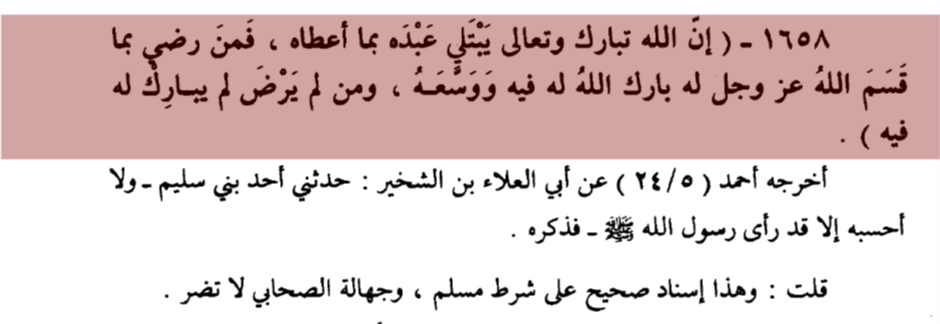
1658 – Gratitude Begets Blessings

1658 – Gratitude Begets Blessings

حَدَّثَنَا إِسْمَاعِيْلُ : عَنْ يُونُسَ : حَدَّثَنِي أَبُو الْعَلَاءِ بْنُ الشِّخِّيْرِ : حَدَّثَنِي أَحَدُ بَنِي سُلَيْمٍ – وَلَا أَحْسَبُهُ إِلَّا قَدْ رَأَىٰ رَسُولَ اللهِ ﷺ – قَالَ : قَالَ رَسُولُ اللهِ ﷺ : (( إِنَّ اللهَ يَبْتَلِي عَبْدَهُ بِمَا أَعْطَاهُ، فَمَنْ رَضِيَ بِمَا قَسَمَ اللهُ لَهُ، بَارَكَ اللهُ لَهُ فِيْهِ وَوَسَّعَهُ، وَمَنْ لَمْ يَرْضَ لَمْ يُبَارِكْ لَهُ )) . رَوَاهُ أَحْمَدُ.

Ismāʿīl narrated to us: from Yūnus: Abū al-ʿAlāʾ b. al-Shikhkhīr narrated to me: one of Banū Sulaym narrated to me – and I do not think except that he saw the Messenger of Allāh ﷺ – he said, “The Messenger of Allāh ﷺ said:

‘Indeed Allāh tests His slave with what He gave him, so whoever is pleased with what Allāh has apportioned him, Allāh blesses him therein and expands it, and whoever is not pleased, He does not bless him.”’

Reported by Aḥmad.

Ṣaḥīḥ: Aḥmad (5: 24) or (20279). See: al-Ṣaḥīḥah (1658) of al-Albānī wherein he says, “This is an authentic chain upon the condition of Muslims, and the anonymity of a Companion does no harm.”

Notes:

Everything you have in your life was divinely decreed for you by Allāh the All-Wise and All-Just before you were even born. The test lies in whether you will be pleased with Allāh’s Decree or be dissatisfied with it.

One who is pleased and content with what Allāh has divinely decreed for him, deserves to be blessed by Him, and increased in that because he submitted to His Lord’s decision.

One who is displeased and discontent with what Allāh has divinely decreed for him deserves to be left unblessed. It is as though such a person is angry with Allāh for not having apportioned for him more than he has been given. Thus, he is deserving of being deprived of blessings because he sees himself as deserving of more than what was decreed for him, and it is as if he objects to Allāh’s Wisdom.

This is a disease found mainly amongst materialistic individuals. Such people look down on what they have been apportioned by Allāh and consider it to be little. They look at what others have been given and consider it to be more and greater. Consequently, they constantly strive to increase their material lot, and squander their life and waste away their strength, and are beset with worry, anxiety, and fatigue. They blacken their scroll of deeds with their many sins due to becoming engrossed in their pursuit to acquire more of the dunyá, which they feel they deserve. What they do not realise is that they will only obtain what Allāh has decreed for them and no more, no matter how much they strive.

So, contentment of the heart is the key to success in this regard. Once a slave realises Allāh is All-Wise, All-Just, The Most Generous, and that He does not oppress anyone, the heart finds peace with every decree of His. The slave becomes more appreciate of what he has and strives to be grateful to his Lord for His immense generosity and kindness. He realises he does not deserve any of blessings he has been given and so feels deeply indebted to his Lord. Such a slave of Allāh does not feel entitled – he feels that his Lord is entitled to every atom of gratitude he can muster for His kindness.

See: Fayḍ al-Qadīr Sharḥ al-Jāmiʿ al-Ṣaghīr by al-Munāwī, DKI edition, ḥadīth number: 1843.

Does Fasting the Day of ‘Arafah or the Day of ‘Ashura’ Expiate Major Sins?

The Prophet ﷺ said fasting the Day of ʿArafah results in the expiation of sins of the year that has passed, and the year that is to come. He ﷺ also said that fasting the Day of ʿĀshūrāʾ results in the expiation of the sins of the year that has passed [Muslim (1162 (197))].

Does this expiation of sins include major and minor sins, or just minor sins?

Sh. Muḥammad b. Ṣāliḥ al-ʿUthaymīn رَحِمَهُ اللهُ explains that the apparent meaning of the ḥadīth indicates the expiation of both major and minor sins. This is because the Prophet ﷺ mentioned it in an unqualified manner and did not elaborate further, and whatever the Prophet ﷺ left unrestricted, it is taken to be unrestricted. This is why some scholars took the view, that the expiation of sins, refers to both minor and major because the Prophet ﷺ left it unrestricted, and did not elaborate further.

Most of the scholars take the view the expiation is only of minor sins. As for major sins then they must be accompanied with repentance. They support their view by arguing that fasting the Day of ʿArafah is not superior to the five daily prayers or Jumuʿah or Ramaḍān, and the Prophet ﷺ said, “The five daily prayers, Jumuʿah to Jumuʿah, and Ramaḍān to Ramaḍān, expiate what is between them as long as the major sins are avoided.” [Muslim (233)]. They say if these great and noble acts of worship, which are from the pillars of Islām, are not strong enough to expiate major sins, then this even more the case with this optional day of fasting. This is the weightier view – that it is qualified, just as the five daily prayers and Ramaḍān to Ramaḍān are qualified.

Source: Sharḥ Bulūgh al-Marām (7: 356).

A Word on the Virtue of Fasting the Day of ‘Ashura’ by Sh. Muhammad b. Salih al-‘Uthaymin

In the Name of Allāh, the Most Merciful, the Giver of Special Mercy

All praise is due to Allāh the Most High and Most Great, the One Who is alone in creating and controlling, the One Who honoured His friends with His help, and humiliated His enemies through His forsaking [of them], so how excellent a Protector is our Lord, and how excellent a Helper is He.

I testify that there is none worthy of worship except Allāh alone without any partners, to Him belong the Kingdom and praise, and He is, over all thing, completely capable. And I bear witness that Muḥammad is His slave and His Messenger; the bringer of glad tidings, the warner, and shining lantern, may the praise and protection of Allāh be upon him, his family, his Companions, and those who follow them in excellence until the Day of Recompense.

To proceed:

Indeed, in this month, the month of Muḥarram, was the salvation of Mūsá, may praise and protection be upon him, and his people from the enemy of Allāh – Pharaoh and his army. By Allāh it was a major blessing obligating gratitude towards Allāh the Almighty and Majestic. This is why, when the Prophet ﷺ arrived in al-Madīnah, and he found the Jews fasting the tenth day of this month, the Prophet ﷺ said, “I have more right to Mūsá than you”, thus he fasted it and commanded its fasting. He was asked about the virtue of fasting it and he said, “I hope in Allāh that it may expiate for (the sins of) the year that came before it.” After that he commanded contradicting the Jews by fasting the tenth and a day before it which is the ninth, or a day after it which is the eleventh.

Consequently, it is best to fast the tenth day and add to it a day before it, or a day after it. Adding the ninth day to it is better than the eleventh.

Thus, it is necessary for you, my Muslim brother, to fast the Day of ʿĀshūrāʾ, likewise the ninth day, in order to actualise contradicting the Jews which the Messenger of Allāh ﷺ commanded.

May Allāh facilitate success for me and you to be grateful for His blessings, and worship Him with excellence, and may He protect us from the evils of our souls through His care – indeed He is the Most Generous and Most Bountiful.

I have no objections to spreading it (i.e., this letter).

Written by Muḥammad al-Ṣāliḥ al-ʿUthaymīn 21/12/1409.

Source: Majmūʿ al-Fatā (20: 39-40).

0004 Riyad al-Salihin: The Reward of One Who is Prevented by Illness or Another Excuse

And in a narration: “except that they shared the reward with you.”

Reported by Muslim (1911).

Sh. Muḥammad b. Ṣāliḥ al-ʿUthaymīn رحمه الله makes the following points, regarding this ḥadīth, in his explanation of Riyāḍ al-Ṣāliḥīn (1: 36-38):

The word ghazāh and ghazwah mean the same thing, i.e., military expedition.

If a person intends to do a righteous deed, however he is prevented by an obstacle, he will have recorded for him, the reward of what he intended.

If he used to do a good deed when he was capable of doing it, then he became incapable afterwards, he will have the reward of the complete deed recorded for him, because the Prophet ﷺ said, “If a slave becomes ill, or he travels, he will have recorded for him the like of what he used to do when resident and healthy” [al-Bukhārī (2996)].

The one who wishes for good and is keen on it, if doing that good deed was his habit, but then he was prevented by an obstacle from doing it, he will have the complete rewarded recorded for him.

Examples:

(1) If it was the habit of the person to pray in congregation in the masjid, and he was then prevented from attending due to sleep or illness etc, he will have the complete reward of having prayed in congregation without any deduction.

(2) If it was his habit to pray optional prayers, but he was then prevented by something making him unable to pray them, he will have the complete reward written for him.

(3) If it was his habit to fast three days out of every month, then he was incapable of that and was prevented by something, he will have the complete reward recorded for him.

There are many other examples like this.

If it was not his habit to do that good deed, he will have the reward of the intention written for him but not the reward of the action.

The proof for this is the ḥadīth in which the poor Companions mentioned to the Prophet ﷺ about how the rich Companions had gone ahead of them in terms of charity and freeing slaves. The Prophet ﷺ taught them to do tasbīḥ, takbīr and taḥmīd 33 times each after every obligatory prayer, and that if they did that, none would equal them, except one who does the same. The rich heard about this and began doing this good deed as well! The poor Companions went back to the Prophet ﷺ and said that their rich brothers were doing the same as them. The Prophet ﷺ replied, “This is the grace of Allāh, He gives it to whom He wishes.” He did not say that you have achieved the reward of their deed, but there is no doubt that they will have the reward for the intention of the deed [al-Bukhārī (843)].

This is why the Prophet ﷺ said regarding the one to whom Allāh gave wealth, and he spends it in the paths of goodness, and there is a poor man who sees this and says, ‘If I had the money of so-and-so I would have done the same deed’; the Prophet ﷺ said regarding this person, “He has his intention, so their rewards are the same.” [al-Tirmidhī (2325)]. Meaning: the same in the reward of the intention, as for the deed itself, its reward is not recorded for him, unless it was something he used to do habitually.

This ḥadīth contains an indication that whoever goes out in the path of Allāh in a military expedition, he will be rewarded for his walking, this is why the Prophet ﷺ said, “…you have not covered any distance nor crossed any valley but they are with you…”.

This is indicated by Allāh’s statement: {It was not [proper] for the people of Madīnah and those surrounding them of the Bedouins that they remain behind after [the departure of] the Messenger of Allāh or that they prefer themselves over his self. That is because they are not afflicted by thirst or fatigue or hunger in the cause of Allāh, nor do they tread on any ground that enrages the disbelievers, nor do they inflict upon an enemy any infliction but that it is registered for them as a righteous deed. Indeed, Allāh does not allow to be lost the reward of the doers of good. Nor do they spend an expenditure, small or large, or cross a valley but that it is registered for them that Allāh may reward them for the best of what they were doing.} [al-Tawbah (9): 120-121].

What is similar to this is when a man performs well ablution at home, and then goes out to the masjid – not being brought out of his house except for prayer – then indeed there is no step that he takes except that Allāh raises him one level by it, and removes one sin by it.

This is from the grace of Allāh, the Almighty and Majestic, that the means of deeds contain this reward which the Prophet ﷺ has explained to us.

And Allāh is the facilitator of success.

Does the Qurʾān Tell the Jews and the Christians to Follow Their Own Books?

I have heard Christians cite the following words from Sūrah al-Māʾidah, verse number 68, to argue that the Qurʾān tells them to follow their own book:

قُلْ يَـٰٓأَهْلَ ٱلْكِتَـٰبِ لَسْتُمْ عَلَىٰ شَىْءٍ حَتَّىٰ تُقِيمُوا۟ ٱلتَّوْرَىٰةَ وَٱلْإِنجِيل

{Say [O Prophet], “O People of the Book! You have nothing to stand on unless you observe the Torah, the Gospel…”}

This is only a part of the verse.

The full verse is as follows:

قُلْ يَـٰٓأَهْلَ ٱلْكِتَـٰبِ لَسْتُمْ عَلَىٰ شَىْءٍ حَتَّىٰ تُقِيمُوا۟ ٱلتَّوْرَىٰةَ وَٱلْإِنجِيلَ وَمَآ أُنزِلَ إِلَيْكُم مِّن رَّبِّكُمْ ۗ وَلَيَزِيدَنَّ كَثِيرًۭا مِّنْهُم مَّآ أُنزِلَ إِلَيْكَ مِن رَّبِّكَ طُغْيَـٰنًۭا وَكُفْرًۭا ۖ فَلَا تَأْسَ عَلَى ٱلْقَوْمِ ٱلْكَـٰفِرِينَ ۝٦٨

{Say [O Prophet], “O People of the Book! You have nothing to stand on unless you observe the Torah, the Gospel, and what has been revealed to you from your Lord [i.e., the Qurʾān].” And that which has been revealed to you [O Prophet] from your Lord will surely increase many of them in transgression and disbelief. So do not grieve over the disbelieving people.}

They leave out the part which mentions the Qurʾān because it does not support their claim.

In explanation of this verse, al-Ṭabarī (d. 310) states, “This is a command from Allāh, exalted be His mention, to His Prophet Muḥammad ﷺ to convey to the Jews and Christians who were in the midst of his place of emigration, [that] He, exalted be His mention, says to him {Say!} O Muḥammad to these Jews and Christians, {O People of the Book}; the Torah and the Gospel, {You have nothing to stand on} from that which you claim to stand on from what Mūsá came to you with O community of Jews, nor what ʿĪsá came to you with O community of Christians, {unless you observe the Torah, the Gospel, and what has been revealed to you from your Lord} from that which Muḥammad ﷺ came to you with from The Criterion (al-Furqān), acting on all of that, having faith in what it contains in terms of faith in Muḥammad ﷺ and believing in his truthfulness, and affirming that all of that is from Allāh, so do not disbelieve in any of it, and do not distinguish between the Messengers of Allāh thereby believing a part and disbelieving in a part, for indeed disbelieving in a part of that is disbelief in all of it, because the Books of Allāh confirm the truthfulness of each other, so whoever disbelieves in one of them has disbelieved in all of them.” [8: 572, ed. al-Turkī].

Lesson: whenever your opponent quotes something, do not take his word for it – look at the original source and read it yourself to ensure he has cited it accurately.

I ask Allāh to aid us over those who seek to cast doubt into the hearts of the believers.

816 – Salam Before Kalam

(( السَّلَامُ قَبْلَ السُّؤَالِ؛ فَمَنْ بَدَأَكُمْ بِالسُّؤَالِ قَبْلَ السَّلَامِ فَلَا تُجِيْبُوهُ ))

“Greeting with salām comes before asking a question; so, whoever begins with the question before greeting with salām, do not answer him.”

Source of the Ḥadīth

This ḥadīth is recorded by Ibn ʿAdī in al-Kāmil (2: 303) via al-Sarī b. ʿĀṣim who narrated to us: Ḥafṣ b. ʿUmar al-Aylī who narrated to us: ʿAbd al-ʿAzīz b. Abī Rawwād narrated to us: from Nāfiʿ: from Ibn ʿUmar who said: “The Messenger of Allāh ﷺ said…” then he mentioned it.

Ibn Abī Rawwād

Ibn ʿAdī mentions this ḥadīth in the biography of Ibn Abī Rawwād, and says regarding him, “And in some of his transmissions [there is] that which is not followed up.”

al-Albānī says that this is soft impugnment of him, and that a group have declared him reliable, and Muslim utilised him as proof. So, if the chain did not contain other than him, it would have been good.

Ḥafṣ b. ʿUmar

However, al-Albānī notes, the defect lies in those lower than him, for indeed, Ibn ʿAdī said regarding Ḥafṣ b. ʿUmar: “His traditions – all of them – are rejected either in the text or the chain, and he is closer to weakness.”

Abū Ḥātim said, “He was a lying shaykh.”

al-Sarī b. ʿĀṣim

And al-Sarī b. ʿĀṣim was declared feeble by Ibn ʿAdī, and he said, “He steals traditions.”

Ibn Khirāsh declared him a liar.

al-Dhahabī cited some of his rejected traditions and said, “Indeed they are from his trials and afflictions.”

After citing these criticisms of al-Sarī, al-Albānī states that it would have been closer to correctness for Ibn ʿAdī to have cited the ḥadīth in the biography of one of them instead of including it in the biography of Ibn Abī Rawwād.

He then opines that perhaps Ibn ʿAdī only mentioned it in the biography of Ibn Abī Rawwād because the ḥadīth is recognised due to him.

Other Routes

Others, besides these two (Ḥafṣ b. ʿUmar and al-Sarī b. ʿĀṣim) have reported it from him:

Ibn Abī Ḥātim states in al-ʿIlal (2: 331): “Abū Zurʿah was asked about the ḥadīth reported by Abū Taqī who said: Baqiyyah narrated to me and said: ʿAbd al-ʿAzīz b. Abī Rawwād narrated to me with it…then he mentioned it with the wording, “Do not initiate speech before extending salām, thus, whoever begins with speech before extending salām – do not answer him.” Abū Zurʿah said, ‘This ḥadīth does not have any basis; Baqiyyah did not hear this ḥadīth from ʿAbd al-ʿAzīz – it is only from the people of Ḥimṣ, and the people of Ḥimṣ do not differentiate this [i.e., the mode of audition being ambiguous or explicit].”

al-Albānī notes that Abū Taqī’s name is Hishām b. ʿAbd al-Malik, and that Abū Nuʿaym reports it via him in his Ḥilyat al-Awliyāʾ (8: 199) and says at the end: “[It is] strange (gharīb); from the ḥadīth of ʿAbd al-ʿAzīz, we did not write it except from the ḥadīth of Baqiyyah.”

al-Albānī then states that Abū Nuʿaym’s report does not contain explicit audition, but that it does in another transmission recorded by Ibn al-Sunnī in his ʿAmal al-Yawm wa al-Laylah (210). The chain is: al-ʿAbbās b. Aḥmad al-Ḥimṣī informed us: Kathīr b. ʿUbayd narrated to us: Baqiyyah b. al-Walīd narrated to us: Ibn Abī Rawwād narrated to us in an abridged form with the wording:

“Whoever begins with speech before extending salām, then do not answer him.”

Kathīr b. ʿUbayd, al-Albānī says, is Ḥimṣī and reliable, and that he finds it difficult to agree with Abū Zurʿah that the mere fact he is Ḥimṣī – while being reliable – would necessitate him not making a distinction between Baqiyyah saying “from” (ambiguous audition) and “he narrated to us” (explicit audition)! This is the reason why al-Albānī remarks that he holds the view that the ḥadīth with this chain is, at a minimum, the level of ḥasan.

With regards to al-ʿAbbās b. Aḥmad al-Ḥimṣī, al-Albānī states that Ibn ʿAsākir included a biographical entry for him in his Tārīkh (8: 444: 21), but did not mention any validation or impugnment of him, although a group has narrated from him.

I (Salal) say: the point of al-Albānī mentioning that a group has narrated from him is to indicate that al-ʿAbbās is not an unknown narrator. One can also add to this, the fact that, Ibn Ḥibbān includes al-ʿAbbās in his Ṣaḥīḥ which is an indication of his validation of him. However, due to Ibn Ḥibbān’s leniency in validating transmitters, we would need to find another leading transmitter-critic, who grades this al-ʿAbbās reliable as well, in order for any validation of him to be accepted.

al-Albānī then goes on to mention other routes via which this report is transmitted via Nāfiʿ, however, he states that they are all weak.

Firstly: al-Ṭabarānī records in his al-Awsaṭ via Hārūn b. Muḥammad Abū al-Ṭayyib: from ʿAbd Allāh al-ʿUmarī. al-Haythamī (8: 32) states, “Hārūn b. Muḥammad is an inveterate liar.” According to al-Albānī, when Abū Zurʿah said that this ḥadīth has no basis, he was referring to this particular iteration of the report.

Secondly: al-Silafī records it in al-Ṭuyuriyyāt (manuscript, 1: 252) via al-Wāqidī. This al-Wāqidī, the Shaykh says, is accused of lying, and his name is Muḥammad b. ʿUmar b. Wāqid al-Aslamī.

In Summary

I (Salal) say: what is apparent from the above is that al-Albānī grades the ḥadīth ḥasan due to the following:

[1] Ibn Abī Ḥātim’s report in his al-ʿIlal: the only issue Abū Zurʿah had with the chain was Abū Ṭaqī stating that Baqiyyah reported the ḥadīth with explicit audition, which indicates he did not have an issue with the rest of the chain. al-Albānī disagrees with Abū Zurʿah’s view regarding the people of Ḥimṣ not differentiating between ambiguous and explicit forms of audition. Baqiyyah is mudallis and would do tadlīs via unknown and weak transmitters which is why Ibn Ḥajar includes him amongst the tadlīs practitioners whose reports are only accepted if they state explicit audition. See his Taʿrīf Ahl al-Taqdīs bi Marātib al-Mawṣūfīn bi al-Tadlīs, pages 14 and 49, ed. Dr. ʿĀṣim al-Qaryūtī.

[2] Abū Nuʿaym’s report in al-Ḥilyah: this chain does not contain explicit audition from Baqiyyah. But this is remedied by:

[3] Ibn al-Sunnī’s report which does contain explicit audition from Baqiyyah. The only issue is al-ʿAbbās b. Aḥmad al-Ḥimṣī who is ungraded. This is remedied by the above two chains which all indicate a fair basis for this report.

    The Shaykh did not base the authenticity of the ḥadīth on the extremely weak chains from:

    1. Ibn ʿAdī in al-Kāmil: two of its narrators are extremely weak (al-Sarī b. ʿĀṣim and Ḥafṣ b. ʿUmar al-Aylī).
    2. al-Ṭabarānī’s report in al-Awsa as it contains a liar (Hārūn b. Muḥammad).
    3. al-Silafī’s report: it also contains a liar (al-Wāqidī).

    Further Notes

    • This ḥadīth indicates giving salām is obligatory.
    • Imām al-Albānī held the opinion it is obligatory to extend the greeting of salām: https://www.youtube.com/watch?v=wriEWtZoSDA
    • The opinion that it is obligatory is also indicated by the ḥadīth, “The right of a Muslim over another Muslim are 6…when you meet him extend the greeting of salām to him…” Reported by Muslim (2162).