al-Bayhaqī reported via Yaʿlá b. Shaddād: from his father that he said, “During the time of the Prophet ﷺ, we used to consider showing-off as minor polytheism.”
Graded ṣaḥīḥ by al-Albānī in Ṣaḥīḥ al-Targhīb (35).
al-Albānī states in the footnote, “And al-Ḥākim also narrated it (4: 329) and said ‘Ṣaḥīḥ’, and al-Dhahabī agreed with him, and it is as they both said. If the author had referenced it to him, it would have been more appropriate.”
I (Salal) say: al-Ḥākim (d. 405) was the teacher of al-Bayhaqī (d. 458), thus the former should have been referenced over the latter.
Abū al-Dardāʾ reported from the Prophet ﷺ that he said, “The world is cursed; cursed is what is in it, except that by which the Face of Allāh is sought.” Reported by al-Ṭabarānī.
Graded ḥasan li ghayrih by al-Albānī in Ṣaḥīḥ al-Targhīb (9). See: al-Ṣaḥīḥah (2797).
Anas b. Mālik, may Allāh be pleased with him, reported that the Prophet ﷺ said, “If there were 100,000 or more in this masjid, and among them was a man from the people of the Fire, and he were to breathe and his breath were to touch them: the masjid and those in it would be burnt.” Reported by Abū Yaʿlá.
Graded ṣaḥīḥ by al-Albānī in Ṣaḥīḥ al-Targhīb (3668).
And al-Bazzār narrated it with the wording:
“If there were 100,000 or more in the masjid, then a man from the people of the Fire were to breathe, he would have burnt them all.”
Anas b. Mālik, may Allāh be pleased with him, reported that the Messenger of Allāh ﷺ said to Jibrīl, “Why have I never seen Mīkāʾīl laughing?” He said, “Mīkāʾīl has not laughed since the Fire was created.” Reported by Aḥmad (13343).
Graded ḥasan li ghayrih by al-Albānī in Ṣaḥīḥ al-Targhīb (3664).
Umm Kulthūm bt. ʿUqbah, may Allāh be pleased with her, reported that the Prophet ﷺ said, “The best charity is charity to a close relative who secretly harbours enmity.” Reported by al-Ṭabarānī in al-Kabīr.
Graded ṣaḥīḥ by al-Albānī in Ṣaḥīḥ al-Targhīb (894).
Ḥakīm b. Ḥizām, may Allāh be pleased with him, reported that a man asked the Messenger of Allāh ﷺ about charity and which form is the best. He said, “To the close relative who secretly harbours enmity.” Reported by Aḥmad and al-Ṭabarānī.
Graded ṣaḥīḥ li ghayrih by al-Albānī in Ṣaḥīḥ al-Targhīb (893).
In the Name of Allāh, all praise is due to Allāh, may praise and protection be upon the Messenger of Allāh.
To proceed:
In this article I present some proofs indicating the prohibition of innovations in the Dīn of Islām. I also added some statements of the Salaf highlighting the pernicious effects of such innovations.
This article will be useful for refuting innovations: please feel free to use in your khuṭbahs, lectures, social media platforms etc.
ʿAbd Allāh b. Masʿūd (d. 32) reported that the Messenger of Allāh ﷺ said, “Indeed there is nothing which will bring you closer to Paradise except that I have command you with it, and there is nothing which will bring you closer to the Fire except that I have prohibited you from it.” reported by al-Ḥākim and others.
Ḥasan: Ibn Abī Shaybah (35473), al-Ḥākim in al-Mustadrak (2168) ed. Dār al-Taʾṣīl, al-Baghawī in Sharḥ al-Sunnah (4110) and (4111), al-Bayhaqī in Shuʿab al-Īmān (10376) and Abū Bakr al-Ḥaddād in al-Muntakhab min Fawāʾid Ibn ʿAlawayh al-Qaṭṭān. See: al-Ṣaḥīḥah (2866) of al-Albānī.
ʿĀʾishah, may Allāh pleased with her, reported that the Messenger of Allāh ﷺ said, “Whoever innovates into this matter of ours that which is not from it, it is rejected.” Agreed upon, and the wording is that of Muslim.
She also reported that the Messenger of Allāh ﷺ said, “Whoever does a deed which is not in conformity with our affair, it is rejected.” Reported by Muslim.
Muslim (1718 (18)).
Innovations Imply the Prophet ﷺ Failed to Fulfil the Message
al-Shāṭibī (d. 790) mentions in al-Iʿtiṣām (1: 62, ed. Mashhūr Ḥasan) that Ibn al-Mājishūn (d. 164) reported that he heard Imām Mālik (d. 179) say,
“Whoever innovates an innovation into Islām, seeing it as something good, then he has claimed that Muḥammad betrayed the message because Allāh says {This day I have perfected for you your religion}, so that which was not religion on that day, then it is not religion today.”
One of the Imāms of the Tābiʿīn, Saʿīd b. al-Musayyib (d. 94), saw a man praying multiple units after the time of Fajr had entered. He prohibited him from doing so as one is only permitted to pray the two recommended units of Fajr before the obligatory prayer. The man turned around to him and said, “O Abū Muḥammad, will Allāh punish me for praying?” Saʿīd b. al-Musayyib replied, “No, but He will punish you for opposing the Sunnah!” Reported by ʿAbd al-Razzāq in his Muṣannaf (4807) ed. Dār al-Taʾṣīl.
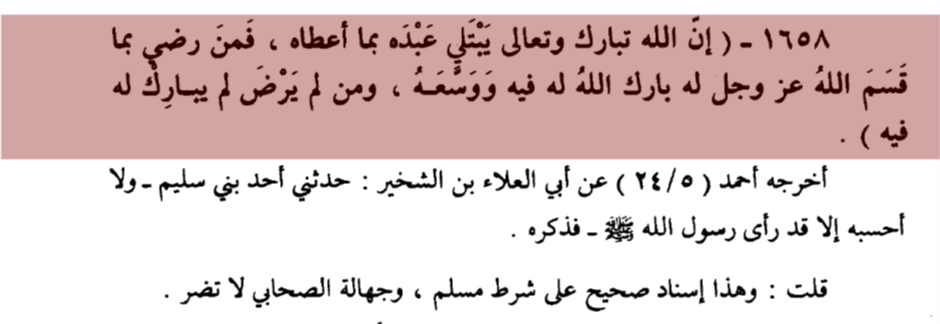
Ismāʿīl narrated to us: from Yūnus: Abū al-ʿAlāʾ b. al-Shikhkhīr narrated to me: one of Banū Sulaym narrated to me – and I do not think except that he saw the Messenger of Allāh ﷺ – he said, “The Messenger of Allāh ﷺ said:
‘Indeed Allāh tests His slave with what He gave him, so whoever is pleased with what Allāh has apportioned him, Allāh blesses him therein and expands it, and whoever is not pleased, He does not bless him.”’
Reported by Aḥmad.
Ṣaḥīḥ: Aḥmad (5: 24) or (20279). See: al-Ṣaḥīḥah (1658) of al-Albānī wherein he says, “This is an authentic chain upon the condition of Muslims, and the anonymity of a Companion does no harm.”
Notes:
Everything you have in your life was divinely decreed for you by Allāh the All-Wise and All-Just before you were even born. The test lies in whether you will be pleased with Allāh’s Decree or be dissatisfied with it.
One who is pleased and content with what Allāh has divinely decreed for him, deserves to be blessed by Him, and increased in that because he submitted to His Lord’s decision.
One who is displeased and discontent with what Allāh has divinely decreed for him deserves to be left unblessed. It is as though such a person is angry with Allāh for not having apportioned for him more than he has been given. Thus, he is deserving of being deprived of blessings because he sees himself as deserving of more than what was decreed for him, and it is as if he objects to Allāh’s Wisdom.
This is a disease found mainly amongst materialistic individuals. Such people look down on what they have been apportioned by Allāh and consider it to be little. They look at what others have been given and consider it to be more and greater. Consequently, they constantly strive to increase their material lot, and squander their life and waste away their strength, and are beset with worry, anxiety, and fatigue. They blacken their scroll of deeds with their many sins due to becoming engrossed in their pursuit to acquire more of the dunyá, which they feel they deserve. What they do not realise is that they will only obtain what Allāh has decreed for them and no more, no matter how much they strive.
So, contentment of the heart is the key to success in this regard. Once a slave realises Allāh is All-Wise, All-Just, The Most Generous, and that He does not oppress anyone, the heart finds peace with every decree of His. The slave becomes more appreciate of what he has and strives to be grateful to his Lord for His immense generosity and kindness. He realises he does not deserve any of blessings he has been given and so feels deeply indebted to his Lord. Such a slave of Allāh does not feel entitled – he feels that his Lord is entitled to every atom of gratitude he can muster for His kindness.
See: Fayḍ al-Qadīr Sharḥ al-Jāmiʿ al-Ṣaghīr by al-Munāwī, DKI edition, ḥadīth number: 1843.
“Greeting with salām comes before asking a question; so, whoever begins with the question before greeting with salām, do not answer him.”
Source of the Ḥadīth
This ḥadīth is recorded by Ibn ʿAdī in al-Kāmil (2: 303) via al-Sarī b. ʿĀṣim who narrated to us: Ḥafṣ b. ʿUmar al-Aylī who narrated to us: ʿAbd al-ʿAzīz b. Abī Rawwād narrated to us: from Nāfiʿ: from Ibn ʿUmar who said: “The Messenger of Allāh ﷺ said…” then he mentioned it.
Ibn Abī Rawwād
Ibn ʿAdī mentions this ḥadīth in the biography of Ibn Abī Rawwād, and says regarding him, “And in some of his transmissions [there is] that which is not followed up.”
al-Albānī says that this is soft impugnment of him, and that a group have declared him reliable, and Muslim utilised him as proof. So, if the chain did not contain other than him, it would have been good.
Ḥafṣ b. ʿUmar
However, al-Albānī notes, the defect lies in those lower than him, for indeed, Ibn ʿAdī said regarding Ḥafṣ b. ʿUmar: “His traditions – all of them – are rejected either in the text or the chain, and he is closer to weakness.”
Abū Ḥātim said, “He was a lying shaykh.”
al-Sarī b. ʿĀṣim
And al-Sarī b. ʿĀṣim was declared feeble by Ibn ʿAdī, and he said, “He steals traditions.”
Ibn Khirāsh declared him a liar.
al-Dhahabī cited some of his rejected traditions and said, “Indeed they are from his trials and afflictions.”
After citing these criticisms of al-Sarī, al-Albānī states that it would have been closer to correctness for Ibn ʿAdī to have cited the ḥadīth in the biography of one of them instead of including it in the biography of Ibn Abī Rawwād.
He then opines that perhaps Ibn ʿAdī only mentioned it in the biography of Ibn Abī Rawwād because the ḥadīth is recognised due to him.
Other Routes
Others, besides these two (Ḥafṣ b. ʿUmar and al-Sarī b. ʿĀṣim) have reported it from him:
Ibn Abī Ḥātim states in al-ʿIlal (2: 331): “Abū Zurʿah was asked about the ḥadīth reported by Abū Taqī who said: Baqiyyah narrated to me and said: ʿAbd al-ʿAzīz b. Abī Rawwād narrated to me with it…then he mentioned it with the wording, “Do not initiate speech before extending salām, thus, whoever begins with speech before extending salām – do not answer him.” Abū Zurʿah said, ‘This ḥadīth does not have any basis; Baqiyyah did not hear this ḥadīth from ʿAbd al-ʿAzīz – it is only from the people of Ḥimṣ, and the people of Ḥimṣ do not differentiate this [i.e., the mode of audition being ambiguous or explicit].”
al-Albānī notes that Abū Taqī’s name is Hishām b. ʿAbd al-Malik, and that Abū Nuʿaym reports it via him in his Ḥilyat al-Awliyāʾ (8: 199) and says at the end: “[It is] strange (gharīb); from the ḥadīth of ʿAbd al-ʿAzīz, we did not write it except from the ḥadīth of Baqiyyah.”
al-Albānī then states that Abū Nuʿaym’s report does not contain explicit audition, but that it does in another transmission recorded by Ibn al-Sunnī in his ʿAmal al-Yawm wa al-Laylah (210). The chain is: al-ʿAbbās b. Aḥmad al-Ḥimṣī informed us: Kathīr b. ʿUbayd narrated to us: Baqiyyah b. al-Walīd narrated to us: Ibn Abī Rawwād narrated to us in an abridged form with the wording:
“Whoever begins with speech before extending salām, then do not answer him.”
Kathīr b. ʿUbayd, al-Albānī says, is Ḥimṣī and reliable, and that he finds it difficult to agree with Abū Zurʿah that the mere fact he is Ḥimṣī – while being reliable – would necessitate him not making a distinction between Baqiyyah saying “from” (ambiguous audition) and “he narrated to us” (explicit audition)! This is the reason why al-Albānī remarks that he holds the view that the ḥadīth with this chain is, at a minimum, the level of ḥasan.
With regards to al-ʿAbbās b. Aḥmad al-Ḥimṣī, al-Albānī states that Ibn ʿAsākir included a biographical entry for him in his Tārīkh (8: 444: 21), but did not mention any validation or impugnment of him, although a group has narrated from him.
I (Salal) say: the point of al-Albānī mentioning that a group has narrated from him is to indicate that al-ʿAbbās is not an unknown narrator. One can also add to this, the fact that, Ibn Ḥibbān includes al-ʿAbbās in his Ṣaḥīḥ which is an indication of his validation of him. However, due to Ibn Ḥibbān’s leniency in validating transmitters, we would need to find another leading transmitter-critic, who grades this al-ʿAbbās reliable as well, in order for any validation of him to be accepted.
al-Albānī then goes on to mention other routes via which this report is transmitted via Nāfiʿ, however, he states that they are all weak.
Firstly: al-Ṭabarānī records in his al-Awsaṭ via Hārūn b. Muḥammad Abū al-Ṭayyib: from ʿAbd Allāh al-ʿUmarī. al-Haythamī (8: 32) states, “Hārūn b. Muḥammad is an inveterate liar.” According to al-Albānī, when Abū Zurʿah said that this ḥadīth has no basis, he was referring to this particular iteration of the report.
Secondly: al-Silafī records it in al-Ṭuyuriyyāt (manuscript, 1: 252) via al-Wāqidī. This al-Wāqidī, the Shaykh says, is accused of lying, and his name is Muḥammad b. ʿUmar b. Wāqid al-Aslamī.
In Summary
I (Salal) say: what is apparent from the above is that al-Albānī grades the ḥadīth ḥasan due to the following:
[1] Ibn Abī Ḥātim’s report in his al-ʿIlal: the only issue Abū Zurʿah had with the chain was Abū Ṭaqī stating that Baqiyyah reported the ḥadīth with explicit audition, which indicates he did not have an issue with the rest of the chain. al-Albānī disagrees with Abū Zurʿah’s view regarding the people of Ḥimṣ not differentiating between ambiguous and explicit forms of audition. Baqiyyah is mudallis and would do tadlīs via unknown and weak transmitters which is why Ibn Ḥajar includes him amongst the tadlīs practitioners whose reports are only accepted if they state explicit audition. See his Taʿrīf Ahl al-Taqdīs bi Marātib al-Mawṣūfīn bi al-Tadlīs, pages 14 and 49, ed. Dr. ʿĀṣim al-Qaryūtī.
[2] Abū Nuʿaym’s report in al-Ḥilyah: this chain does not contain explicit audition from Baqiyyah. But this is remedied by:
[3] Ibn al-Sunnī’s report which does contain explicit audition from Baqiyyah. The only issue is al-ʿAbbās b. Aḥmad al-Ḥimṣī who is ungraded. This is remedied by the above two chains which all indicate a fair basis for this report.
The Shaykh did not base the authenticity of the ḥadīth on the extremely weak chains from:
Ibn ʿAdī in al-Kāmil: two of its narrators are extremely weak (al-Sarī b. ʿĀṣim and Ḥafṣ b. ʿUmar al-Aylī).
al-Ṭabarānī’s report in al-Awsaṭ as it contains a liar (Hārūn b. Muḥammad).
al-Silafī’s report: it also contains a liar (al-Wāqidī).
The opinion that it is obligatory is also indicated by the ḥadīth, “The right of a Muslim over another Muslim are 6…when you meet him extend the greeting of salām to him…” Reported by Muslim (2162).

 Salafi Knowledge