Riyāʾ (Showing-Off) is Minor Polytheism

al-Bayhaqī reported via Yaʿlá b. Shaddād: from his father that he said, “During the time of the Prophet , we used to consider showing-off as minor polytheism.”

Graded ṣaḥīḥ by al-Albānī in Ṣaḥīḥ al-Targhīb (35).

al-Albānī states in the footnote, “And al-Ḥākim also narrated it (4: 329) and said ‘Ṣaḥīḥ’, and al-Dhahabī agreed with him, and it is as they both said. If the author had referenced it to him, it would have been more appropriate.”

I (Salal) say: al-Ḥākim (d. 405) was the teacher of al-Bayhaqī (d. 458), thus the former should have been referenced over the latter.

See: al-Ḥākim (8151) ed. Dār al-Taʾṣīl..
The Dunyá is Cursed Except Sincere Actions

Abū al-Dardāʾ reported from the Prophet ﷺ that he said, “The world is cursed; cursed is what is in it, except that by which the Face of Allāh is sought.” Reported by al-Ṭabarānī.

Graded ḥasan li ghayrih by al-Albānī in Ṣaḥīḥ al-Targhīb (9). See: al-Ṣaḥīḥah (2797).

The Breath of the People of the Fire

Anas b. Mālik, may Allāh be pleased with him, reported that the Prophet ﷺ said, “If there were 100,000 or more in this masjid, and among them was a man from the people of the Fire, and he were to breathe and his breath were to touch them: the masjid and those in it would be burnt.” Reported by Abū Yaʿlá.

Graded ṣaḥīḥ by al-Albānī in Ṣaḥīḥ al-Targhīb (3668).

And al-Bazzār narrated it with the wording:

“If there were 100,000 or more in the masjid, then a man from the people of the Fire were to breathe, he would have burnt them all.”

Graded ṣaḥīḥ li ghayrih by al-Albānī.

Why the Angel Mīkāʾīl Stopped Laughing

Anas b. Mālik, may Allāh be pleased with him, reported that the Messenger of Allāh ﷺ said to Jibrīl, “Why have I never seen Mīkāʾīl laughing?” He said, “Mīkāʾīl has not laughed since the Fire was created.” Reported by Aḥmad (13343).

Graded ḥasan li ghayrih by al-Albānī in Ṣaḥīḥ al-Targhīb (3664).

Give Charity to a Close Relative Who Has Enmity Towards You

Umm Kulthūm bt. ʿUqbah, may Allāh be pleased with her, reported that the Prophet ﷺ said, “The best charity is charity to a close relative who secretly harbours enmity.” Reported by al-Ṭabarānī in al-Kabīr.

Graded ṣaḥīḥ by al-Albānī in Ṣaḥīḥ al-Targhīb (894).

Ḥakīm b. Ḥizām, may Allāh be pleased with him, reported that a man asked the Messenger of Allāh ﷺ about charity and which form is the best. He said, “To the close relative who secretly harbours enmity.” Reported by Aḥmad and al-Ṭabarānī.

Graded ṣaḥīḥ li ghayrih by al-Albānī in Ṣaḥīḥ al-Targhīb (893).

41 Moderation in Sunnah is Better than Striving in Bidʿah

ʿAbd Allāh b. Masʿūd, may Allāh be pleased with him, said, “Moderation in the Sunnah is better than striving in innovation.” Reported by al-Ḥākim.

Ṣaḥīḥ Mawqūf: al-Ḥākim (357), Ibn Baṭṭah in al-Ibānah (201), and al-Marwazī in al-Sunnah (p. 30).

Bedtime

Sūrah al-Kāfirūn

It is recommended for one to recite Sūrah al-Kāfirūn before going to sleep. The proof is:

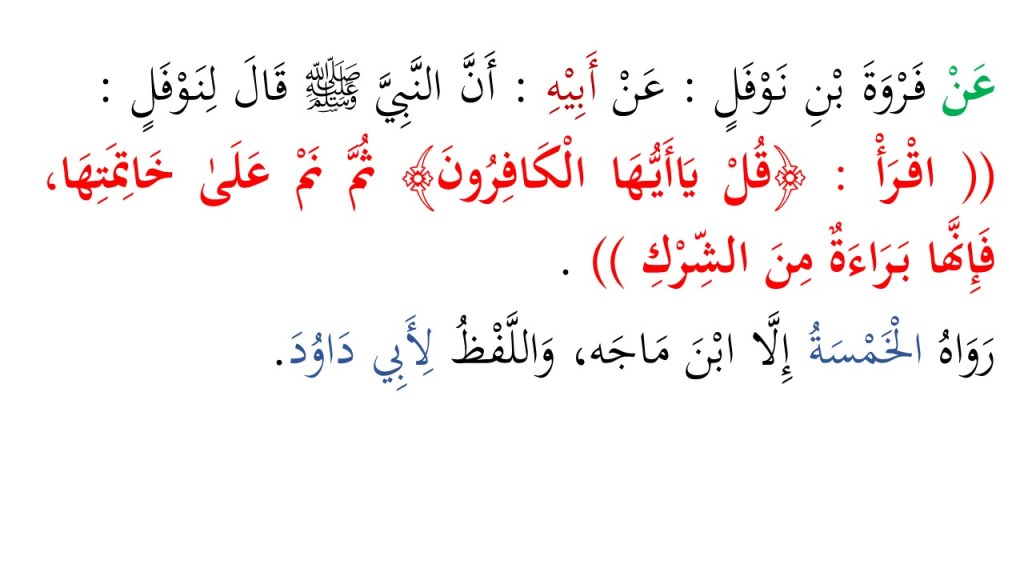
On the authority of Farwah b. Nawfal, [who narrated] from his father: that the Prophet, may the praise and protection of Allāh be upon him, said to Nawfal:

“Read {Say: O you disbelievers!}, then go to sleep at the end of it, for indeed it is a complete disavowal of polytheism.”

Reported by the Five except for Ibn Mājah, and the wording is that of Abū Dāwūd.

Source: Abū Dāwūd (5055), al-Tirmidhī (3403), al-Nasāʾī in al-Kubrá (10569) and (11645), Aḥmad (23807) and Ṣaḥīḥ al-Targhīb (605) by al-Albānī.

Marketplace

Upon entering the marketplace, it is recommended for one to read the following supplication [in green]:

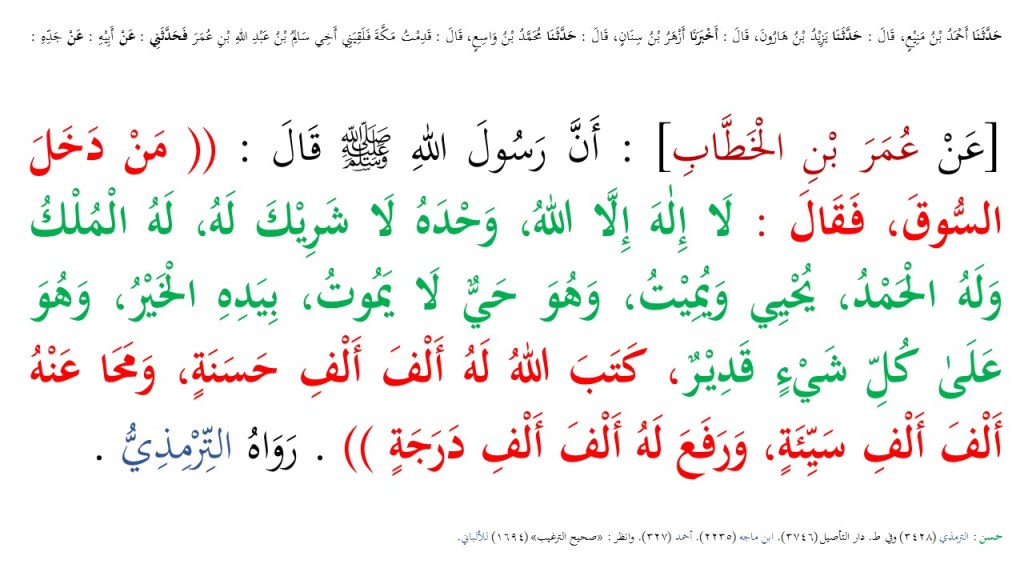
On the authority of ʿUmar b. al-Khaṭṭāb [who narrated] that the Messenger of Allāh, may the praise and protection of Allāh be upon him, said:

“Whoever enters the marketplace and says, ‘There is none worthy of worship except Allāh alone without any partners, to Him belongs the dominion and to Him belongs all praise, He gives life and causes death, He is the All-Living and does not die, in His Hand is all goodness, and He has power over all things’, Allāh will write a million good deeds for him, and wipe a million evil deeds away from him, and raise a million ranks for him.”

Reported by al-Tirmidhī.

Ḥasan: al-Tirmidhī (3428) and in the Dār al-Taʾṣīl edition (3746). Ibn Mājah (2235). Aḥmad (327). See: Ṣaḥīḥ al-Targhīb wa al-Tarhīb (1694) of al-Albānī.