Does Fasting the Day of ‘Arafah or the Day of ‘Ashura’ Expiate Major Sins?

The Prophet ﷺ said fasting the Day of ʿArafah results in the expiation of sins of the year that has passed, and the year that is to come. He ﷺ also said that fasting the Day of ʿĀshūrāʾ results in the expiation of the sins of the year that has passed [Muslim (1162 (197))].

Does this expiation of sins include major and minor sins, or just minor sins?

Sh. Muḥammad b. Ṣāliḥ al-ʿUthaymīn رَحِمَهُ اللهُ explains that the apparent meaning of the ḥadīth indicates the expiation of both major and minor sins. This is because the Prophet ﷺ mentioned it in an unqualified manner and did not elaborate further, and whatever the Prophet ﷺ left unrestricted, it is taken to be unrestricted. This is why some scholars took the view, that the expiation of sins, refers to both minor and major because the Prophet ﷺ left it unrestricted, and did not elaborate further.

Most of the scholars take the view the expiation is only of minor sins. As for major sins then they must be accompanied with repentance. They support their view by arguing that fasting the Day of ʿArafah is not superior to the five daily prayers or Jumuʿah or Ramaḍān, and the Prophet ﷺ said, “The five daily prayers, Jumuʿah to Jumuʿah, and Ramaḍān to Ramaḍān, expiate what is between them as long as the major sins are avoided.” [Muslim (233)]. They say if these great and noble acts of worship, which are from the pillars of Islām, are not strong enough to expiate major sins, then this even more the case with this optional day of fasting. This is the weightier view – that it is qualified, just as the five daily prayers and Ramaḍān to Ramaḍān are qualified.

Source: Sharḥ Bulūgh al-Marām (7: 356).

Is the Punishment of the Grave Lightened for the Deceased During Ramaḍān?

Sh. al-Albānī (رحمه الله) was asked whether during the month of Ramaḍān, the punishment of the grave is lightened for the deceased:

“We do not have any clarification on this. Allāh knows best.”

The interjector then says, “The gates of the Fire are closed?”

The Shaykh replied:

“Yes, but this does not mean the punishment is lightened for the deceased; this requires a proof-text.”

Source: Jāmiʿ Turāth al-ʿAllāmah al-Albānī fī al-Fiqh (10: 117).

Should the Mu’adhin Break His Fast First, or Give the Adhan First?

Sh. al-Albānī (رَحِمَهُ اللهُ) was asked whether the prayer-caller (الْمُؤَذِّنُ) should break his fast first, or give the adhān first. The Shaykh replied that he does share such an intricately meticulous outlook on this issue. Whichever of the two the prayer-caller decides to do is permissible.

He was then asked whether the fasting person can continue to fast after the time has ended. He replied that just as it is permissible to give the adhān in the beginning of the time, it is also permissible for him to break his fast in the beginning of the time. So, whether he does it first, or afterwards, the Shaykh does not have a preference for one over the other for him to say that one should break his fast first and then give the adhān, or for him to say one should give the adhān first and then break his fast.

Source: Jāmiʿ Turāth al-ʿAllāmah al-Albānī fī al-Fiqh (10: 199).

Breaking Your Fast – Do You Eat First, or Pray First?

Anas b. Mālik reported from the Prophet ﷺ that he said:

If the iqāmah for prayer is given while one of you is fasting, let him begin with the evening meal before the Maghrib prayer, and do not rush from your evening meal.”

Sh. al-Albānī (رَحِمَهُ اللهُ) mentions that the addition “while one of you is fasting” does not negate other narrations which omit these words because the versions without these additional words are still absolute in any case, thereby encompassing the one who is fasting, and the one who is not. Rather, the fasting person is more deserving of this concession than the non-fasting person, as is obvious.

Source: Jāmiʿ Turāth al-ʿAllāmah al-Albānī fī al-Fiqh (10: 177). See: al-Ṣaḥīḥah (3964).

Are Good Deeds and Bad Deeds Multiplied During Ramadan? Sh. al-Albani (may Allah have mercy upon him)

Sh. al-Albānī (رحمه الله) was asked whether optional deeds, in a general sense, are multiplied, and also evil deeds. He replied:

“There is no explicit scriptural-text (نَصٌّ) in the Divine Law stating that good deeds are multiplied, and likewise evil deeds with respect to the virtue of [a particular] place, or virtue of [a particular] time…virtue of a place such as Makkah or al-Madīnah for example…or virtue of a time such as this month of ours, this month of Ramaḍān.

There is no explicit scriptural-text regarding good deeds or evil ones being multiplied. However, some scholars say, by way of deduction (اسْتِنْبَاطًا), that they are multiplied…by way of deduction i.e., not [based on] a scriptural-text but only independent reasoning (اجْتِهَادًا), so if a person says: “good deeds are multiplied”, there is no harm in that because it is the view of some scholars, however it is not permissible to be definitive in that regard.”

Source: Jāmiʿ Turāth al-ʿAllāmah al-Albānī fī al-Fiqh (10: 109).

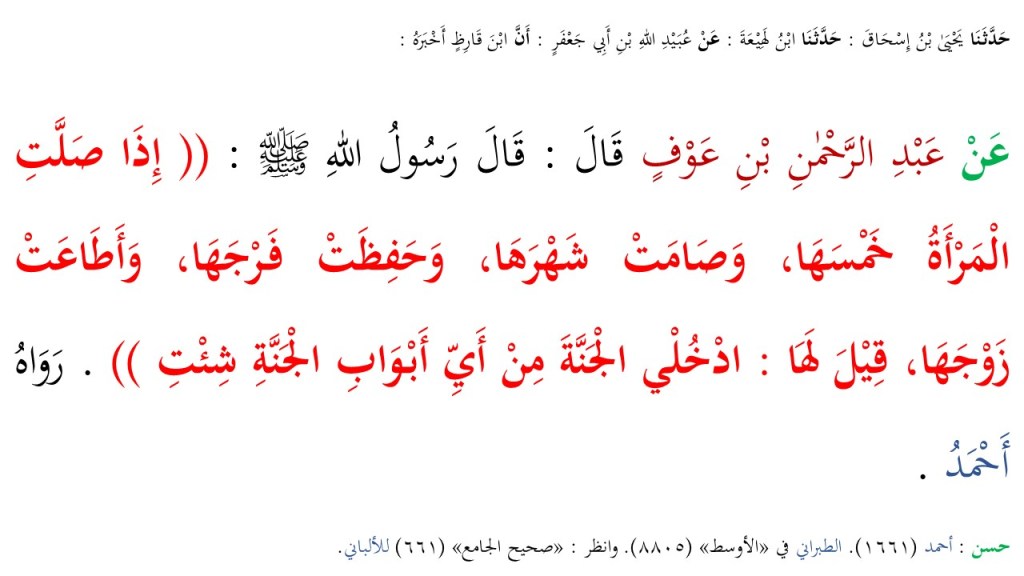
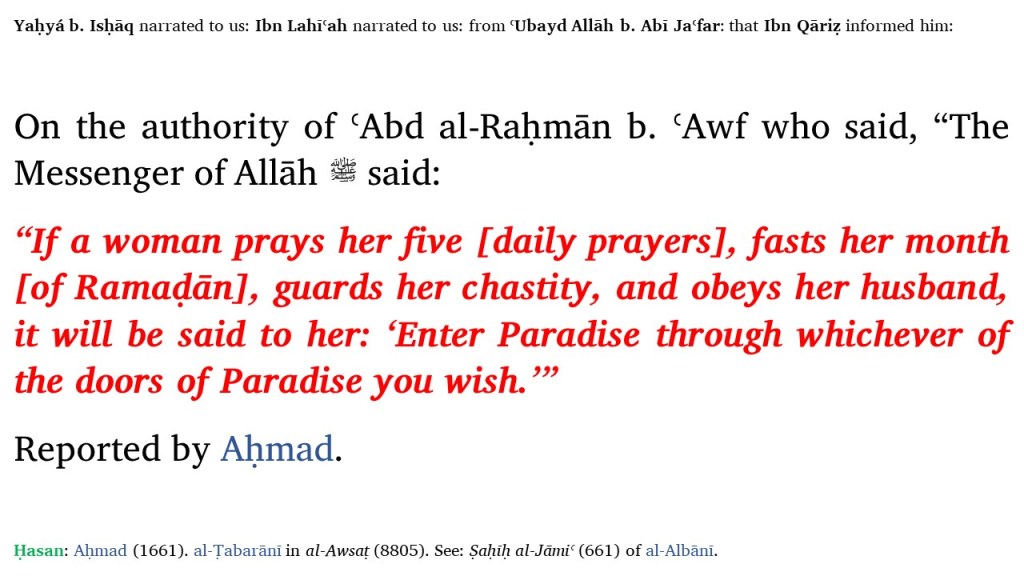
The Woman Who Will Enter Paradise Through Whichever Door She Wishes

Explanation

ʿAbd al-Raḥmān b. ʿAwf (d. 32): A senior Companion of the Prophet ﷺ, one of the first of eight to accept Islām, one of the ten given glad tidings of al-Jannah by the Prophet ﷺ, made hijrah to al-Ḥabashah because of Makkan persecution, paired with Saʿd b. al-Rabīʿah in a bond of brotherhood in al-Madīnah who offered to split everything he had in half with him, he went into trading instead and became extremely wealthy and was amazingly generous in supporting the Prophet ﷺ and the Muslims.

“If a woman” i.e., a Muslim woman, for the deeds of a non-Muslim are not accepted by Allāh until they believe.

“prays her five” the five daily obligatory prayers unless she is menstruating (al-ḥayḍ) or experience post-natal bleeding (al-nifās). This contains an encouragement for her to take the prayers extremely seriously and not to be negligent. She should ensure she fulfils the conditions (shurūṭ), pillars (arkān) and obligations (wājibāt) of prayer in order for her prayers to be accepted.

“fasts her month” the month of Ramaḍān except for the days of her menstruation which she makes up after the completion of the month. This contains an encouragement for her to fast the month of Ramaḍān and to do so properly by fulfilling its conditions and obligations by staying away from its nullifiers and working to obtain the goal of Ramaḍān: al-taqwá (fear of Allāh).  

“guards her chastity” from illegal sexual intercourse whether it be with a man who is not her husband, or a woman (siḥāq: lesbianism). The word used in the ḥadīth is farj (the private part) and this refers primarily to the front but also includes the back. This ḥadīth contains an encouragement for her to stay away from the means which lead to the loss of her chastity such as; being in complete privacy with a non-maḥram man, journeying on her own, touching a non-maḥram man, free-mixing with non-maḥram men etc.  

“and obeys her husband” in everything related to his legal rights, unless he orders her to do something sinful, in which case she should not obey him because the Prophet ﷺ said, “There is no obedience to the creation when it involves disobedience to the Creator.” This also contains an encouragement for a woman to get married.

“it will be said to her” an announcement will be made for her, out of honour and respect for her because of the goodness she did in this dunyá, and the means she took to enter Paradise by pleasing her Lord.

“whichever of the doors of Paradise” and there are eight doors of Paradise.

Aḥmad: Ibn Ḥanbal (d. 241), the eponym of the Ḥanbalī legal school, Imām of Ahl al-Sunnah, Imām in ḥadīth and Imām in fiqh.

Some Other Lessons

  • The righteous woman who fulfils her obligations towards Allāh and then to her husband, holds a lofty status with her Lord. He will be pleased with her and give her the choice of entering through any of the doors of Paradise her heart desires.
  • The ḥadīth indicates the great status of these deeds because they are a means to acquiring a great reward: entry into Paradise through any door one wishes.
  • The deeds mentioned in this ḥadīth are obligatory deeds which she must fulfil otherwise, as with all obligations, non-fulfilment of obligations without a legal excuse is a cause of punishment in the Hereafter, which Allāh may choose to exercise if He wills.
  • She should not be rebuked if she fulfils these obligations and does not do more. Sh. ʿUthaymīn was asked regarding a mother who rebukes her married daughter for not memorising the Qurʾān even though she reads it regularly. The Shaykh stated: “As long as the wife is obedient towards Allāh the Almighty and Exalted, and to His Messenger, by fulfilling what is obligatory upon her in terms of the rights of blood-relatives and the rights of the husband; there is no blame on her, and it is not appropriate to scold her for not memorising the Qurʾān because memorisation of the Qurʾān may be difficult for some people especially the married woman who is busy with her husband and the house.