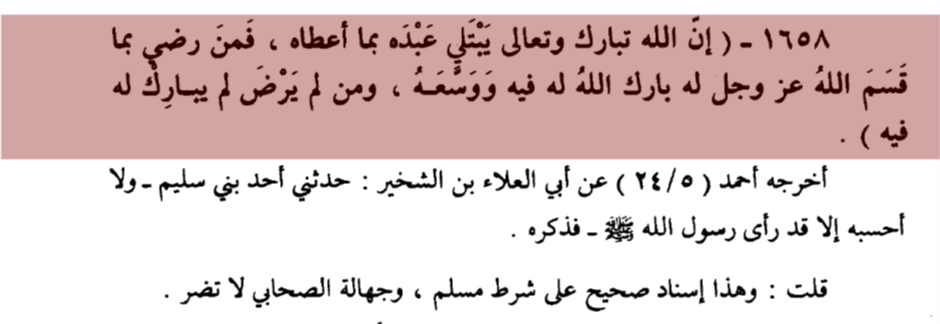
1658 – Gratitude Begets Blessings
حَدَّثَنَا إِسْمَاعِيْلُ : عَنْ يُونُسَ : حَدَّثَنِي أَبُو الْعَلَاءِ بْنُ الشِّخِّيْرِ : حَدَّثَنِي أَحَدُ بَنِي سُلَيْمٍ – وَلَا أَحْسَبُهُ إِلَّا قَدْ رَأَىٰ رَسُولَ اللهِ ﷺ – قَالَ : قَالَ رَسُولُ اللهِ ﷺ : (( إِنَّ اللهَ يَبْتَلِي عَبْدَهُ بِمَا أَعْطَاهُ، فَمَنْ رَضِيَ بِمَا قَسَمَ اللهُ لَهُ، بَارَكَ اللهُ لَهُ فِيْهِ وَوَسَّعَهُ، وَمَنْ لَمْ يَرْضَ لَمْ يُبَارِكْ لَهُ )) . رَوَاهُ أَحْمَدُ.
Ismāʿīl narrated to us: from Yūnus: Abū al-ʿAlāʾ b. al-Shikhkhīr narrated to me: one of Banū Sulaym narrated to me – and I do not think except that he saw the Messenger of Allāh ﷺ – he said, “The Messenger of Allāh ﷺ said:
‘Indeed Allāh tests His slave with what He gave him, so whoever is pleased with what Allāh has apportioned him, Allāh blesses him therein and expands it, and whoever is not pleased, He does not bless him.”’
Reported by Aḥmad.
Ṣaḥīḥ: Aḥmad (5: 24) or (20279). See: al-Ṣaḥīḥah (1658) of al-Albānī wherein he says, “This is an authentic chain upon the condition of Muslims, and the anonymity of a Companion does no harm.”
Notes:
Everything you have in your life was divinely decreed for you by Allāh the All-Wise and All-Just before you were even born. The test lies in whether you will be pleased with Allāh’s Decree or be dissatisfied with it.
One who is pleased and content with what Allāh has divinely decreed for him, deserves to be blessed by Him, and increased in that because he submitted to His Lord’s decision.
One who is displeased and discontent with what Allāh has divinely decreed for him deserves to be left unblessed. It is as though such a person is angry with Allāh for not having apportioned for him more than he has been given. Thus, he is deserving of being deprived of blessings because he sees himself as deserving of more than what was decreed for him, and it is as if he objects to Allāh’s Wisdom.
This is a disease found mainly amongst materialistic individuals. Such people look down on what they have been apportioned by Allāh and consider it to be little. They look at what others have been given and consider it to be more and greater. Consequently, they constantly strive to increase their material lot, and squander their life and waste away their strength, and are beset with worry, anxiety, and fatigue. They blacken their scroll of deeds with their many sins due to becoming engrossed in their pursuit to acquire more of the dunyá, which they feel they deserve. What they do not realise is that they will only obtain what Allāh has decreed for them and no more, no matter how much they strive.
So, contentment of the heart is the key to success in this regard. Once a slave realises Allāh is All-Wise, All-Just, The Most Generous, and that He does not oppress anyone, the heart finds peace with every decree of His. The slave becomes more appreciate of what he has and strives to be grateful to his Lord for His immense generosity and kindness. He realises he does not deserve any of blessings he has been given and so feels deeply indebted to his Lord. Such a slave of Allāh does not feel entitled – he feels that his Lord is entitled to every atom of gratitude he can muster for His kindness.
See: Fayḍ al-Qadīr Sharḥ al-Jāmiʿ al-Ṣaghīr by al-Munāwī, DKI edition, ḥadīth number: 1843.

 Salafi Knowledge