Anas b. Mālik, may Allāh be pleased with him, reported that the Messenger of Allāh ﷺ said to Jibrīl, “Why have I never seen Mīkāʾīl laughing?” He said, “Mīkāʾīl has not laughed since the Fire was created.” Reported by Aḥmad (13343).
Graded ḥasan li ghayrih by al-Albānī in Ṣaḥīḥ al-Targhīb (3664).
Umm Kulthūm bt. ʿUqbah, may Allāh be pleased with her, reported that the Prophet ﷺ said, “The best charity is charity to a close relative who secretly harbours enmity.” Reported by al-Ṭabarānī in al-Kabīr.
Graded ṣaḥīḥ by al-Albānī in Ṣaḥīḥ al-Targhīb (894).
Ḥakīm b. Ḥizām, may Allāh be pleased with him, reported that a man asked the Messenger of Allāh ﷺ about charity and which form is the best. He said, “To the close relative who secretly harbours enmity.” Reported by Aḥmad and al-Ṭabarānī.
Graded ṣaḥīḥ li ghayrih by al-Albānī in Ṣaḥīḥ al-Targhīb (893).
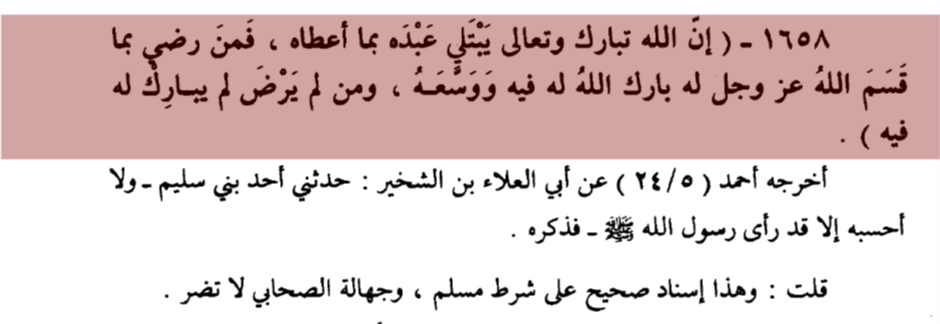
Ismāʿīl narrated to us: from Yūnus: Abū al-ʿAlāʾ b. al-Shikhkhīr narrated to me: one of Banū Sulaym narrated to me – and I do not think except that he saw the Messenger of Allāh ﷺ – he said, “The Messenger of Allāh ﷺ said:
‘Indeed Allāh tests His slave with what He gave him, so whoever is pleased with what Allāh has apportioned him, Allāh blesses him therein and expands it, and whoever is not pleased, He does not bless him.”’
Reported by Aḥmad.
Ṣaḥīḥ: Aḥmad (5: 24) or (20279). See: al-Ṣaḥīḥah (1658) of al-Albānī wherein he says, “This is an authentic chain upon the condition of Muslims, and the anonymity of a Companion does no harm.”
Notes:
Everything you have in your life was divinely decreed for you by Allāh the All-Wise and All-Just before you were even born. The test lies in whether you will be pleased with Allāh’s Decree or be dissatisfied with it.
One who is pleased and content with what Allāh has divinely decreed for him, deserves to be blessed by Him, and increased in that because he submitted to His Lord’s decision.
One who is displeased and discontent with what Allāh has divinely decreed for him deserves to be left unblessed. It is as though such a person is angry with Allāh for not having apportioned for him more than he has been given. Thus, he is deserving of being deprived of blessings because he sees himself as deserving of more than what was decreed for him, and it is as if he objects to Allāh’s Wisdom.
This is a disease found mainly amongst materialistic individuals. Such people look down on what they have been apportioned by Allāh and consider it to be little. They look at what others have been given and consider it to be more and greater. Consequently, they constantly strive to increase their material lot, and squander their life and waste away their strength, and are beset with worry, anxiety, and fatigue. They blacken their scroll of deeds with their many sins due to becoming engrossed in their pursuit to acquire more of the dunyá, which they feel they deserve. What they do not realise is that they will only obtain what Allāh has decreed for them and no more, no matter how much they strive.
So, contentment of the heart is the key to success in this regard. Once a slave realises Allāh is All-Wise, All-Just, The Most Generous, and that He does not oppress anyone, the heart finds peace with every decree of His. The slave becomes more appreciate of what he has and strives to be grateful to his Lord for His immense generosity and kindness. He realises he does not deserve any of blessings he has been given and so feels deeply indebted to his Lord. Such a slave of Allāh does not feel entitled – he feels that his Lord is entitled to every atom of gratitude he can muster for His kindness.
See: Fayḍ al-Qadīr Sharḥ al-Jāmiʿ al-Ṣaghīr by al-Munāwī, DKI edition, ḥadīth number: 1843.
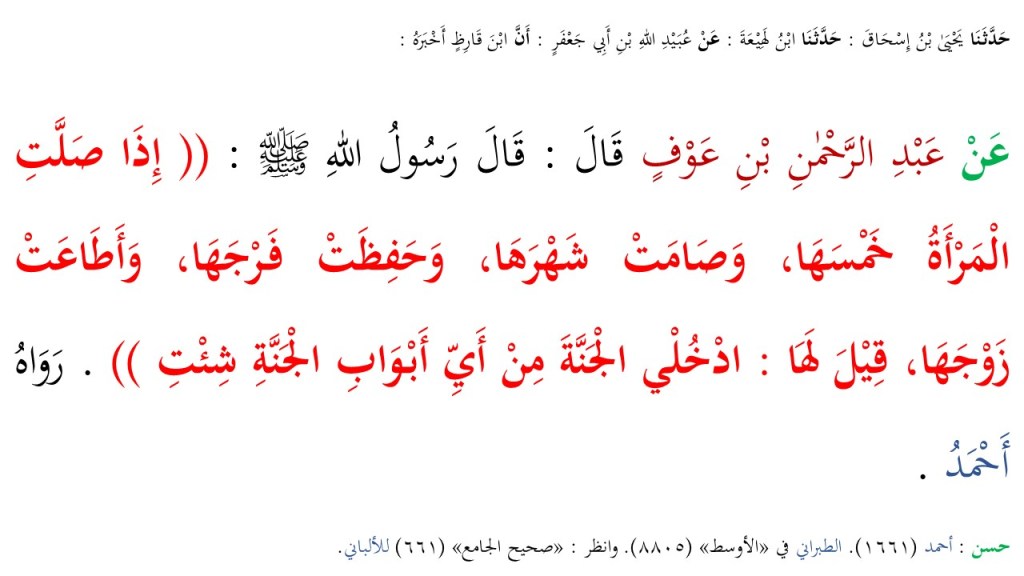
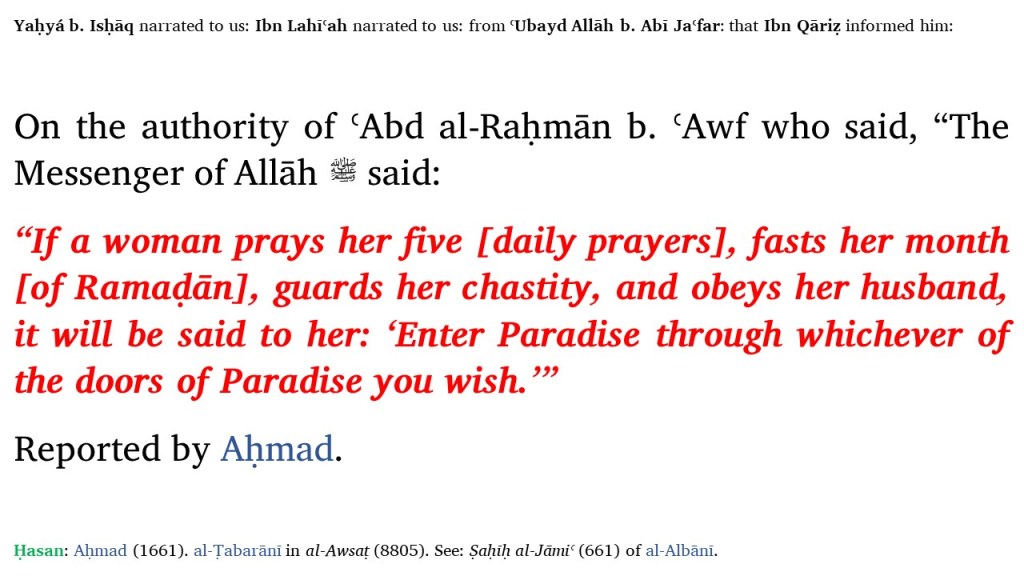
ʿAbd al-Raḥmān b. ʿAwf (d. 32): A senior Companion of the Prophet ﷺ, one of the first of eight to accept Islām, one of the ten given glad tidings of al-Jannah by the Prophet ﷺ, made hijrah to al-Ḥabashah because of Makkan persecution, paired with Saʿd b. al-Rabīʿah in a bond of brotherhood in al-Madīnah who offered to split everything he had in half with him, he went into trading instead and became extremely wealthy and was amazingly generous in supporting the Prophet ﷺ and the Muslims.
“If a woman”i.e., a Muslim woman, for the deeds of a non-Muslim are not accepted by Allāh until they believe.
“prays her five”the five daily obligatory prayers unless she is menstruating (al-ḥayḍ) or experience post-natal bleeding (al-nifās). This contains an encouragement for her to take the prayers extremely seriously and not to be negligent. She should ensure she fulfils the conditions (shurūṭ), pillars (arkān) and obligations (wājibāt) of prayer in order for her prayers to be accepted.
“fasts her month”the month of Ramaḍān except for the days of her menstruation which she makes up after the completion of the month. This contains an encouragement for her to fast the month of Ramaḍān and to do so properly by fulfilling its conditions and obligations by staying away from its nullifiers and working to obtain the goal of Ramaḍān: al-taqwá (fear of Allāh).
“guards her chastity”from illegal sexual intercourse whether it be with a man who is not her husband, or a woman (siḥāq: lesbianism). The word used in the ḥadīth is farj (the private part) and this refers primarily to the front but also includes the back. This ḥadīth contains an encouragement for her to stay away from the means which lead to the loss of her chastity such as; being in complete privacy with a non-maḥram man, journeying on her own, touching a non-maḥram man, free-mixing with non-maḥram men etc.
“and obeys her husband”in everything related to his legal rights, unless he orders her to do something sinful, in which case she should not obey him because the Prophet ﷺ said, “There is no obedience to the creation when it involves disobedience to the Creator.” This also contains an encouragement for a woman to get married.
“it will be said to her” an announcement will be made for her, out of honour and respect for her because of the goodness she did in this dunyá, and the means she took to enter Paradise by pleasing her Lord.
“whichever of the doors of Paradise” and there are eight doors of Paradise.
Aḥmad: Ibn Ḥanbal (d. 241), the eponym of the Ḥanbalī legal school, Imām of Ahl al-Sunnah, Imām in ḥadīth and Imām in fiqh.
Some Other Lessons
The righteous woman who fulfils her obligations towards Allāh and then to her husband, holds a lofty status with her Lord. He will be pleased with her and give her the choice of entering through any of the doors of Paradise her heart desires.
The ḥadīth indicates the great status of these deeds because they are a means to acquiring a great reward: entry into Paradise through any door one wishes.
The deeds mentioned in this ḥadīth are obligatory deeds which she must fulfil otherwise, as with all obligations, non-fulfilment of obligations without a legal excuse is a cause of punishment in the Hereafter, which Allāh may choose to exercise if He wills.
She should not be rebuked if she fulfils these obligations and does not do more. Sh. ʿUthaymīn was asked regarding a mother who rebukes her married daughter for not memorising the Qurʾān even though she reads it regularly. The Shaykh stated: “As long as the wife is obedient towards Allāh the Almighty and Exalted, and to His Messenger, by fulfilling what is obligatory upon her in terms of the rights of blood-relatives and the rights of the husband; there is no blame on her, and it is not appropriate to scold her for not memorising the Qurʾān because memorisation of the Qurʾān may be difficult for some people especially the married woman who is busy with her husband and the house.
The Prophet ﷺ used to ask Allāh for beautiful character and manners despite him being the best role model for mankind.
Muḥāḍir Abū al-Muwarriʿ narrated us: ʿĀṣim narrated to us: from ʿAwsajah b. al-Rammāḥ: from ʿAbd Allāh b. Abī al-Hudhayl:
On the authority of Ibn Masʿūd [who narrated] that the Messenger of Allāh, may the praise and protection of Allāh be upon him, used to say:
“O Allāh, You have beautified my body, and so beautify my character as well.”
Reported by Aḥmad.
Ḥasan: Aḥmad (3823), (24392) and (25221). al-Bukhārī in al-Adab al-Mufrad (290). Ibn Ḥibbān (959). al-Ṭayālisī (374). Abū Yaʿlá (5181). Bulūgh al-Marām (1327) as in Hādī’s edition. See Irwāʾ al-Ghalīl (74) of al-Albānī.


 Salafi Knowledge