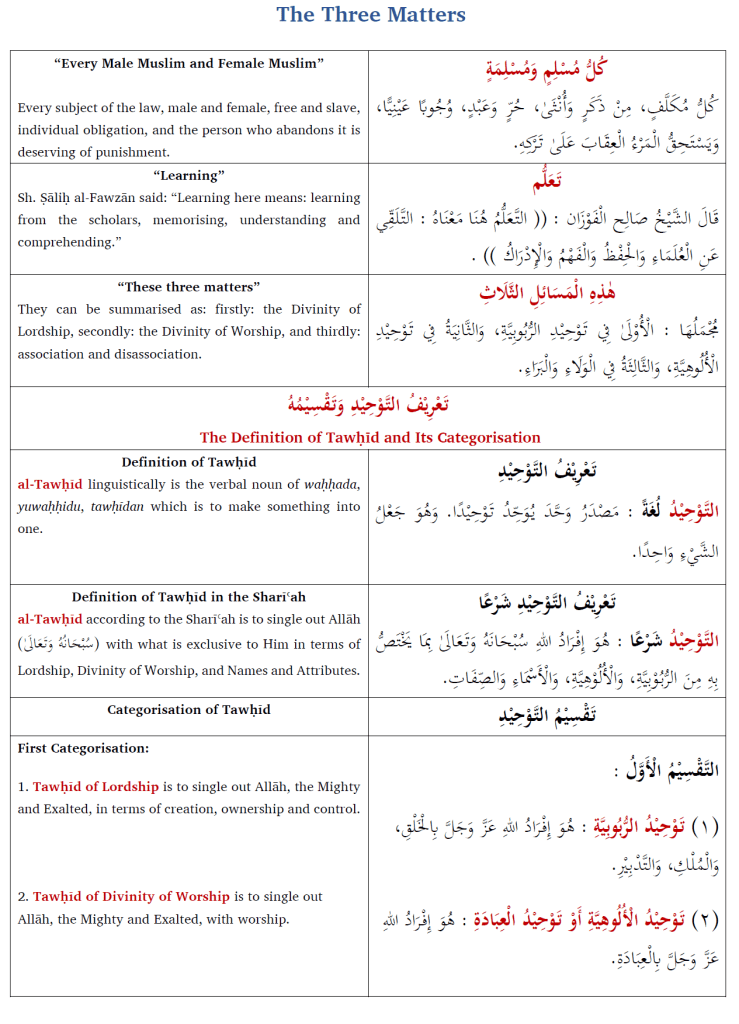
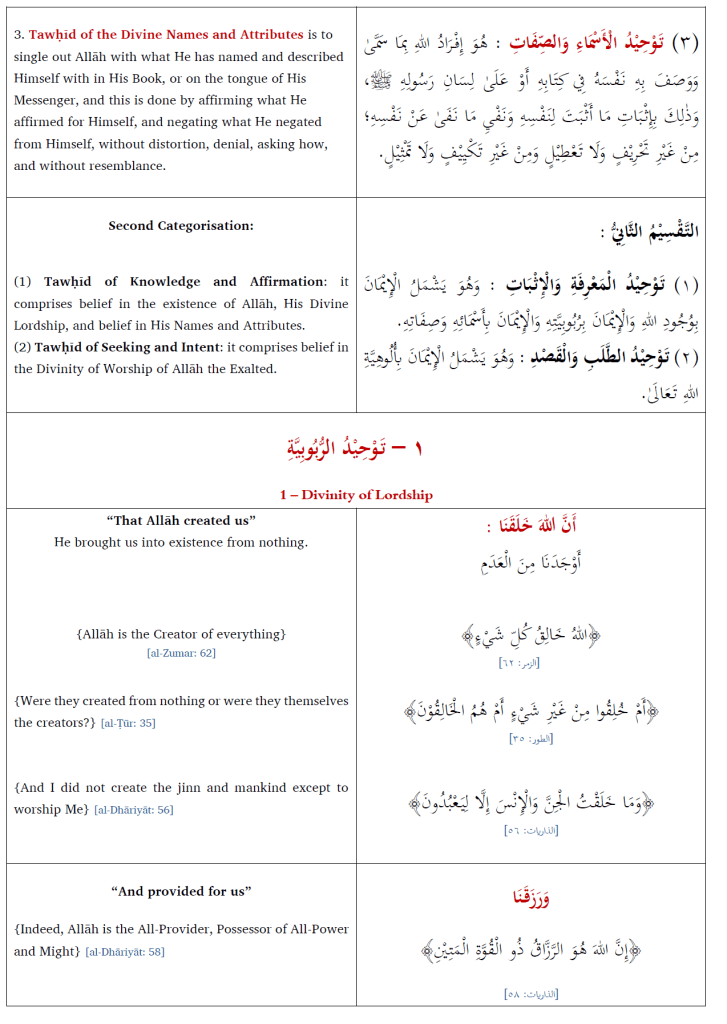
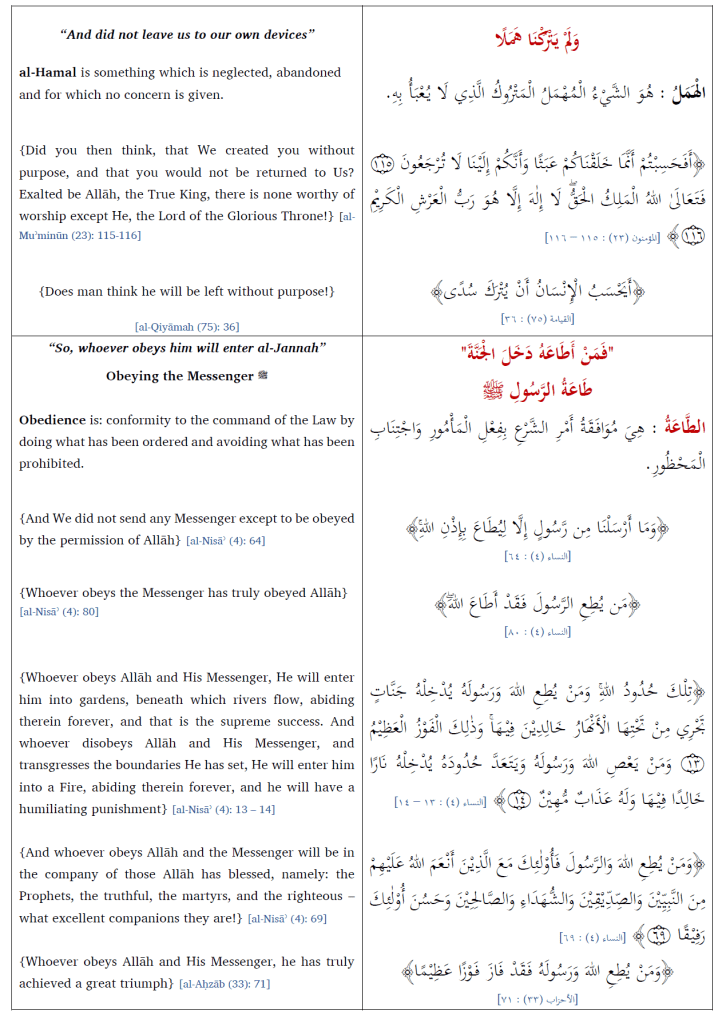
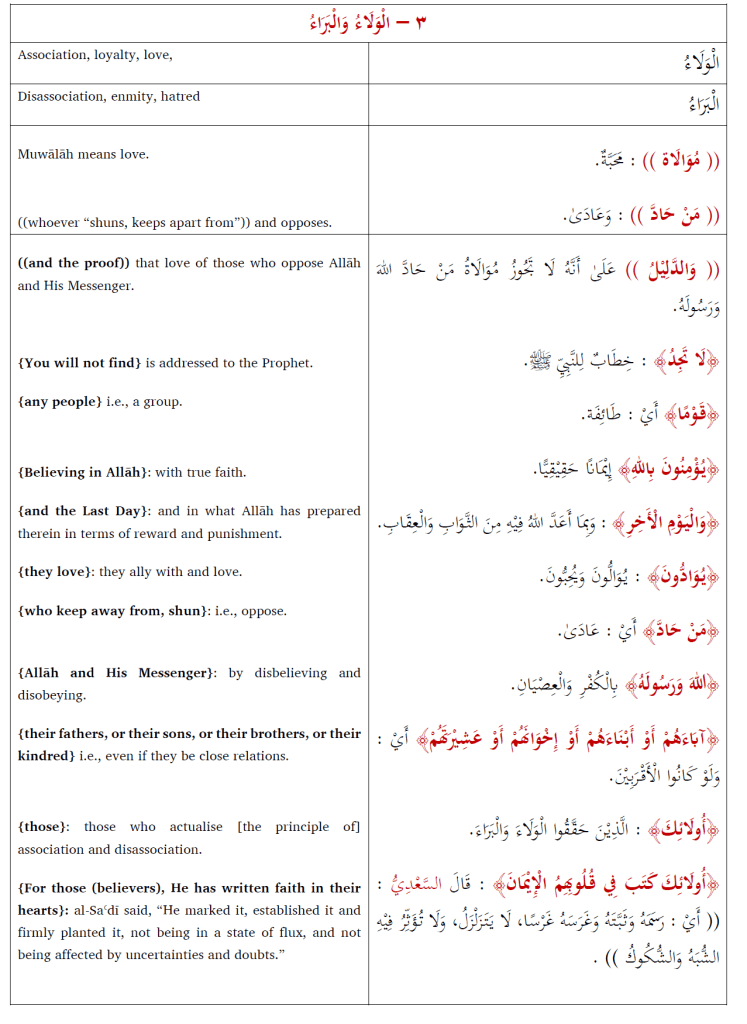
Thalāthat-ul-Uṣūl – Title – Key Definitions


“A slave will not reach true faith until he knows that what happened to him was not going to pass him by, and what passed him by was not going to happen him.”
Reported by al-Bazzār (1/21/1/33 in Kashf al-Astār): ʿAmr narrated to us: Sulaymān b. ʿAbd al-Raḥmān narrated to us: Sulaymān b. ʿUtbah narrated to us and said: I heard Yūnus b. Maysarah b. Ḥalbas narrate from Abū Idrīs: from Abū al-Dardāʾ – he then mentioned a ḥadīth with this chain, then said, with his chain, from the Messenger of Allāh ﷺ who said…he then mentioned it.
[more to follow…]
Lessons

“Would you not be satisfied in being my wife in this worldly life and in the Hereafter?” I said, “Of course, by Allāh!” He said, “Then you are my wife in this worldly life and in the Hereafter.”
Reported by Ibn Ḥibbān (7053 as in al-Iḥsān), and al-Ḥākim (4/10) by way of Saʿīd b. Yaḥyá al-Umawī: my father narrated to me: Abū al-ʿAnbas Saʿīd b. Kathīr narrated to me: from his father who said: ʿĀʾishah narrated to us that the Messenger of Allāh, may the praise and protection of Allah be upon him, mentioned Fāṭimah, she said, ‘So I spoke, and he said… and then mentioned the ḥadīth.
[analysis to follow…]
Lessons

3002 – “Indeed, the heavenly wives (ḥūr) in Paradise will sing and say: ‘We are beautiful and good heavenly wives, we have been gifted to noble husbands’”.
Reported by al-Bukhārī in al-Tārīkh al-Kabīr (4/1/16), Ibn Abī Dāwūd in al-Baʿth wa al-Nushūr (75), and al-Ṭabarānī in al-Awsaṭ (6642) via Ibn Abī Fudayk: from Ibn Abī al-Dhiʾb: from ʿAwn b. al-Khaṭṭāb b. ʿAbd Allāh b. Rāfiʿ: from a son of Anas b. Mālik: that Anas b. Mālik…in marfūʿ form [raised to the Prophet ﷺ].
[more to follow…]

“If you are admitted into Paradise, you shall be brought a horse of rubies with two wings, then you shall be carried on it, then it will fly with you wherever you wish.”
Reported by al-Tirmidhī (2547) and al-Ṭabarānī (4/215: 4075), and from him Abū Nuʿaym in Ṣifat al-Jannah [Description of Paradise] (261/423) by way of Wāṣil b. al-Sāʾib, from Abū Sawrah, from Abū Ayyūb [who] said:
“A Bedouin came to the Prophet, may the praise and protection of Allāh be upon him, and said, ‘O Messenger of Allāh, I love horses, are there horses in Paradise?’ The Messenger of Allāh, may the praise and protection of Allāh be upon him, said: … and he mentioned the ḥadīth.
[more to follow…]


Explanation
ʿAbd al-Raḥmān b. ʿAwf (d. 32): A senior Companion of the Prophet ﷺ, one of the first of eight to accept Islām, one of the ten given glad tidings of al-Jannah by the Prophet ﷺ, made hijrah to al-Ḥabashah because of Makkan persecution, paired with Saʿd b. al-Rabīʿah in a bond of brotherhood in al-Madīnah who offered to split everything he had in half with him, he went into trading instead and became extremely wealthy and was amazingly generous in supporting the Prophet ﷺ and the Muslims.
“If a woman” i.e., a Muslim woman, for the deeds of a non-Muslim are not accepted by Allāh until they believe.
“prays her five” the five daily obligatory prayers unless she is menstruating (al-ḥayḍ) or experience post-natal bleeding (al-nifās). This contains an encouragement for her to take the prayers extremely seriously and not to be negligent. She should ensure she fulfils the conditions (shurūṭ), pillars (arkān) and obligations (wājibāt) of prayer in order for her prayers to be accepted.
“fasts her month” the month of Ramaḍān except for the days of her menstruation which she makes up after the completion of the month. This contains an encouragement for her to fast the month of Ramaḍān and to do so properly by fulfilling its conditions and obligations by staying away from its nullifiers and working to obtain the goal of Ramaḍān: al-taqwá (fear of Allāh).
“guards her chastity” from illegal sexual intercourse whether it be with a man who is not her husband, or a woman (siḥāq: lesbianism). The word used in the ḥadīth is farj (the private part) and this refers primarily to the front but also includes the back. This ḥadīth contains an encouragement for her to stay away from the means which lead to the loss of her chastity such as; being in complete privacy with a non-maḥram man, journeying on her own, touching a non-maḥram man, free-mixing with non-maḥram men etc.
“and obeys her husband” in everything related to his legal rights, unless he orders her to do something sinful, in which case she should not obey him because the Prophet ﷺ said, “There is no obedience to the creation when it involves disobedience to the Creator.” This also contains an encouragement for a woman to get married.
“it will be said to her” an announcement will be made for her, out of honour and respect for her because of the goodness she did in this dunyá, and the means she took to enter Paradise by pleasing her Lord.
“whichever of the doors of Paradise” and there are eight doors of Paradise.
Aḥmad: Ibn Ḥanbal (d. 241), the eponym of the Ḥanbalī legal school, Imām of Ahl al-Sunnah, Imām in ḥadīth and Imām in fiqh.
Some Other Lessons
Shaykh Muḥammad b. ʿAbd al-ʿAzīz al-Māniʿ, may Allāh have mercy upon him, said:
“It is necessary for the seeker of knowledge to completely preoccupy his time, and so, when he becomes tired of one aspect of knowledge, he should preoccupy himself with another aspect of knowledge.”
[Irshād al-Ṭullāb Ilá Faḍīlat al-ʿIlm wa al-ʿAmal wa al-Ādāb, ed. ʿAlī al-Ḥalabī, p. 26].