“This is not from the Sunnah, the Sunnah in the sermon of the marriage is to read the Sermon of Ibn Masʿūd رضي الله عنه, and it is famous and known, and if one left it off there is no harm, but it is better to read it.”
Sh. Ibn al-ʿUthaymīn رَحِمَهُ اللهُ was asked about a girl who wants to marry the son of her paternal uncle. However, her brothers were breastfed by the mother of this man she wants to marry. Is she permitted for him in marriage or is she forbidden for him?
Sh. Ibn al-ʿUthaymīn رَحِمَهُ اللهُ said:
“It is clear from this question that the man who wants this woman was not breastfed by her mum, and that she was not breastfed by his mum. Accordingly, there is no brotherhood between her and the man, and so, it is lawful for him to marry her. As for his brothers who were breastfed by her mother, she is not lawful for them because she is their sister.”
Source: Fatāwá Nūr ʿalá al-Darb (10: 528, no. 5484) of Ibn al-ʿUthaymīn.
Sh. Ibn al-ʿUthaymīn, may Allāh have mercy upon him, was asked whether he could provide some words of advice to the youth regarding hastening marriage and protecting their chastity.
The Shaykh, may Allāh have mercy upon him, replied:
“Yes, there are no better words than the words of the Prophet ﷺ who said, “O young men, whoever amongst you is able to marry, then let him marry, for indeed it is more effective in guarding the gaze and protecting the private parts, and whoever is unable, then he must fast for indeed it will be a restraint for him.”
I advise the youth to hasten in marrying, especially in this age in which the causes of temptations and distractions have become numerous. This is why we find many of the youth enduring the difficulty of bachelorhood, and if it was not for his belief in Allāh – the Almighty and Majestic – he would have gone hunting for fornication.
Moreover, I say, if the young man has sufficient wealth to marry, then this is what is demanded in order for him to marry. If, however, he does not have wealth, it is obligatory upon his father to marry him off if he is capable of that, just as it is obligatory upon him to spend on him in terms of food, drink, clothing, and accommodation. It is not lawful for anyone whom Allāh has enriched, and his sons have reached the age of marriage, and they seek that from him – either through their explicit speech or their actions which indicate seeking marriage – it is not lawful for him to prevent that. Rather, it is obligatory upon him to marry them off, and if he does not do that then he is sinning, and Allāh will not bless his wealth for him. Some of the ignoramuses amongst fathers say a common proverb to their children if they seek to marry, “Nothing scratches your back like your own nails” (i.e., one should abstain from relying on others), you go and obtain what you can marry with on your own, otherwise I will not marry you off. This is prohibited for them as long as they are capable and their sons are unable.”
Source: Fatāwá Nūr ʿalá al-Darb (10: 15) of Sh. Muḥammad b. Ṣāliḥ al-ʿUthaymīn. The ḥadīth is from al-Bukhārī (5066) and Muslim (1400).
The Shaykh, may Allāh have mercy upon him, was asked:
“If a young man delays marriage until after his 30s, and he is capable of it, is there any blame on him because he wants to build his future and finish his studies (first)?”
The Shaykh, may Allāh have mercy upon him, replied:
Yes, there is (blame) on him because he did not adopt the guidance of the Prophet ﷺ, which is his statement, “O young men, whoever among you is able to marry, let him get married, for indeed it is more effective in lowering the gaze and protecting one’s chastity”, so he commanded the young men to marry and explained its benefits.
The statement that it will distract one’s studies and from building one’s future is a false statement. How many a people there are who do not relax except after marrying, then they find relaxation and sufficiency of provision, and abstention from looking at what is prohibited in terms of women and images and the like.
Hence, my advice to all young men is to marry early in compliance with the command of the Messenger ﷺ and in seeking to procure sustenance – because the one who marries seeking chastity, Allāh the Almighty and Majestic helps him, just as in the ḥadīth, “It is a right upon Allāh to help three” and he mentioned among them, “and the one who marries with the goal of chastity”.
Source: Fatāwá Nūr ʿalá al-Darb of ʿUthaymīn (10: 7, no. 4967). The first ḥadīth is from: al-Bukhārī (5066) & Muslim (1400), and the second ḥadīth is from: al-Tirmidhī (1655) & al-Nasāʾī (3218).
Sh. Muḥammad b. Ṣāliḥ al-ʿUthaymīn, may Allāh have mercy upon him, said:
“al-Tiwalah is something [people] do claiming that it causes a woman to be loved by her husband and vice versa. The closest [term] to that is what is referred amongst us as al-diblah (ring). It is said that the husband inscribes his wife’s name in his ring, and the wife inscribes her husband’s name in her ring, and they claim that they – the couple – attain love and affection through this action of theirs, and that if he removes the ring, or she removes it, it means [their] separation.
So, if one asks: what is the means for a man to love his wife and his wife to love her husband? We say: the means to that has been explained by Allāh in His statement: {And live with them in a good manner} [al-Nisāʾ (4): 19]. So, if a person lives in a good manner with his wife, and she does likewise; love, closeness and blissful married life occurs.”
One of the many notable and beneficial features of Sh. al-ʿUthaymīn’s works, is that he always tries to provide a divinely legislated solution, and alternative, to something which is prohibited in the Dīn. May Allāh bless him with all goodness.
ʿAbd al-Raḥmān b. ʿAwf (d. 32): A senior Companion of the Prophet ﷺ, one of the first of eight to accept Islām, one of the ten given glad tidings of al-Jannah by the Prophet ﷺ, made hijrah to al-Ḥabashah because of Makkan persecution, paired with Saʿd b. al-Rabīʿah in a bond of brotherhood in al-Madīnah who offered to split everything he had in half with him, he went into trading instead and became extremely wealthy and was amazingly generous in supporting the Prophet ﷺ and the Muslims.
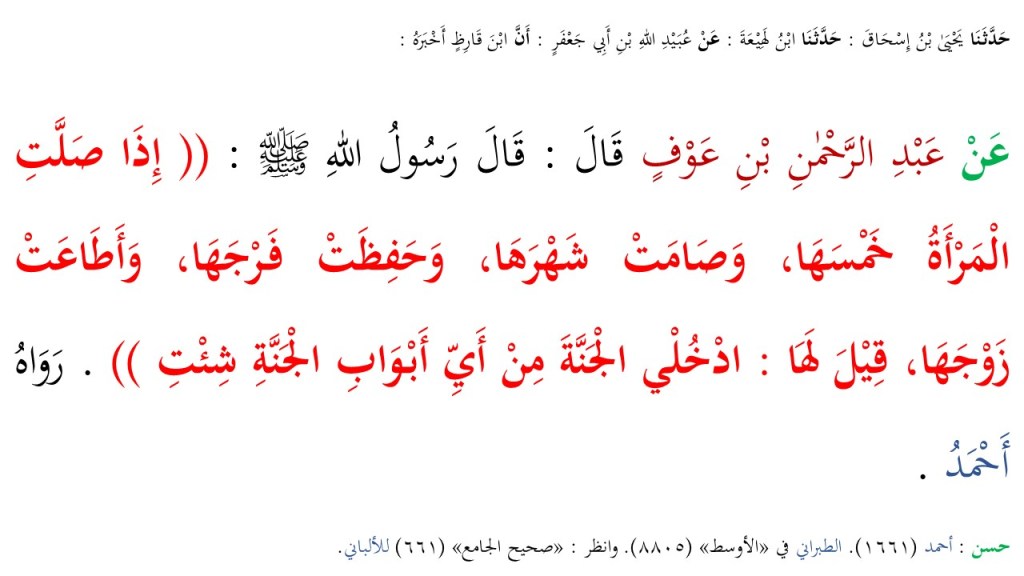
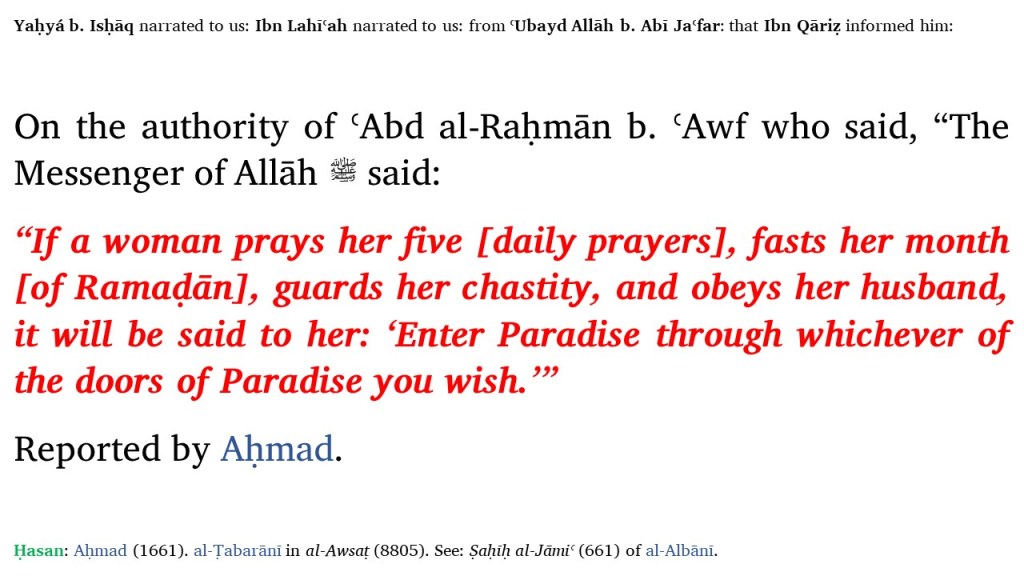
“If a woman”i.e., a Muslim woman, for the deeds of a non-Muslim are not accepted by Allāh until they believe.
“prays her five”the five daily obligatory prayers unless she is menstruating (al-ḥayḍ) or experience post-natal bleeding (al-nifās). This contains an encouragement for her to take the prayers extremely seriously and not to be negligent. She should ensure she fulfils the conditions (shurūṭ), pillars (arkān) and obligations (wājibāt) of prayer in order for her prayers to be accepted.
“fasts her month”the month of Ramaḍān except for the days of her menstruation which she makes up after the completion of the month. This contains an encouragement for her to fast the month of Ramaḍān and to do so properly by fulfilling its conditions and obligations by staying away from its nullifiers and working to obtain the goal of Ramaḍān: al-taqwá (fear of Allāh).
“guards her chastity”from illegal sexual intercourse whether it be with a man who is not her husband, or a woman (siḥāq: lesbianism). The word used in the ḥadīth is farj (the private part) and this refers primarily to the front but also includes the back. This ḥadīth contains an encouragement for her to stay away from the means which lead to the loss of her chastity such as; being in complete privacy with a non-maḥram man, journeying on her own, touching a non-maḥram man, free-mixing with non-maḥram men etc.
“and obeys her husband”in everything related to his legal rights, unless he orders her to do something sinful, in which case she should not obey him because the Prophet ﷺ said, “There is no obedience to the creation when it involves disobedience to the Creator.” This also contains an encouragement for a woman to get married.
“it will be said to her” an announcement will be made for her, out of honour and respect for her because of the goodness she did in this dunyá, and the means she took to enter Paradise by pleasing her Lord.
“whichever of the doors of Paradise” and there are eight doors of Paradise.
Aḥmad: Ibn Ḥanbal (d. 241), the eponym of the Ḥanbalī legal school, Imām of Ahl al-Sunnah, Imām in ḥadīth and Imām in fiqh.
Some Other Lessons
The righteous woman who fulfils her obligations towards Allāh and then to her husband, holds a lofty status with her Lord. He will be pleased with her and give her the choice of entering through any of the doors of Paradise her heart desires.
The ḥadīth indicates the great status of these deeds because they are a means to acquiring a great reward: entry into Paradise through any door one wishes.
The deeds mentioned in this ḥadīth are obligatory deeds which she must fulfil otherwise, as with all obligations, non-fulfilment of obligations without a legal excuse is a cause of punishment in the Hereafter, which Allāh may choose to exercise if He wills.
She should not be rebuked if she fulfils these obligations and does not do more. Sh. ʿUthaymīn was asked regarding a mother who rebukes her married daughter for not memorising the Qurʾān even though she reads it regularly. The Shaykh stated: “As long as the wife is obedient towards Allāh the Almighty and Exalted, and to His Messenger, by fulfilling what is obligatory upon her in terms of the rights of blood-relatives and the rights of the husband; there is no blame on her, and it is not appropriate to scold her for not memorising the Qurʾān because memorisation of the Qurʾān may be difficult for some people especially the married woman who is busy with her husband and the house.
 Salafi Knowledge