02 The Pillars of Muḥammad is the Messenger of Allāh

In the previous section we learnt the two pillars of Lā ilāha illa Allāh. In this section we will cover the pillars of the second part of the Shahādah; the pillars of Muḥammad Rasūl Allāh.

Let us examine the full wording of the testimony of faith which is as follows:

أَشْهَدُ أَنْ لا إِلهَ إِلَّا الله، وَأَشْهَدُ أَنَّ مُحَمَّداً عَبْدُهُ وَرَسُولُهُ

ash-hadu an lā ilāha illa Allāh wa ash-hadu anna Muḥammadan ʿabduhu wa rasūluh

“I bear witness that there is none worthy of worship except Allāh and I bear witness that Muḥammad is His slave and Messenger

Sh. Ṣāliḥ al-Fawzān explains (p. 47) that the two pillars of this second part of the testimony of faith are taken explicitly from it: عَبْدُهُ وَرَسُولُهُ {His slave and His Messenger}. They nullify any exaggeration (الإِفْرَاط) and negligence (التَفْرِيط) regarding his ﷺ noble rights. Thus he ﷺ is His slave and His Messenger and in these two noble characteristics he ﷺ is the most complete and perfect of all creation.

First Pillar: عَبْدُهُ {His slave}

This means that Muḥammad ﷺ is a slave who is owned by Allāh. It means that he ﷺ is a human being,  from one of mankind and that he ﷺ was created from the same thing all humans have been created. The same things that happen to human beings also happen to him ﷺ. This is based on the statement of Allāh the Exalted:

قُلْ إِنَّما أَنَا بَشَرٌ مِثْلُكُم

{Say (O Muḥammad): I am only a human being like you}

[al-Kahf (18): 110]

The Prophet ﷺ fulfilled servitude to Allāh in submitting to Him and worshipping Him in its truest sense which is why Allāh praised him ﷺ by referring to him ﷺ by this quality of his when He said:

أَلَيسَ اللَّهُ بِكافٍ عَبْدَهُ

{Is Allāh not sufficient for His slave?}

[al-Zumar (39): 36]

And He the Exalted said:

الحَمْدُ لِلَّهِ الَّذي أَنْزَلَ عَلىٰ عَبْدِهِ الْكِتَابَ

{All praise is due to Allāh Who revealed the Book upon His slave}

[al-Kahf (18): 1]

And He the Exalted said:

سُبْحَانَ الَّذِي أَسْرىٰ بِعَبْدِهِ لَيْلًا مِنَ الْمَسْجِدِ الحَرامِ

{Far removed is Allāh from all imperfections, the One Who took His slave by night from the Sacred Mosque}

[al-Isrāʾ: 1]

Second Pillar: رَسُولُهُ {His Messenger}

This means that he ﷺ is the one sent to all of mankind to call to Allāh, informing them of glad tidings and warning them of the consequences of rejecting Allāh.

Thus, by bearing witness to these two qualities and descriptions of him, any exaggeration has been nullified on the one hand and any negligence has been nullified on the other.

There are many people who claim to be from his Ummah who exaggerate regarding his rights and go to extremes in them, to the extent that they raise him ﷺ from the level of servitude to Allāh to the level of being worshipped besides Allāh. Hence, such people seek relief from him besides Allāh and they seek things from him ﷺ which he is incapable of doing and that only Allāh can do in terms of fulfilling people’s needs and saving them from calamities.

Other people go to the opposite extreme and reject the fact that he was a Messenger of Allāh sent with a Scripture calling them to His pleasure and warning them against His Fire. Others fall in to neglecting his right of being followed by choosing to rely upon their own opinions and views which run contrary to what he came with.

Conclusion

In conclusion, we have learnt that just as there are two pillars for the first part of the Shahādah; Lā ilāha illa Allāh, similarly there are two pillars for the second part of the Shahādah; Muḥammad Rasūl Allāh. The first part of the Shahādah rests upon the contrasting pillars of Negation and Affirmation whilst the second part of the Shahādah rests upon the two pillars of Servitude and Messengership. Without the presence of these two pillars; i.e. the acceptance that Muḥammad ﷺ is a human being like us and a slave of Allāh and accepting that he ﷺ is Allāh’s Messenger thus not deserving of any worship, one’s Shahādah is not complete.

Bibliography

al-Fawzān, Ṣāliḥ b. Fawzān b. ʿAbd Allāh. ʿAqīdat al-Tawḥīd wa Bayān Mā Yuḍaduhā aw Yanquṣuha Min al-Shirk al-Akbar wa al-Aṣghar wa al-Taʿṭīl wa al-Biḍaʿ wa Ghayr Dhālik. al-Riyāḍ: Maktabat Dār al-Minhāj, 1432.


01 The Pillars of Lā Ilāha Illa Allāh

After having understood the precise meaning of the Shahādah, it is essential to point out that there are pillars to Lā ilāha illa Allāh (there is none worthy of worship except Allāh) which are known in the Arabic language as: أَرْكَانُ لا إِلهَ إِلَّا الله, Arkānu Lā ilāha illa Allāh.

To be more precise, there are two pillars which are:

Negation and Affirmation (النَّفْيُ وَالْإِثْبَاتُ)

First Pillar: Negation ( النَّفْيُ)

This means to negate, deny, disbelieve in and reject anything else that is worshipped besides Allāh. It means to believe that nothing else is deserving of worship i.e. negate the worthiness of anything being worshipped besides Allāh.

This is the meaning of لا إِلهَ.

Second Pillar: Affirmation (الإِثْبَاتُ)

This means to affirm that Allāh alone, and Him alone, is worthy of worship and that He has all the Attributes that make Him worthy of our worship and that none else is worthy. Therefore, anything else worshipped besides Him is false (بَاطِل).

This is the meaning of إِلَّا الله.

The evidence for this is the statement of Allāh the Exalted:

ذٰلِكَ بِأَنَّ اللَّهَ هُوَ الحَقُّ وَأَنَّ مَا يَدْعُونَ مِنْ دُونِهِ هُوَ الْبَاطِلُ وَأَنَّ اللَّهَ هُوَ العَلِيُّ الكَبِيرُ

{That is because, Allāh is the Truth, and that which they call upon besides Him is false, and Allāh is the Most High and Great}

[al-Ḥajj (22): 62]

So, {That is because, Allāh is the Truth} is the affirmation and {that which they call upon besides Him is false} is the negation.

Consequently, when you say Lā ilāha illa Allāh, you are negating something and affirming something.

When you say Lā ilāha, as Imām Muḥammad b. ʿAbd al-Wahhāb (d. 1206) explains in his elementary treatise entitled The Three Principles and Their Evidences (ثَلَاثَةُ الْأُصُولِ وَأَدِلَّتُهَا), it means:

slide2

Lā ilāha negates everything that is worshipped besides Allāh, whether that be a person, angel, jinn, animal, rock, tree, planet, star etc because these things are not deserving or worthy of worship.

slide3

Illa Allāh affirms all forms of worship for Allāh the Exalted alone as He is the Only One deserving and worthy of worship (الْمُسْتَحِقُّ لِلْعِبَادَة) without any partners in His worship at all.

There are other verses throughout the Qurʾān which echo this negation and affirmation as Sh. Ṣāliḥ al-Fawzān explains (p. 46):

فَمَنْ يَكْفُرْ بِالطَّاغُوتِ وَيُؤمِن بِاللَّهِ فَقَدِ اسْتَمْسَكَ بِالْعُرْوَةِ الْوُثْقىٰ

{So whoever disbelieves in al-Ṭāghūt (everything that is pleased to be worshipped besides Allāh) and believes in Allāh; he has grasped the firmest handhold…}

[al-Baqarah (2): 256]

Thus, His statement فَمَن يَكفُر بِالطّاغوتِ {whoever disbelieves in al-Ṭāghūt} is the meaning of first pillar: لا إِلهَ.

His statement: وَيُؤمِن بِاللَّهِ {and believes in Allāh} is the meaning of the second pillar: إِلَّا الله .

al-Waṣābī (p. 33) mentions two verses conveying the same meaning:

slide4

{And worship Allāh and do not associate anything with Him}

[al-Nisāʾ (4): 36]

The affirmation in this āyah is in the words {And worship Allāh}. The negation is in the words {and do not associate anything with Him}.

slide5

{And your Lord has ordained that you worship none except Him}

[al-Isrāʾ (17): 23]

The affirmation in this āyah is in the words {except Him} and the negation is {that you worship none}.

In conclusion, Lā ilāha illa Allāh (there is none worthy of worship except Allāh) is built upon 2 pillars: [1] Negation and [2] Affirmation. The negation is found in Lā ilaha (there is none worthy of worship) and the affirmation is found in illa Allāh (except Allāh). The negation indicates that you disbelieve in and reject everything that is worshipped apart from or along with Allāh. The affirmation indicates that you believe only Allāh alone is deserving of worship. Without these two pillars, one’s statement of Lā ilāha illa Allāh is not accepted. Just as there are pillars for the Lā ilāha illa Allāh, there are also pillars for Muḥammad Rasūl Allāh, which is the next section you should read.

Bibliography

al-Fawzān, Ṣāliḥ b. Fawzān b. ʿAbd Allāh. ʿAqīdat al-Tawḥīd wa Bayān Mā Yuḍaduhā aw Yanquṣuha Min al-Shirk al-Akbar wa al-Aṣghar wa al-Taʿṭīl wa al-Biḍaʿ wa Ghayr Dhālik. al-Riyāḍ: Maktabat Dār al-Minhāj, 1432.

al-Qaḥṭānī, Saʿīd b. ʿAlī b. Wahf. ʿAqīdat al-Muslim fī Ḍawʾ al-Kitāb wa al-Sunnah. 2 vols. al-Riyāḍ: n.p., 1429/2008.

al-Qāsim, Dr. ʿAbd al-Muḥsin. “al-Uṣūl al-Thalāthah wa Adillatuhā.” Mutūn Ṭālib al-ʿIlm: al-Mustawā al-Awwal. al-Riyāḍ: n.p., 1430/2009. 33 – 63.

al-Waṣābī, Muḥammad b. ʿAbd al-Wahhāb b. ʿAlī al-Yamanī al-ʿAbdalī. al-Qawl al-Mufīd fī Adillat al-Tawḥīd. Ṣanʿāʾ: Maktabat al-Irshād, 1427/2006.

The Meaning of Muḥammad is the Messenger of Allāh

The meaning of the second part of the testimony of faith, or Shahadah is:

لَا مَتْبُوعَ بِحَقٍّ إِلَّا رَسُولَ اللهِ صلى الله عليه وسلم

“There is none worthy of being followed in truth except the Messenger of Allah”

If someone does follow other than the Messenger of Allah in something which has no evidence to support it; then he has followed falsehood.

Allah the Exalted said:

اتَّبِعوا ما أُنزِلَ إِلَيكُم مِن رَبِّكُم وَلا تَتَّبِعوا مِن دونِهِ أَولِياءَ ۗ قَليلًا ما تَذَكَّرونَ

{Follow what has been revealed to you from your Lord, and do not follow other than Him any allies. Little do you remember}

[al-A’raf (7): 3]

He, the Exalted said:

فَلا وَرَبِّكَ لا يُؤمِنونَ حَتّىٰ يُحَكِّموكَ فيما شَجَرَ بَينَهُم ثُمَّ لا يَجِدوا في أَنفُسِهِم حَرَجًا مِمّا قَضَيتَ وَيُسَلِّموا تَسليمًا

{But no by your Lord, they will not truly believe until they make you [O Muhammad], judge concerning that over which they dispute among themselves and then find within themselves no discomfort from what you have judged and they submit in [full] submission}

[al-Nisa’ (4): 65]

And He, the Exalted said:

وَما كانَ لِمُؤمِنٍ وَلا مُؤمِنَةٍ إِذا قَضَى اللَّهُ وَرَسولُهُ أَمرًا أَن يَكونَ لَهُمُ الخِيَرَةُ مِن أَمرِهِم ۗ وَمَن يَعصِ اللَّهَ وَرَسولَهُ فَقَد ضَلَّ ضَلالًا مُبينًا

{It is not for a believing man or a believing woman, when Allah and His Messenger have decided a matter, that they should [thereafter] have any choice over the matter. And whoever disobeys Allah and His Messenger has certainly strayed into clear error}

[al-Ahzab (33): 36]

Muhammad b. ‘Abd al-Wahhab al-Wasabi al-‘Abdali, al-Qawl al-Mufid fi Adillat al-Tawhid, (San’a: Maktabat al-Irshad, 1427/2006), 35.

The Meaning of Lā Ilāha Illa Allāh

In Arabic, the meaning of the first part of the Shahadah is:

لَا مَعْبُودَ بِحَقٍّ إِلَّا الله

There is none worthy of worship in truth except Allah.

 If anything other than Allah is worshipped then it is false:

Allah the Exalted said:

ذلِكَ بِأَنَّ اللَّهَ هُوَ الْحَقُّ وَأَنَّ مَا يَدْعُونَ مِن دُونِهِ هُوَ الْبَـاطِلُ وَأَنَّ اللَّهَ هُوَ الْعَلِىُّ الْكَبِيرُ

{That is because Allah is the Truth, and that which they call upon other than Him is falsehood, and because Allah is the Most High, the Great}

[al-Hajj (22): 62]

And He the Exalted said:

فَاعْلَمْ أَنَّهُ لاَ إِلَـهَ إِلأاللَّهُ

{Know! there is none worthy of worship except Allah…}

[Muhammad (47): 19]

Muhammad b. ‘Abd al-Wahhab al-Wasabi al-‘Abdali, al-Qawl al-Mufid fi Adillat al-Tawhid, (San’a: Maktabat al-Irshad, 1427/2006), 27.

Definition of ʿUlūm al-Ḥadīth

ʿUlūm al-Ḥadīth, as it was more commonly referred to in classical works, or Muṣṭalaḥ al-Ḥadīth as it is more commonly known today, is defined as:

“…the knowledge of the principles and maxims by which the conditions of chains of narrations and texts are known, in terms of acceptability and rejection.”

See: Maḥmūd al-Ṭaḥḥān’s Taysīr Muṣṭalaḥ al-Ḥadīth, (Alexandria: Markaz al-Maʿhad li al-Dirāsāt, 1415H), p. 15.

Bedtime

The Last Three Verses of Sūrah al-Baqarah

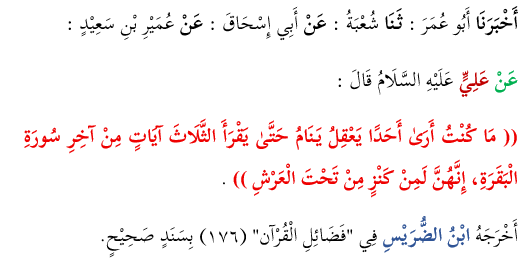
ʿAlī, peace be upon him, said,

I cannot imagine anyone of sound mind going to sleep before reciting the last three verses of Sūrah al-Baqarah; they are truly a treasure from beneath the Throne.”

Reported by Ibn al-Ḍurays in Faḍāʾil al-Qurʾān (176) with a sound chain.

For the takhrīj of this report, click on this post: Reciting the Last Three Verses of Sūrah al-Baqarah at Bedtime

Sūrah al-Kāfirūn

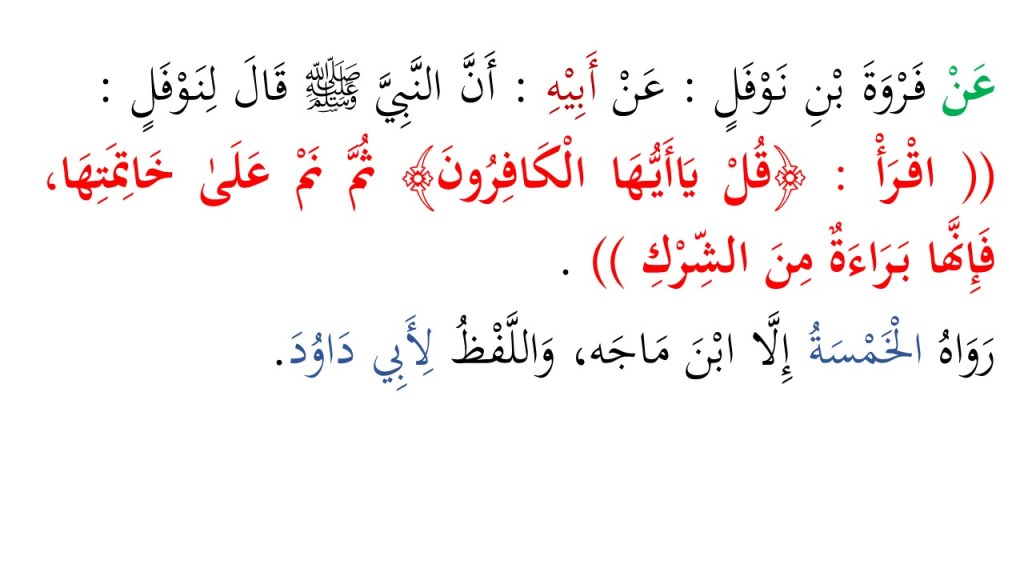
It is recommended for one to recite Sūrah al-Kāfirūn before going to sleep. The proof is:

On the authority of Farwah b. Nawfal, [who narrated] from his father: that the Prophet, may the praise and protection of Allāh be upon him, said to Nawfal:

“Read {Say: O you disbelievers!}, then go to sleep at the end of it, for indeed it is a complete disavowal of polytheism.”

Reported by the Five except for Ibn Mājah, and the wording is that of Abū Dāwūd.

Source: Abū Dāwūd (5055), al-Tirmidhī (3403), al-Nasāʾī in al-Kubrá (10569) and (11645), Aḥmad (23807) and Ṣaḥīḥ al-Targhīb (605) by al-Albānī.

Marketplace

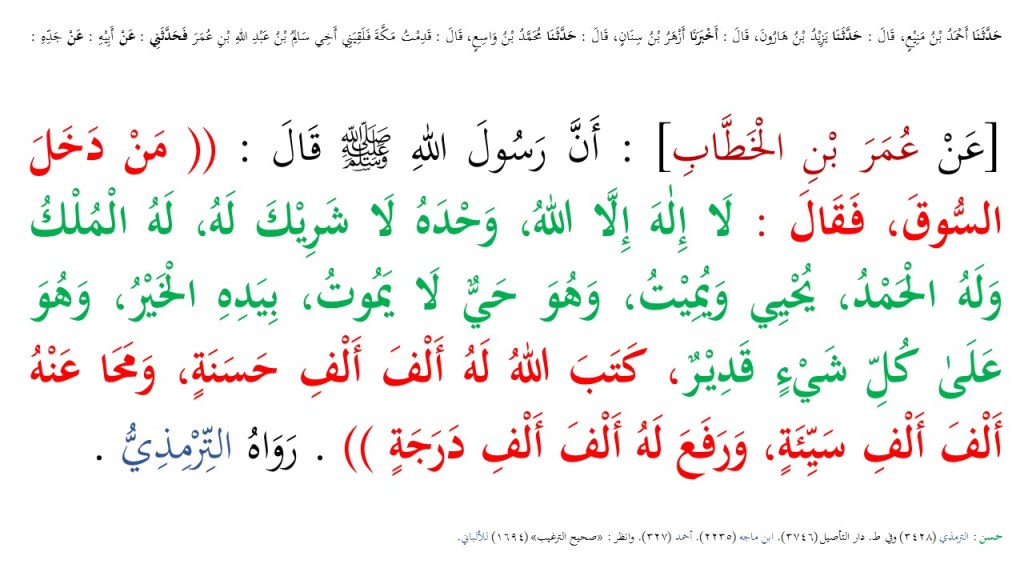
Upon entering the marketplace, it is recommended for one to read the following supplication [in green]:

On the authority of ʿUmar b. al-Khaṭṭāb [who narrated] that the Messenger of Allāh, may the praise and protection of Allāh be upon him, said:

“Whoever enters the marketplace and says, ‘There is none worthy of worship except Allāh alone without any partners, to Him belongs the dominion and to Him belongs all praise, He gives life and causes death, He is the All-Living and does not die, in His Hand is all goodness, and He has power over all things’, Allāh will write a million good deeds for him, and wipe a million evil deeds away from him, and raise a million ranks for him.”

Reported by al-Tirmidhī.

Ḥasan: al-Tirmidhī (3428) and in the Dār al-Taʾṣīl edition (3746). Ibn Mājah (2235). Aḥmad (327). See: Ṣaḥīḥ al-Targhīb wa al-Tarhīb (1694) of al-Albānī.

Character

The Prophet ﷺ used to ask Allāh for beautiful character and manners despite him being the best role model for mankind.

Muḥāḍir Abū al-Muwarriʿ narrated us: ʿĀṣim narrated to us: from ʿAwsajah b. al-Rammāḥ: from ʿAbd Allāh b. Abī al-Hudhayl:

On the authority of Ibn Masʿūd [who narrated] that the Messenger of Allāh, may the praise and protection of Allāh be upon him, used to say:

“O Allāh, You have beautified my body, and so beautify my character as well.”

Reported by Aḥmad.

Ḥasan: Aḥmad (3823), (24392) and (25221). al-Bukhārī in al-Adab al-Mufrad (290). Ibn Ḥibbān (959). al-Ṭayālisī (374). Abū Yaʿlá (5181). Bulūgh al-Marām (1327) as in Hādī’s edition. See Irwāʾ al-Ghalīl (74) of al-Albānī.