How Do We Love for the Sake of Allāh and Hate for the Sake of Allāh?

Sh. Muḥammad b. Ṣāliḥ al-ʿUthaymīn, may Allāh have mercy upon him, replied:

“Loving for the sake of Allāh means to not love a man except for the sake of Allāh, in that you see him engage in an abundance of worship, abundant charity, loving goodness, and hating evil; so you love him for that, not because he is a close relative of yours, or a friend, or rich, or poor etc.

Hating for the sake of Allāh means to hate him [a person] because he is disobedient towards Allāh the Almighty and Exalted, and is not steadfast upon the command of Allāh, not because of personal enmity between you and him but because he neglected Allāh’s rights.”

Source: Fatāwá Nūr ʿalá al-Darb (1: 645, no. 512).

Who are the Muʿtazilah? by Shaykh Muḥammad b. Ṣāliḥ al-ʿUthaymīn

Shaykh Muḥammad b. Ṣāliḥ al-ʿUthaymīn, may Allāh have mercy upon him, was asked: “Who are the Muʿtazilah?”

He replied:

“The Muʿtazilah are an innovated group, they speak about Allāh, the Speech of Allāh, and regarding the actions of Allāh [in a manner] which opposes the way of Ahl al-Sunnah wa al-Jamāʿah. Their heads are ʿAmr b. ʿUbayd (d. 144) and Wāṣil b. ʿAṭāʾ (d. 131). They were called the Muʿtazilah because they withdrew and isolated themselves from al-Ḥasan al-Baṣrī (d. 110) who affirmed that the perpetrator of a major sin has not left īmān, rather he is a believer who is deficient in faith, or he is a believer with regards to his faith but a sinner with respect to his perpetration of a major sin. So, they withdrew from this gathering; the gathering of al-Ḥasan al-Baṣrī, and they pronounced the infamous opinion: the perpetrator of a major sin is in a state between two states; he is not a believer neither is he a disbeliever, but despite that he is eternally in the Fire.

So, they converge with the Khawārij in stating that the perpetrator of a major sin is in the Fire forever, but the Khawārij declare that he is a disbeliever who is outside the fold of Islām, while they [the Muʿtazilah] declare that he is outside the fold of Islām but they do not state that he is a disbeliever. Instead, they say that he is in a state between two states. So, they affirm this state which opposes the Speech of Allāh the Almighty and Exalted in which He stated, the Blessed and Most High: {He is the One Who created you all, then some of you are disbelievers and some of you are believers} [al-Taghābun (64): 2] – there is no third category in which one is neither a disbeliever nor a believer except according to the view of these Muʿtazilah who innovated in the religion of Allāh and His Divine Law that which is not from it.”

Source: Fatāwá Nūr ʿalá al-Darb (1: 687, no. 574).

الخوف

Shaykh Ibn Bāz mentions three types of khawf (fear) in his explanation of Thalāthat-ul-Uṣūl:

[1] Khawf al-Sirr (Secret (Supernatural) Fear)

[2] Khawf al-Asbāb al-Ḥissiyyah (Fear of Tangible Means)

[3] al-Khawf al-Ṭabīʿī (Natural Fear)

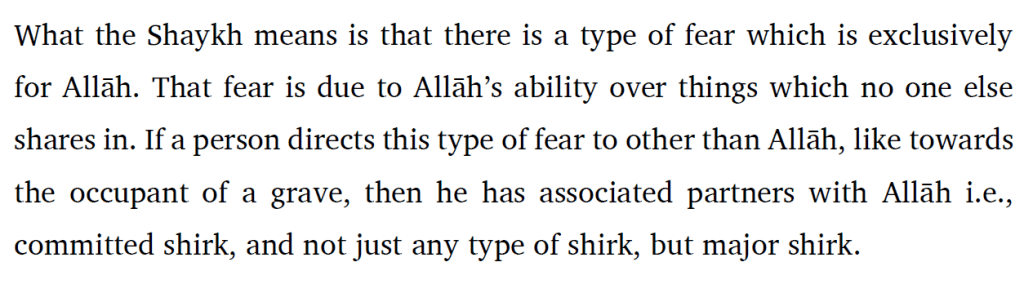
He defines the first as:

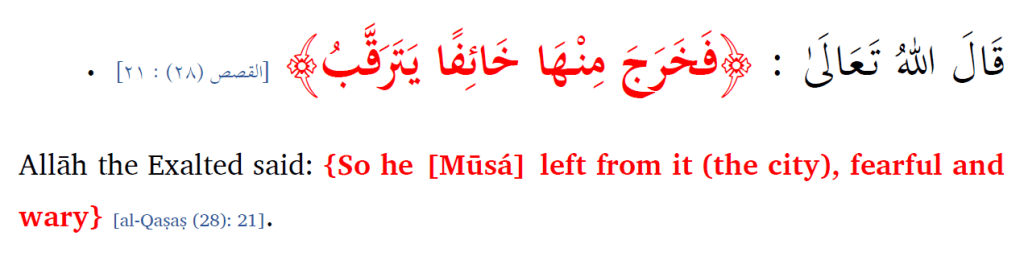
The second type of fear is the fear of something which is tangible and realistic such as the fear one has of an enemy. The devil, for instance, tries to cause the believers to fear his allies but Allāh has ordered us to ignore these flimsy attempts and to fear Him alone:

Natural fear is the fear which Allāh has put in us as a part of our nature. This includes, for instance, the fear of venomous creatures, predatory animals, criminals, murderers, the fear of hunger, thirst, cold weather etc. Taking precautions against these fears is not blameworthy.

Blameworthy fear is the fear which stops one from fulfilling an obligation towards Allāh.

الدعاء

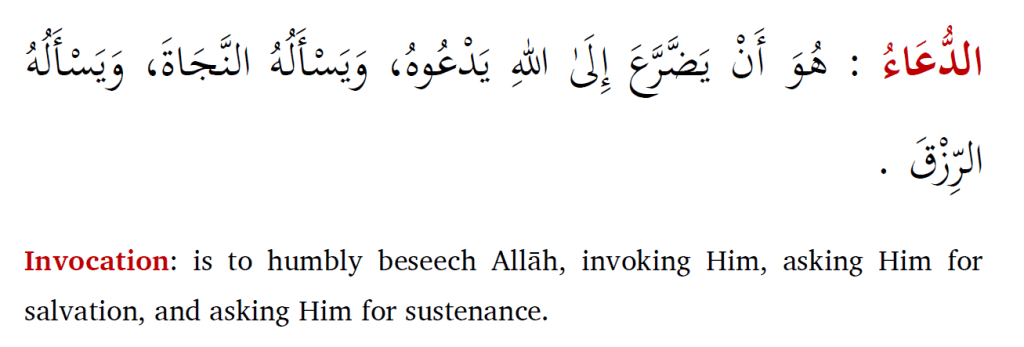
Sh. Ibn Bāz states in his explanation of Thalāthat-ul-Uṣūl:

The Shaykh then discusses the concept of al-Shafāʿah (Intercession) and the conditions under which it is accepted by Allāh.

Allāh’s permission is required for any intercession to be heard by Him:

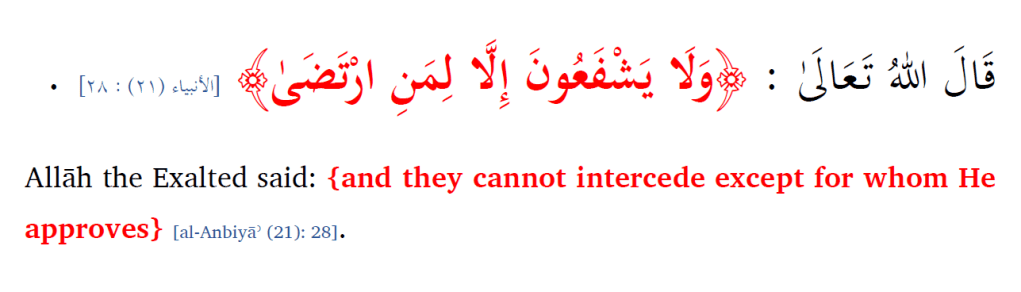
The intercessor can only be one with whom Allāh is pleased and has approved, and the one for whom the intercession is made must be a person of tawhid: