Author: Salafi Knowledge
Takbir for Eid
The takbīr for ʿĪd al-Fiṭr is said from the moment one leaves his home until he reaches the prayer place, and he should stop when the Imām arrives. Shaykh al-Albānī authenticates a number of reports on this issue in his Irwāʾ al-Ghalīl (1: 121, no. 649 onwards). I will add these reports in full another time in shāʾa Allāh.
There are no specific words reported from the Prophet ﷺ for the takbīr of the two ʿĪds.
The most authentically reported takbīr is that of Salmān al-Fārisī, may Allāh be pleased with him, as recorded by ʿAbd al-Razzāq in which he said, “Say takbīr, Allāh is the Greatest, Allāh is the Greatest, Allāh is the Greatest [in all] Greatness.” See: al-ʿAwāyishah in his al-Mawsūʿah al-Fiqhiyyah (2: 418). This is the report collected by al-Bayhaqī through ʿAbd al-Razzāq al-Ṣanʿānī:
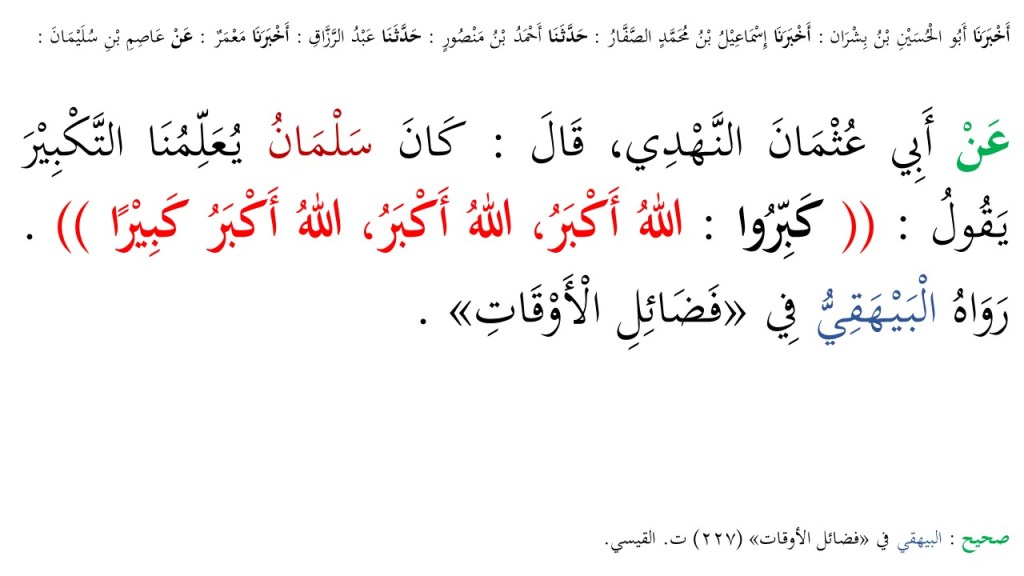
On the authority of Abū ʿUthmān al-Nahdī who said, “Salmān used to teach us the takbīr saying, “Say takbīr: “Allāh is the Greatest, Allāh is the Greatest, Allāh is the Greatest [in all] Greatness.” Reported by al-Bayhaqī in Faḍāʾil al-Awqāt (The Virtues of Time).
In his Irwāʾ al-Ghalīl (1: 125ff) Sh. al-Albānī (d. 1420) mentions other authentically reported wordings of the takbīr from the Righteous Salaf:
The first, and most famous takbīr is that of the Companion ʿAbd Allāh b. Masʿūd (d. 32), may Allāh be pleased with him. There are two forms of the takbīr in which “Allāhu Akbar” is said either twice or thrice. The first report is recorded by Ibn Abī Shaybah as follows:

On the authority of ʿAbd Allāh [b. Masʿūd] that he used to say takbīr during the Days of al-Tashrīq: “Allāh is the Greatest, Allāh is the Greatest, there is none worthy of worship except Allāh, and Allāh is the Greatest, Allāh is the Greatest, and all praise is due to Allāh.” Reported by Ibn Abī Shaybah.
The second report which mentions “Allāhu Akbar” thrice is also recorded by Ibn Abī Shaybah and is as follows:

On the authority of al-Aswad who said, “ʿAbd Allāh [b. Masʿūd] used to say takbīr from the Fajr prayer on the Day of ʿArafah until the ʿAṣr prayer on the Day of Sacrifice, saying: “Allāh is the Greatest, Allāh is the Greatest, Allāh is the Greatest, there is none worthy of worship except Allāh, and Allāh is the Greatest, Allāh is the Greatest, and all praise is due to Allāh.” Reported by Ibn Abī Shaybah.
The Shaykh then mentions Ibn ʿAbbās’s takbīr as recorded by al-Bayhaqī:
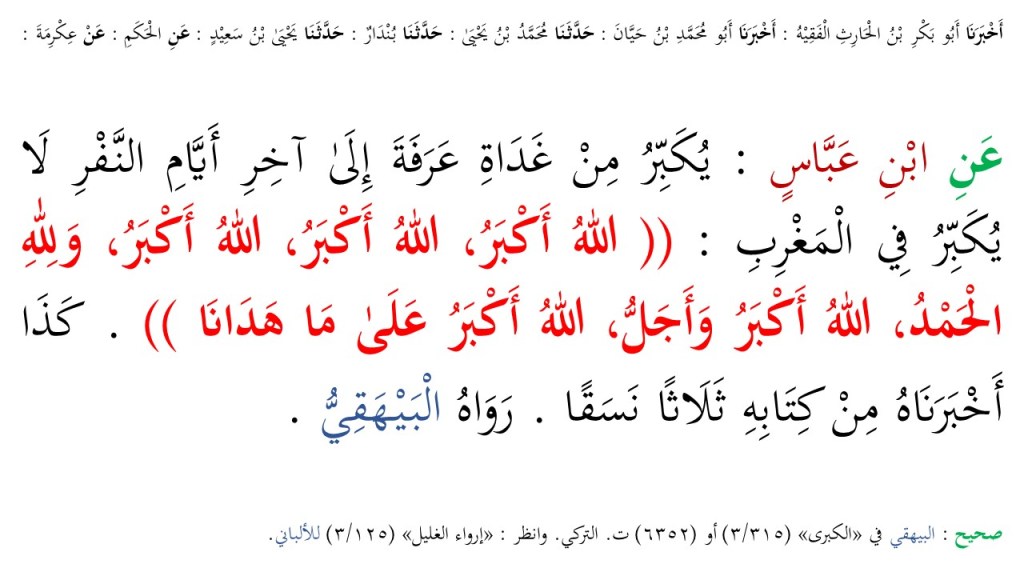
On the authority of Ibn ʿAbbās [who] used to say takbīr from the morning of ʿArafah until the end of the days of al-Nafr and not say takbīr for Maghrib [using the words]: “Allāh is the Greatest, Allāh is the Greatest, and all praise is due to Allāh, Allāh is the Greatest and Most Sublime, Allāh is the Greatest due to what He has guided us.” Reported by al-Bayhaqī in his al-Kubrá.
Another version of Ibn ʿAbbās’s takbīr, states the Shaykh, is recorded by Ibn Abī Shaybah as follows:

On the authority of Ibn ʿAbbās who used to say: “Allāh is the Greatest [in all] greatness, Allāh is the Greatest [in all] greatness, Allāh is the Greatest and Most Sublime, Allāh is the Greatest, and to Allāh belongs all praise.” Reported by Ibn Abī Shaybah.
The Shaykh then states that al-Maḥāmilī has an addition to this takbīr of Ibn ʿAbbās which is as follows:
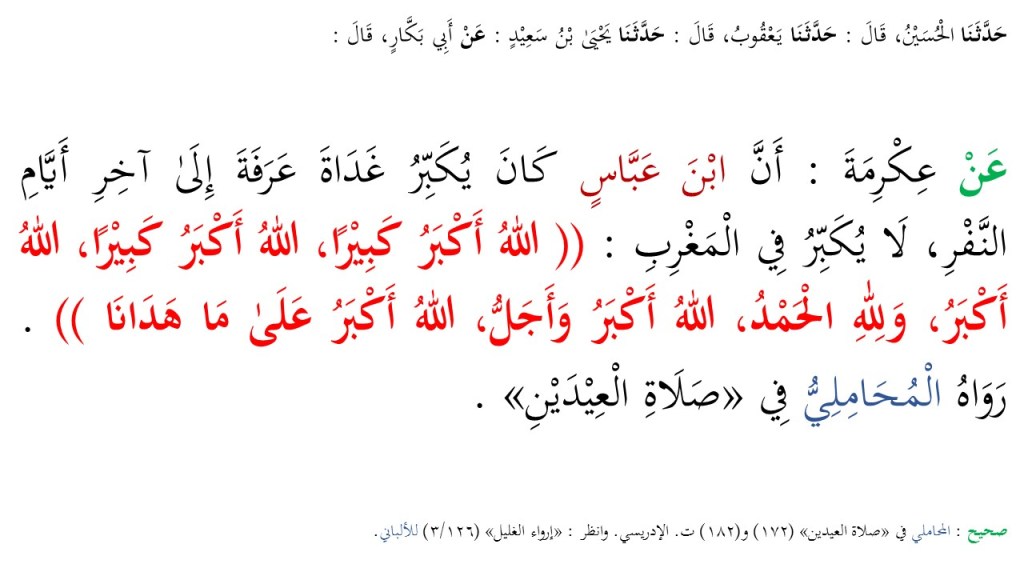
On the authority of ʿIkrimah [who said] that Ibn ʿAbbās used to say takbīr on the morning of ʿArafah until the end of the days of al-Nafr and not say takbīr for Maghrib [using the words]: “Allāh is the Greatest [in all] greatness, Allāh is the Greatest [in all] greatness, Allāh is the Greatest, and to Allāh belongs all praise, Allāh is the Greatest and Most Sublime, Allāh is the Greatest due to what He has guided us.” Reported by al-Maḥāmilī in Ṣalāt al-ʿĪdayn (The Prayer of the Two Eids).
So, these are the wordings of the takbīr which Shaykh al-Albānī states are authentically reported from the Salaf.
And all praise is due to Allāh.
01 The Conditions of Lā Ilāha Illa Allāh
al-Hafiz al-Hakami mentions seven conditions that have been derived from the Qur’an and Sunnah.
These seven conditions, he emphasises, must be fulfilled for it to benefit the one who utters it, in this life and the next. To fulfil these conditions means for the slave to have gathered them in himself and adhere to them, without nullifying any of them. Merely counting its words and memorising them is insufficient.
Shaykh ‘Abd al-Razzaq b. ‘Abd al-Mushin al-Badr mentions that our Righteous Ancestors (al-Salaf al-Salih) used to highlight the critical importance of the conditions of La ilaha ill Allah and the obligation of fulfilling them[1].
al-Hasan al-Basir for instance was told: “People say that one who says La ilaha ill Allah will enter Jannah.” He replied:
“Whoever says La ilaha ill Allah and fulfils its rights and obligations will enter Jannah.”
al-Hasan also said to al-Farzdaq who was burying his wife, “What did you prepare for this day?” He said: “The testimony La ilaha illa Allah for the past seventy years.” al-Hasan said:
“What an excellent preparation, however La ilaha ill Allah has conditions; and beware of falsely accusing chaste women.”
Wahb b. Munabbih said to the one who asked him: “Is not the key to Jannah ((La ilaha ill Allah))?” He replied:
“Of course, however there is no key except that it has teeth, so if you come with keys which have teeth then it will be opened for you, otherwise it will not be opened for you.”
The keys, Wahb b. Munabbih is referring to, are the conditions of ((La ilaha illa Allah) which are binding upon every legally responsible person.
What follows are the seven conditions, their meanings and the evidences from the source-texts establishing these conditions.
- Knowledge (الْعِلْمُ)
Knowledge which negates ignorance of it. It means to have knowledge of its meaning and what it intends in terms of what it negates and what it affirms.
Allah says:
فَاعلَم أَنَّهُ لا إِلٰهَ إِلَّا اللَّهُ
{Know! that there is none worthy of worship except Allah}
[Muhammad (47): 19]
Allah said:
شَهِدَ اللَّهُ أَنَّهُ لا إِلٰهَ إِلّا هُوَ وَالمَلائِكَةُ وَأُولُو العِلمِ قائِمًا بِالقِسطِ ۚ لا إِلٰهَ إِلّا هُوَ العَزيزُ الحَكيمُ
{Allah bears witness there is none worthy of worship except Him and the angels and those given knowledge, He is always maintaining [creation] in justice. There is no deity worthy of worship except Him, the Exalted in Might, the Wise}
[Aal ‘Imran (3): 18]
Imam Muslim (43/26) reports in his Sahih; ‘Uthman said: “The Messenger of Allah ﷺ said:
مَنْ مَاتَ وَهُوَ يَعْلَمُ أَنَّهُ لَا إِلَهَ إِلَّا اللَّهُ دَخَلَ الْجَنَّةَ
“Whoever dies while having knowledge there is none worthy of worship except Allah, he will enter Paradise.”
- Certainty (اليَقِينُ)
Certainty which negates doubt. It means the one who utters it should have complete certainty in the indications of these words. Iman does not benefit anyone except one who has knowledge -based certainty and not assumptions. Now imagine if doubt were to enter him.
Allah the Mighty and exalted said:
إِنَّمَا المُؤمِنونَ الَّذينَ آمَنوا بِاللَّهِ وَرَسولِهِ ثُمَّ لَم يَرتابوا وَجاهَدوا بِأَموالِهِم وَأَنفُسِهِم في سَبيلِ اللَّهِ ۚ أُولٰئِكَ هُمُ الصّادِقونَ
{The believers are only those who have believed in Allah and His Messenger and then doubt not but strive with their properties and their lives in the cause of Allah It is those who are the truthful}
[al-Hujurat (49): 15]
To not entertain any doubt has been made a condition by Allah in proving the truthfulness of one’s Iman. The one who does entertain doubts is from amongst the hypocrites – we seek refuge in Allah from being amongst them. Allah said about the hypocrites:
إِنَّما يَستَأذِنُكَ الَّذينَ لا يُؤمِنونَ بِاللَّهِ وَاليَومِ الآخِرِ وَارتابَت قُلوبُهُم فَهُم في رَيبِهِم يَتَرَدَّدونَ
{It is only those who believe not in Allah and the Last Day and whose hearts are in doubt that ask your permission [to stay at home]. So in their doubts they waver}
[al-Tawbah (9): 45]
Abu Hurayrah said: “The Messenger of Allah ﷺ said:
أَشْهَدُ أَنْ لَا إِلَهَ إِلَّا اللهُ، وَأَنِّي رَسُولُ اللهِ، لَا يَلْقَى اللهَ بِهِمَا عَبْدٌ غَيْرَ شَاكٍّ فِيهِمَا إِلَّا دَخَلَ الْجَنَّةَ
“I bear witness that there is none worthy of worship except Allah and that I am the Messenger of Allah; no slave meets Allah with them both without having any doubt in them except that he will enter Paradise.”
Reported by Muslim (44/27)
- Sincerity (الإِخْلَاصُ)
Sincerity is the opposite of polytheism (shirk), hypocrisy and all forms of showing off.
Sincerity is to purify one’s action with a righteous intention which is free from all association of partners with Allah. It means to not give any share of your intention to anyone other than Allah.
Allah the Most High said:
إِنّا أَنزَلنا إِلَيكَ الكِتابَ بِالحَقِّ فَاعبُدِ اللَّهَ مُخلِصًا لَهُ الدّينَ
{So worship Allah (alone), being sincere to Him in religion}
[al-Zumar (39): 2]
And He said:
وَما أُمِروا إِلّا لِيَعبُدُوا اللَّهَ مُخلِصينَ لَهُ الدّينَ حُنَفاءَ وَيُقيمُوا الصَّلاةَ وَيُؤتُوا الزَّكاةَ ۚ وَذٰلِكَ دينُ القَيِّمَةِ
{And they were not commanded except to worship Allah, making the religion sincerely for Him (alone)}
[al-Bayyinah (98): 5]
Abu Hurayrah reported from the Messenger of Allah ﷺ that he said:
أَسْعَدُ النَّاسِ بِشَفَاعَتِي يَوْمَ القِيَامَةِ، مَنْ قَالَ لاَ إِلَهَ إِلَّا اللَّهُ، خَالِصًا مِنْ قَلْبِهِ
“The happiest person with my intercession on the Day of Judgement is the one who said La ilaha ill Allah, sincerely from his heart.”
Reported by al-Bukhari, no. 99.
‘Itban b. Malik reports from the Messenger of Allah ﷺ that he said:
إِنَّ اللهَ حَرَّمّ اانَّارِ مَنْ قَالَ لَا إِلهَ إِلّّا الله يَبْتَغِي بِذلِكَ وَجْهَ اللهِ
“Indeed Allah has prohibited the Fire for the one who says La ilaha ill Allah, seeking thereby the Face of Allah.”
Reported by al-Bukhari, no. 5401 and Muslim, between 657 and 658, no. 263.
- Truthfulness (الصِّدْقُ)
The opposite of which is lying.
It means to utter this statement truthfully from one’s heart. If he said it with his tongue but was not truthful in his heart then he is a lying hypocrite.
Allah the Exalted said:
(1) الم
(2) أَحَسِبَ النّاسُ أَن يُترَكوا أَن يَقولوا آمَنّا وَهُم لا يُفتَنونَ
(3) وَلَقَد فَتَنَّا الَّذينَ مِن قَبلِهِم ۖ فَلَيَعلَمَنَّ اللَّهُ الَّذينَ صَدَقوا وَلَيَعلَمَنَّ الكاذِبينَ
{Alif Lam Mim. Do people think they will be left to say, “We believe” and they will not be tried? But We have certainly tried those before them, and Allah will surely make evident those who are truthful, and He will surely make evident the liars}
[al-‘Ankabut (29): 1-3]
He, the Exalted also said:
(8)وَمِنَ النّاسِ مَن يَقولُ آمَنّا بِاللَّهِ وَبِاليَومِ الآخِرِ وَما هُم بِمُؤمِنينَ
(9)يُخادِعونَ اللَّهَ وَالَّذينَ آمَنوا وَما يَخدَعونَ إِلّا أَنفُسَهُم وَما يَشعُرونَ
(10)في قُلوبِهِم مَرَضٌ فَزادَهُمُ اللَّهُ مَرَضًا ۖ وَلَهُم عَذابٌ أَليمٌ بِما كانوا يَكذِبونَ
{And of the people are some who say, “We believe in Allah and the Last Day”, but they are not believers. They think to deceive Allah and those who believe, but they deceive not except themselves and perceive it not. In their hearts is a disease, so Allah has increased their disease; and for them is a painful punishment because they used to lie}
[al-Baqarah (2): 8-10]
Anas said: “The Messenger of Allah ﷺ said:
مَا مِنْ أَحَدٍ يَشْهَدُ أَنْ لاَ إِلَهَ إِلَّا اللَّهُ وَأَنَّ مُحَمَّدًا رَسُولُ اللَّهِ، صِدْقًا مِنْ قَلْبِهِ، إِلَّا حَرَّمَهُ اللَّهُ عَلَى النَّارِ
“There is none who testifies there is none worthy of worship except Allah and that Muhammad is the Messenger of Allah, truthfully from his heart, except that Allah will prohibit the Fire for him.””
Reported by al-Bukhari, no. 128 and Muslim, no. 32.
- Love (المَحَبَّةُ)
It means to love this great and blessed statement and what it demands and indicates. By extension, it also means to love the people who act by it and adhere to its conditions and to hate whatever nullifies it.
Allah the Exalted said:
وَمِنَ النَّاسِ مَنْ يَتَّخِذُ مِنْ دُونِ اللَّهِ أَنْدَادًا يُحِبُّونَهُمْ كَحُبِّ اللَّهِ وَالَّذِينَ آمَنُوا أَشَدُّ حُبًّا لِلَّهِ
{And among the people are those who take other than Allah as equals (to Him). They love them as they should love Allah. But those who believe are stronger in love for Allah.}
[al-Baqarah (2): 165]
And Allah said:
يا أَيُّهَا الَّذينَ آمَنوا مَن يَرتَدَّ مِنكُم عَن دينِهِ فَسَوفَ يَأتِي اللَّهُ بِقَومٍ يُحِبُّهُم وَيُحِبّونَهُ
{O you who have believed, whoever amongst you reverts from his religion – Allah will bring forth (in place of them) people He will love and who will love Him…}
[al-Ma’idah (5): 54]
Anas b. Malik reported from the Messenger of Allah ﷺ that he said:
ثَلَاثٌ مَنْ كُنَّ فِيهِ وَجَدَ حَلَاوَةَ الْإِيمَانِ : أَنْ يَكُونَ اللَّهُ وَرَسُولُهُ أَحَبَّ إِلَيْهِ مِمَّا سِوَاهُمَا ، وَأَنْ يُحِبَّ الْمَرْءَ لَا يُحِبُّهُ إِلَّا لِلَّهِ ، وَأَنْ يَكْرَهَ أَنْ يَعُودَ فِي الْكُفْرِ كَمَا يَكْرَهُ أَنْ يُقْذَفَ فِي النَّارِ
“Whoever possesses three qualities will taste the sweetness of faith: 1. Allah and His Messenger are dearer to him than anything else, 2. that he loves a person and he loves him only for the sake of Allah and 3. he hates to revert to disbelief just as he hates to be thrown into the fire.”
Reported by al-Bukhari, no. 16 and Muslim, no. 43.
al-Bara’ b. ‘Azib reported from the Messenger of Allah ﷺ who said:
إِنَّ أَوْثَقَ عُرَى الْإِيمَانِ: أَنْ تُحِبَّ فِي اللهِ، وَتُبْغِضَ فِي اللهِ
“Indeed the firmest grasp of Iman is that you love for the sake of Allah and hate for the sake of Allah.”
Reported by Ahmad, no. 18524 and graded hasan by al-Albani in Sahih al-Targhib, no. 3030.
Thus, the people of La ilaha illa Allah, love Allah with a sincere and exclusive love, whilst the people of polytheism (shirk), love Him and love others alongside Him with a similar level of love, or even greater love. This nullifies the meaning and demands of La ilaha ill Allah.
- Submission (الإِنْقِيَادُ)
It means to submit to what it indicates. Thus it is the opposite of abandonment.
Allah the Exalted said:
وَمَن يُسلِم وَجهَهُ إِلَى اللَّهِ وَهُوَ مُحسِنٌ فَقَدِ استَمسَكَ بِالعُروَةِ الوُثقىٰ ۗ وَإِلَى اللَّهِ عاقِبَةُ الأُمورِ
{And whoever submits his face to Allah while he is a doer of good – then he has grasped the most trustworthy handhold. And to Allah will be the outcome of [all] matters}
[Luqman (31):22]
The meaning of muhsin, is that he is a muwahhid; one who singles out Allah with all those things which are exclusive to Him and does not share them to anything other than him.
And Allah said:
وَأَنيبوا إِلىٰ رَبِّكُم وَأَسلِموا لَهُ مِن قَبلِ أَن يَأتِيَكُمُ العَذابُ ثُمَّ لا تُنصَرونَ
{And return in repentance to your Lord and submit to Him before the punishment comes upon you; then you will not be helped}
[al-Zumar (39): 54]
- Acceptance (القُبُولُ)
This means to accept with one’s heart and tongue all the things necessitated by this pure statement. The opposite is to reject it.
Allah the Exalted said:
إِنَّهُمْ كَانُوا إِذَا قِيلَ لَهُمْ لَا إِلَهَ إِلَّا اللَّهُ يَسْتَكْبِرُونَ
{Truly, when it is said to them: there is none worthy of worship except Allah, they puffed themselves up with pride (i.e. denied it)}
[al-Saffat (37):35]
Abu Musa al-Ash’ari said: “The Messenger of Allah ﷺ said:
مَثَلُ مَا بَعَثَنِي اللَّهُ بِهِ مِنَ الْهُدَى وَالْعِلْمِ ، كَمَثَلِ الْغَيْثِ الْكَثِيرِ أَصَابَ أَرْضًا فَكَانَ مِنْهَا نَقِيَّةٌ قَبِلَتِ الْمَاءَ ، فَأَنْبَتَتِ الْكَلَأَ وَالْعُشْبَ الْكَثِيرَ ، وَكَانَتْ مِنْهَا أَجَادِبُ أَمْسَكَتِ الْمَاءَ ، فَنَفَعَ اللَّهُ بِهَا النَّاسَ فَشَرِبُوا وَسَقَوْا وَزَرَعُوا ، وَأَصَابَتْ مِنْهَا طَائِفَةً أُخْرَى إِنَّمَا هِيَ قِيعَانٌ لَا تُمْسِكُ مَاءً وَلَا تُنْبِتُ كَلَأً ، فَذَلِكَ مَثَلُ مَنْ فَقُهَ فِي دِينِ اللَّهِ وَنَفَعَهُ مَا بَعَثَنِي اللَّهُ بِهِ فَعَلِمَ وَعَلَّمَ ، وَمَثَلُ مَنْ لَمْ يَرْفَعْ بِذَلِكَ رَأْسًا وَلَمْ يَقْبَلْ هُدَى اللَّهِ الَّذِي أُرْسِلْتُ بِهِ
“The example of guidance and knowledge with which Allah has sent me is like abundant rain falling on the earth, some of which was fertile soil that absorbed rain-water and brought forth vegetation and grass in abundance. And another portion of it was hard and held the rain-water and Allah benefited the people with it and they utilised it for drinking, making their animals drink from it and to irrigate the land for cultivation. And a portion of it was barren which could neither hold the water nor bring forth vegetation (then that land gave no benefits).
The first person is the example of the person who comprehends Allah’s religion and gets benefit (from the knowledge) which Allah the Exalted has revealed through me and learns and then teaches it to others.
The (last example is that of a) person who does not care for it and does not take Allah’s guidance revealed through me (he is like that barren land.)””
Reported by al-Bukhari, no. 79
- Disbelieving in Taghut (الكُفرُ بِالطَّاغُوتِ)
Shaykh Muhammad al-Wasabi mentions an eighth condition which is to disbelieve in the tawaghit (pl. of taghut). The tawaghit refer to anything that is worshipped besides Allah.
Thus to disbelieve in tawaghit means to reject anything else as an object of worship and to have iman in Allah as the sole Lord, Creator and the only One worthy of worship in truth.
Allah said:
قَد تَبَيَّنَ الرُّشدُ مِنَ الغَيِّ ۚ فَمَن يَكفُر بِالطّاغوتِ وَيُؤمِن بِاللَّهِ فَقَدِ استَمسَكَ بِالعُروَةِ الوُثقىٰ لَا انفِصامَ لَها ۗ وَاللَّهُ سَميعٌ عَليمٌ
{The right course has become distinct from the wrong. So whoever disbelieves in taghut and believes in Allah has grasped the most trustworthy handhold with no break in it. And Allah is Hearing and Knowing}
[al-Baqarah (2): 256]
Tariq b. Ashim reports from the Messenger of Allah ﷺ that he said:
مَنْ وَحَّدَ اللَّهَ ، وَكَفَرَ بِمَا يُعْبَدُ مِنْ دُونِ اللَّهِ حُرِّمَ مَالُهُ وَدَمُهُ وَحِسَابُهُ عَلَى اللَّهِ
“Whoever says La ilaha ill Allah and disbelieves in what is worshipped other than Allah, He has made his wealth and blood sacred and his reckoning is with Allah.”
Reported by Muslim, no. 23 and Ahmad, 3:472.
Sources:
Hafiz b. Ahmad al-Hakami, Ma’arij al-Qubul Bi Sharh Sullam al-Wusul Ila ‘Ilm al-Usul Fi al-Tawhid, ed. Muhammad Subhi b. Husayn Hallaq, (al-Dammam: Dar Ibn al-Jawzi, 1420/1999), 2:518ff.
[1] http://al-badr.net/muqolat/2575 (Last accessed: 08.08.16).
Muhammad b. ‘Abd al-Wahhab al-Wasabi al-‘Abdali, al-Qawl al-Mufid fi Adillat al-Tawhid, (San’a: Maktabat al-Irshad, 1427/2006).
02 The Pillars of Muḥammad is the Messenger of Allāh
In the previous section we learnt the two pillars of Lā ilāha illa Allāh. In this section we will cover the pillars of the second part of the Shahādah; the pillars of Muḥammad Rasūl Allāh.
Let us examine the full wording of the testimony of faith which is as follows:
أَشْهَدُ أَنْ لا إِلهَ إِلَّا الله، وَأَشْهَدُ أَنَّ مُحَمَّداً عَبْدُهُ وَرَسُولُهُ
ash-hadu an lā ilāha illa Allāh wa ash-hadu anna Muḥammadan ʿabduhu wa rasūluh
“I bear witness that there is none worthy of worship except Allāh and I bear witness that Muḥammad is His slave and Messenger“
Sh. Ṣāliḥ al-Fawzān explains (p. 47) that the two pillars of this second part of the testimony of faith are taken explicitly from it: عَبْدُهُ وَرَسُولُهُ {His slave and His Messenger}. They nullify any exaggeration (الإِفْرَاط) and negligence (التَفْرِيط) regarding his ﷺ noble rights. Thus he ﷺ is His slave and His Messenger and in these two noble characteristics he ﷺ is the most complete and perfect of all creation.
First Pillar: عَبْدُهُ {His slave}
This means that Muḥammad ﷺ is a slave who is owned by Allāh. It means that he ﷺ is a human being, from one of mankind and that he ﷺ was created from the same thing all humans have been created. The same things that happen to human beings also happen to him ﷺ. This is based on the statement of Allāh the Exalted:
قُلْ إِنَّما أَنَا بَشَرٌ مِثْلُكُم
{Say (O Muḥammad): I am only a human being like you}
[al-Kahf (18): 110]
The Prophet ﷺ fulfilled servitude to Allāh in submitting to Him and worshipping Him in its truest sense which is why Allāh praised him ﷺ by referring to him ﷺ by this quality of his when He said:
أَلَيسَ اللَّهُ بِكافٍ عَبْدَهُ
{Is Allāh not sufficient for His slave?}
[al-Zumar (39): 36]
And He the Exalted said:
الحَمْدُ لِلَّهِ الَّذي أَنْزَلَ عَلىٰ عَبْدِهِ الْكِتَابَ
{All praise is due to Allāh Who revealed the Book upon His slave}
[al-Kahf (18): 1]
And He the Exalted said:
سُبْحَانَ الَّذِي أَسْرىٰ بِعَبْدِهِ لَيْلًا مِنَ الْمَسْجِدِ الحَرامِ
{Far removed is Allāh from all imperfections, the One Who took His slave by night from the Sacred Mosque}
[al-Isrāʾ: 1]
Second Pillar: رَسُولُهُ {His Messenger}
This means that he ﷺ is the one sent to all of mankind to call to Allāh, informing them of glad tidings and warning them of the consequences of rejecting Allāh.
Thus, by bearing witness to these two qualities and descriptions of him, any exaggeration has been nullified on the one hand and any negligence has been nullified on the other.
There are many people who claim to be from his Ummah who exaggerate regarding his rights and go to extremes in them, to the extent that they raise him ﷺ from the level of servitude to Allāh to the level of being worshipped besides Allāh. Hence, such people seek relief from him besides Allāh and they seek things from him ﷺ which he is incapable of doing and that only Allāh can do in terms of fulfilling people’s needs and saving them from calamities.
Other people go to the opposite extreme and reject the fact that he was a Messenger of Allāh sent with a Scripture calling them to His pleasure and warning them against His Fire. Others fall in to neglecting his right of being followed by choosing to rely upon their own opinions and views which run contrary to what he came with.
Conclusion
In conclusion, we have learnt that just as there are two pillars for the first part of the Shahādah; Lā ilāha illa Allāh, similarly there are two pillars for the second part of the Shahādah; Muḥammad Rasūl Allāh. The first part of the Shahādah rests upon the contrasting pillars of Negation and Affirmation whilst the second part of the Shahādah rests upon the two pillars of Servitude and Messengership. Without the presence of these two pillars; i.e. the acceptance that Muḥammad ﷺ is a human being like us and a slave of Allāh and accepting that he ﷺ is Allāh’s Messenger thus not deserving of any worship, one’s Shahādah is not complete.
Bibliography
al-Fawzān, Ṣāliḥ b. Fawzān b. ʿAbd Allāh. ʿAqīdat al-Tawḥīd wa Bayān Mā Yuḍaduhā aw Yanquṣuha Min al-Shirk al-Akbar wa al-Aṣghar wa al-Taʿṭīl wa al-Biḍaʿ wa Ghayr Dhālik. al-Riyāḍ: Maktabat Dār al-Minhāj, 1432.
01 The Pillars of Lā Ilāha Illa Allāh
After having understood the precise meaning of the Shahādah, it is essential to point out that there are pillars to Lā ilāha illa Allāh (there is none worthy of worship except Allāh) which are known in the Arabic language as: أَرْكَانُ لا إِلهَ إِلَّا الله, Arkānu Lā ilāha illa Allāh.
To be more precise, there are two pillars which are:
Negation and Affirmation (النَّفْيُ وَالْإِثْبَاتُ)
First Pillar: Negation ( النَّفْيُ)
This means to negate, deny, disbelieve in and reject anything else that is worshipped besides Allāh. It means to believe that nothing else is deserving of worship i.e. negate the worthiness of anything being worshipped besides Allāh.
This is the meaning of لا إِلهَ.
Second Pillar: Affirmation (الإِثْبَاتُ)
This means to affirm that Allāh alone, and Him alone, is worthy of worship and that He has all the Attributes that make Him worthy of our worship and that none else is worthy. Therefore, anything else worshipped besides Him is false (بَاطِل).
This is the meaning of إِلَّا الله.
The evidence for this is the statement of Allāh the Exalted:
ذٰلِكَ بِأَنَّ اللَّهَ هُوَ الحَقُّ وَأَنَّ مَا يَدْعُونَ مِنْ دُونِهِ هُوَ الْبَاطِلُ وَأَنَّ اللَّهَ هُوَ العَلِيُّ الكَبِيرُ
{That is because, Allāh is the Truth, and that which they call upon besides Him is false, and Allāh is the Most High and Great}
[al-Ḥajj (22): 62]
So, {That is because, Allāh is the Truth} is the affirmation and {that which they call upon besides Him is false} is the negation.
Consequently, when you say Lā ilāha illa Allāh, you are negating something and affirming something.
When you say Lā ilāha, as Imām Muḥammad b. ʿAbd al-Wahhāb (d. 1206) explains in his elementary treatise entitled The Three Principles and Their Evidences (ثَلَاثَةُ الْأُصُولِ وَأَدِلَّتُهَا), it means:

Lā ilāha negates everything that is worshipped besides Allāh, whether that be a person, angel, jinn, animal, rock, tree, planet, star etc because these things are not deserving or worthy of worship.

Illa Allāh affirms all forms of worship for Allāh the Exalted alone as He is the Only One deserving and worthy of worship (الْمُسْتَحِقُّ لِلْعِبَادَة) without any partners in His worship at all.
There are other verses throughout the Qurʾān which echo this negation and affirmation as Sh. Ṣāliḥ al-Fawzān explains (p. 46):
فَمَنْ يَكْفُرْ بِالطَّاغُوتِ وَيُؤمِن بِاللَّهِ فَقَدِ اسْتَمْسَكَ بِالْعُرْوَةِ الْوُثْقىٰ
{So whoever disbelieves in al-Ṭāghūt (everything that is pleased to be worshipped besides Allāh) and believes in Allāh; he has grasped the firmest handhold…}
[al-Baqarah (2): 256]
Thus, His statement فَمَن يَكفُر بِالطّاغوتِ {whoever disbelieves in al-Ṭāghūt} is the meaning of first pillar: لا إِلهَ.
His statement: وَيُؤمِن بِاللَّهِ {and believes in Allāh} is the meaning of the second pillar: إِلَّا الله .
al-Waṣābī (p. 33) mentions two verses conveying the same meaning:

{And worship Allāh and do not associate anything with Him}
[al-Nisāʾ (4): 36]
The affirmation in this āyah is in the words {And worship Allāh}. The negation is in the words {and do not associate anything with Him}.

{And your Lord has ordained that you worship none except Him}
[al-Isrāʾ (17): 23]
The affirmation in this āyah is in the words {except Him} and the negation is {that you worship none}.
In conclusion, Lā ilāha illa Allāh (there is none worthy of worship except Allāh) is built upon 2 pillars: [1] Negation and [2] Affirmation. The negation is found in Lā ilaha (there is none worthy of worship) and the affirmation is found in illa Allāh (except Allāh). The negation indicates that you disbelieve in and reject everything that is worshipped apart from or along with Allāh. The affirmation indicates that you believe only Allāh alone is deserving of worship. Without these two pillars, one’s statement of Lā ilāha illa Allāh is not accepted. Just as there are pillars for the Lā ilāha illa Allāh, there are also pillars for Muḥammad Rasūl Allāh, which is the next section you should read.
Bibliography
al-Fawzān, Ṣāliḥ b. Fawzān b. ʿAbd Allāh. ʿAqīdat al-Tawḥīd wa Bayān Mā Yuḍaduhā aw Yanquṣuha Min al-Shirk al-Akbar wa al-Aṣghar wa al-Taʿṭīl wa al-Biḍaʿ wa Ghayr Dhālik. al-Riyāḍ: Maktabat Dār al-Minhāj, 1432.
al-Qaḥṭānī, Saʿīd b. ʿAlī b. Wahf. ʿAqīdat al-Muslim fī Ḍawʾ al-Kitāb wa al-Sunnah. 2 vols. al-Riyāḍ: n.p., 1429/2008.
al-Qāsim, Dr. ʿAbd al-Muḥsin. “al-Uṣūl al-Thalāthah wa Adillatuhā.” Mutūn Ṭālib al-ʿIlm: al-Mustawā al-Awwal. al-Riyāḍ: n.p., 1430/2009. 33 – 63.
al-Waṣābī, Muḥammad b. ʿAbd al-Wahhāb b. ʿAlī al-Yamanī al-ʿAbdalī. al-Qawl al-Mufīd fī Adillat al-Tawḥīd. Ṣanʿāʾ: Maktabat al-Irshād, 1427/2006.
The Meaning of Muḥammad is the Messenger of Allāh
The meaning of the second part of the testimony of faith, or Shahadah is:
لَا مَتْبُوعَ بِحَقٍّ إِلَّا رَسُولَ اللهِ صلى الله عليه وسلم
“There is none worthy of being followed in truth except the Messenger of Allah”
If someone does follow other than the Messenger of Allah in something which has no evidence to support it; then he has followed falsehood.
Allah the Exalted said:
اتَّبِعوا ما أُنزِلَ إِلَيكُم مِن رَبِّكُم وَلا تَتَّبِعوا مِن دونِهِ أَولِياءَ ۗ قَليلًا ما تَذَكَّرونَ
{Follow what has been revealed to you from your Lord, and do not follow other than Him any allies. Little do you remember}
[al-A’raf (7): 3]
He, the Exalted said:
فَلا وَرَبِّكَ لا يُؤمِنونَ حَتّىٰ يُحَكِّموكَ فيما شَجَرَ بَينَهُم ثُمَّ لا يَجِدوا في أَنفُسِهِم حَرَجًا مِمّا قَضَيتَ وَيُسَلِّموا تَسليمًا
{But no by your Lord, they will not truly believe until they make you [O Muhammad], judge concerning that over which they dispute among themselves and then find within themselves no discomfort from what you have judged and they submit in [full] submission}
[al-Nisa’ (4): 65]
And He, the Exalted said:
وَما كانَ لِمُؤمِنٍ وَلا مُؤمِنَةٍ إِذا قَضَى اللَّهُ وَرَسولُهُ أَمرًا أَن يَكونَ لَهُمُ الخِيَرَةُ مِن أَمرِهِم ۗ وَمَن يَعصِ اللَّهَ وَرَسولَهُ فَقَد ضَلَّ ضَلالًا مُبينًا
{It is not for a believing man or a believing woman, when Allah and His Messenger have decided a matter, that they should [thereafter] have any choice over the matter. And whoever disobeys Allah and His Messenger has certainly strayed into clear error}
[al-Ahzab (33): 36]
Muhammad b. ‘Abd al-Wahhab al-Wasabi al-‘Abdali, al-Qawl al-Mufid fi Adillat al-Tawhid, (San’a: Maktabat al-Irshad, 1427/2006), 35.
The Meaning of Lā Ilāha Illa Allāh
In Arabic, the meaning of the first part of the Shahadah is:
لَا مَعْبُودَ بِحَقٍّ إِلَّا الله
There is none worthy of worship in truth except Allah.
If anything other than Allah is worshipped then it is false:
Allah the Exalted said:
ذلِكَ بِأَنَّ اللَّهَ هُوَ الْحَقُّ وَأَنَّ مَا يَدْعُونَ مِن دُونِهِ هُوَ الْبَـاطِلُ وَأَنَّ اللَّهَ هُوَ الْعَلِىُّ الْكَبِيرُ
{That is because Allah is the Truth, and that which they call upon other than Him is falsehood, and because Allah is the Most High, the Great}
[al-Hajj (22): 62]
And He the Exalted said:
فَاعْلَمْ أَنَّهُ لاَ إِلَـهَ إِلأاللَّهُ
{Know! there is none worthy of worship except Allah…}
[Muhammad (47): 19]
Muhammad b. ‘Abd al-Wahhab al-Wasabi al-‘Abdali, al-Qawl al-Mufid fi Adillat al-Tawhid, (San’a: Maktabat al-Irshad, 1427/2006), 27.
Definition of ʿUlūm al-Ḥadīth
ʿUlūm al-Ḥadīth, as it was more commonly referred to in classical works, or Muṣṭalaḥ al-Ḥadīth as it is more commonly known today, is defined as:
“…the knowledge of the principles and maxims by which the conditions of chains of narrations and texts are known, in terms of acceptability and rejection.”
See: Maḥmūd al-Ṭaḥḥān’s Taysīr Muṣṭalaḥ al-Ḥadīth, (Alexandria: Markaz al-Maʿhad li al-Dirāsāt, 1415H), p. 15.
Bedtime
Sūrah al-Kāfirūn
It is recommended for one to recite Sūrah al-Kāfirūn before going to sleep. The proof is:
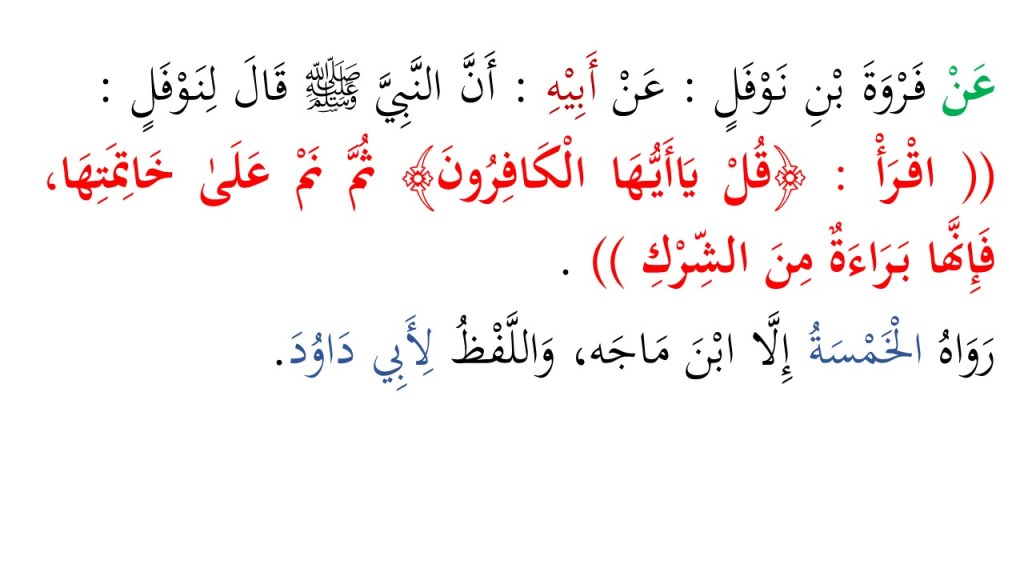
On the authority of Farwah b. Nawfal, [who narrated] from his father: that the Prophet, may the praise and protection of Allāh be upon him, said to Nawfal:
“Read {Say: O you disbelievers!}, then go to sleep at the end of it, for indeed it is a complete disavowal of polytheism.”
Reported by the Five except for Ibn Mājah, and the wording is that of Abū Dāwūd.
Source: Abū Dāwūd (5055), al-Tirmidhī (3403), al-Nasāʾī in al-Kubrá (10569) and (11645), Aḥmad (23807) and Ṣaḥīḥ al-Targhīb (605) by al-Albānī.
Marketplace
Upon entering the marketplace, it is recommended for one to read the following supplication [in green]:
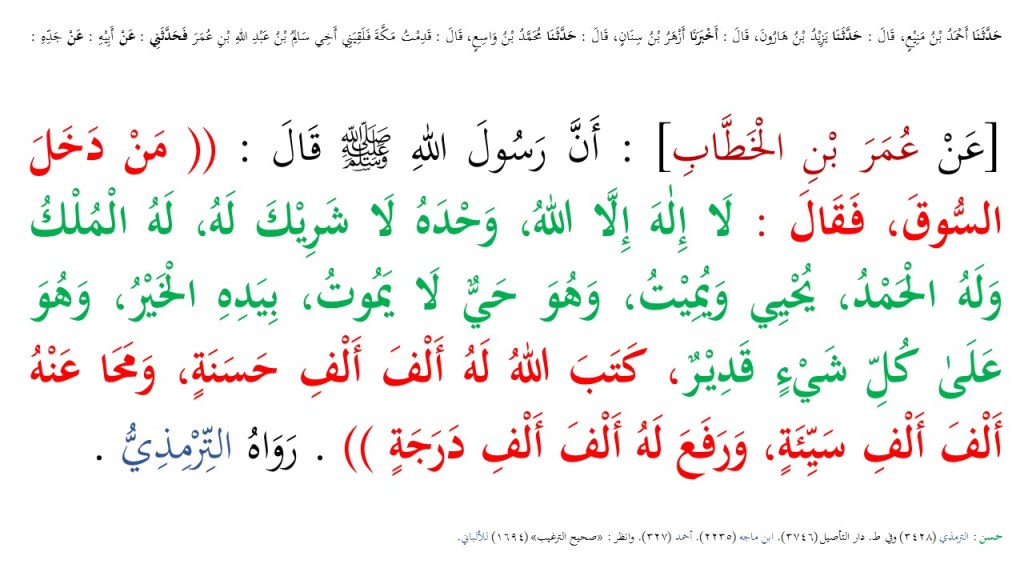
On the authority of ʿUmar b. al-Khaṭṭāb [who narrated] that the Messenger of Allāh, may the praise and protection of Allāh be upon him, said:
“Whoever enters the marketplace and says, ‘There is none worthy of worship except Allāh alone without any partners, to Him belongs the dominion and to Him belongs all praise, He gives life and causes death, He is the All-Living and does not die, in His Hand is all goodness, and He has power over all things’, Allāh will write a million good deeds for him, and wipe a million evil deeds away from him, and raise a million ranks for him.”
Reported by al-Tirmidhī.
Ḥasan: al-Tirmidhī (3428) and in the Dār al-Taʾṣīl edition (3746). Ibn Mājah (2235). Aḥmad (327). See: Ṣaḥīḥ al-Targhīb wa al-Tarhīb (1694) of al-Albānī.
 Salafi Knowledge