Imām Muḥammad b. ʿAbd al-Wahhāb states in “The Three Fundamental Principles” that the first knowledge one must acquire is that of Allāh.
The People of the Sunnah, in contrast to the People of Innovation, follow the principle that: the first obligation upon every person is to learn about the tawḥīd of Allāh and then to state the two testimonies of faith:
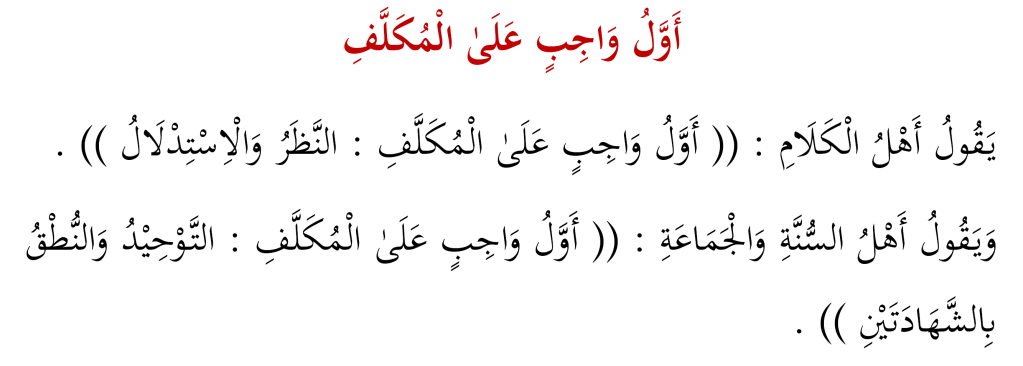
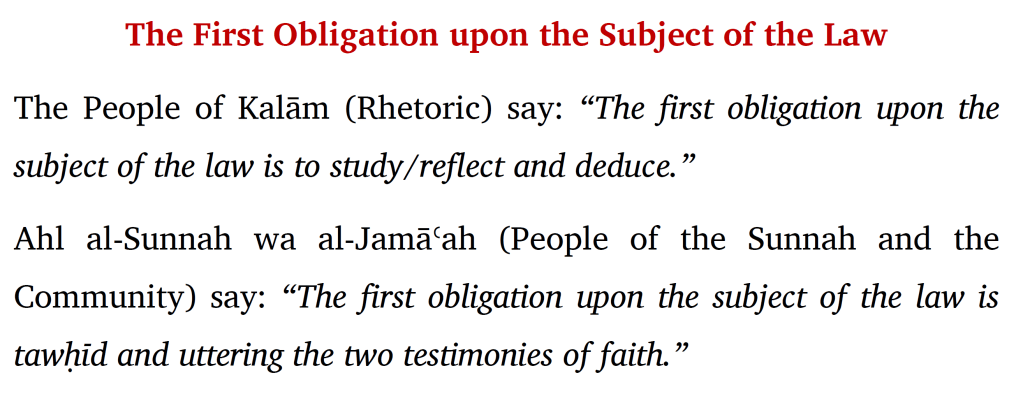
The proof for the position of the People of the Sunnah is the ḥadīth of Muʿādh b. Jabal, may Allāh be pleased with him. When the Prophet ﷺ sent him to Yemen, he commanded him to firstly call the people to tawḥīd and to state the two testimonies of faith, before anything else. [See: al-Bukhārī (7372) and Muslim (19) for instance].
The People of Rhetoric require every legally capable person (mukallaf), to firstly expend their intellectual efforts in establishing the existence of a creator, utilising the logical maxims and rules developed by Hellenic philosophers, which were later dilated on by Arab scholars who were influenced by such works. This initial step imposed by the People of Rhetoric on the mukallaf, is contradicted by the ḥadīth that every child is born in a state of natural disposition believing in Allāh [See: al-Bukhārī (1358) and Muslim (2658) for instance].
Note: this does not mean one should not use his intellect in reflecting upon the creation of Allāh, and making deductions about how the beauty and uniformity of the creation is an indication of the greatness and oneness of the Creator. This particular principle mentioned here, is to point out how the People of Rhetoric, contradict the Sunnah regarding what the first obligation is upon the mukallaf. A deeper discussion on this issue will have to be saved for another time.

